

Mastering the OET Writing Introduction: Your Key to a C+ Grade and Beyond
When you sit down to write your OET Writing sub-test, you have exactly 40 minutes to produce a letter that earns a C+ grade (300 or above). Every part of your letter matters, but one section stands out as the most influential: The Introduction.
The introduction is the first thing the assessor reads. It is also the first opportunity you have to show that you understand the task, the recipient, and the purpose of your communication. A strong introduction instantly signals professionalism, clarity, and task fulfilment. A weak introduction, on the other hand, forces the assessor to work harder to understand your intent, which can quietly lower your score across several criteria without you even realising why.
Why the Introduction Is the Most Important Part of Your OET Letter
Many candidates focus their preparation on the body of the letter – case notes, clinical details, treatment plans, and so on. While these are important, they come later. The introduction sets the stage for everything that follows. It does three critical jobs that directly influence how the assessor perceives your letter:
1. It Shows Task Fulfilment Immediately
The OET Writing sub-test is scored across six criteria: Purpose, Content, Conciseness and Clarity, Genre and Style, Organisation and Layout, and Language. The first criterion, Purpose, is essentially about whether the reason for your letter is immediately apparent.
If the assessor must read two or three paragraphs before understanding why you are writing, your purpose score will suffer. A strong introduction states the purpose in the very first sentence.
2. It Sets the Professional Tone
The OET writing sub-test is designed to assess your ability to communicate in a healthcare setting. Assessors are looking for a formal, professional, and transactional tone. The introduction is where this tone is established.
A concise, healthcare-appropriate introduction frames the rest of your letter. If your introduction is too casual, vague, or overly polite, the assessor may judge the rest of your letter by that standard. If your introduction is confident and professional, the assessor will be more receptive to what follows.
3. It Improves Coherence and Readability
A well-structured introduction helps the reader predict what information will follow. This creates a sense of logic and organisation, which directly supports the Organisation and layout criterion. When the assessor can anticipate the structure of your letter, they can read more quickly and confidently, which subtly improves your overall impression score.
Key Takeaway: A good introduction doesn’t just impress the assessor – it makes the assessor’s job easier. And when the assessor’s job is easier, your letter is more likely to be scored higher.
What a High-Scoring OET Introduction Looks Like
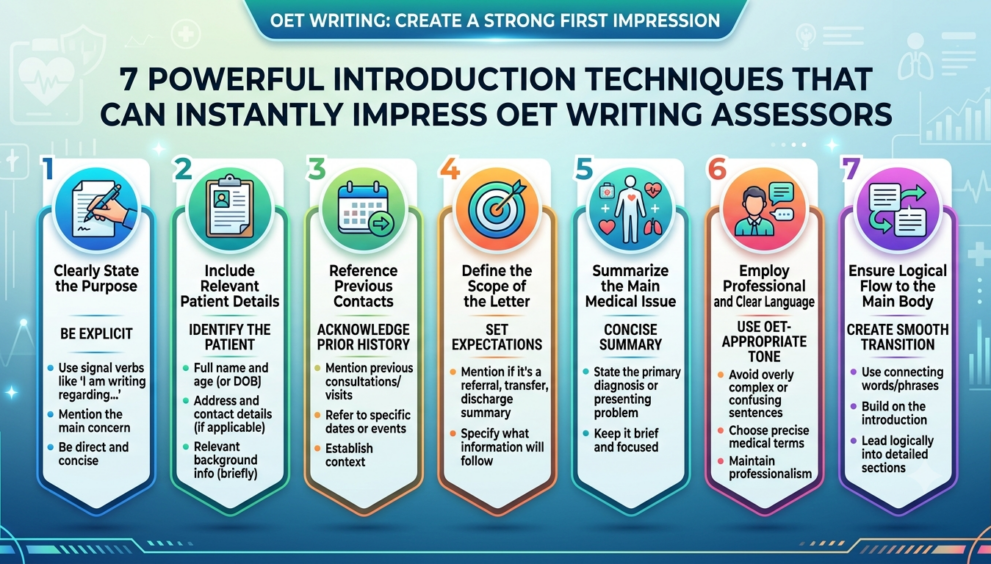
A strong OET introduction is usually one to two sentences and includes three essential elements:
- The purpose of the letter (why you are writing)
- The patient’s identity (name, and often DOB or age)
- A clear, professional context (reason for referral, discharge, transfer, or update)
These elements can be arranged in different ways depending on the task, but they must all be present in some form.
Three Reliable Introduction Patterns
You don’t need to invent new structures in the exam. Memorise these three patterns and adapt them to the task at hand.
1. Purpose-First (Best for referrals and transfers)
Start with the reason for writing, then identify the patient.
- “I am writing to refer Mr John Smith (DOB 02/06/1978) for assessment and ongoing physiotherapy following a left total hip replacement.”
This pattern is ideal for referral letters because the recipient immediately knows what action is required.
2. Patient-First (Useful when the patient’s identity is central)
Start with the patient’s details, then state the reason.
- “Mr John Smith, a 48-year-old construction worker, was admitted on 28 May 2026 with a closed tibial fracture; I am writing to request an orthopaedic review.”
This pattern works well when the patient’s background or occupation is clinically relevant.
3. Summary-First (When the clinical problem needs immediate clarity)
Start with a one-sentence summary of the clinical problem and the action required.
- “Mr John Smith, admitted with worsening breathlessness and type II respiratory failure, requires review and consideration for NIV.”
This pattern is useful when the clinical situation is urgent or complex, and the recipient needs to grasp the urgency immediately.
Language and Tone: What to Use and What to Avoid
The language you choose in your introduction signals professionalism. Because the introduction is so short, every word counts.
Use These:
- Clear purpose verbs: refer, request, update, discharge, transfer, arrange, advise
- Precise clinical language: “type II respiratory failure”, “displaced tibial fracture”, “worsening dyspnoea”
- Concise, transactional phrasing: Get straight to the point.
Avoid These:
- Vague phrasing: “I am writing regarding…”, “I am writing about Mr Smith who has been having problems…”
- Overly polite or casual language: “I hope this letter finds you well.” “I would be most grateful if you could…” (Save polite requests for the closing paragraph).
- Irrelevant background: History, opinions, or detailed clinical data belong firmly in the body, not the introduction.
Common Introduction Mistakes (and How to Fix Them)
Even experienced candidates make predictable mistakes in their introductions. Recognising these errors is the first step to avoiding them.
1. Too Wordy
Many candidates try to be overly polite or descriptive in the introduction, using unnecessary words that dilute the purpose.
- Incorrect: “I just wanted to let you know that we have a patient who has been having some issues with his leg, and I was wondering if you could maybe take a look at him.”
- Correct: “I am writing to refer Mr John Smith for orthopaedic assessment following a displaced tibial fracture.”
2. Missing Purpose
If the assessor must search the body to find why you wrote, your marks will drop. State the purpose clearly in the very first sentence.
3. Irrelevant Detail
History, examination findings, and management plans belong in the body. The introduction should only give what the recipient needs to know immediately.
4. Weak Verbs
Replace ambiguous phrases like “I am writing regarding…” with stronger, clearer verbs like “refer”, “request”, or “update”.
How to Write a Strong Introduction Under Exam Pressure
You only have 40 minutes for the entire OET Writing sub-test. Time management is critical. Here’s a practical approach by Fortuwest International to writing a strong introduction under pressure:
- Read the task prompt carefully: Identify the recipient, purpose, and patient details. Underline key information in the case notes.
- Read the notes given just above the Writing Task: These notes will give you a clear view of exactly why you’re writing the letter to the recipient.
- Write the introduction first: This anchors your letter and prevents wandering into irrelevant details. It also gives you a clear roadmap for the rest of the body.
- Keep it to 1-2 sentences: If you’re over 35-40 words, you’re likely being too wordy. Aim for 20-35 words for a punchy introduction.
- Check that the purpose is obvious: Ask yourself: “If I read only this sentence, would I know exactly why the letter was written?”
- Move on to the body: Don’t spend more than 3-4 minutes on the introduction. The body and closing are equally important.
Practice Drills to Build Introduction Skills
To improve quickly, focus your practice sessions on introductions alone using these three targeted drills:
- Drill 1: Three Variations — Given a single case note, write three different introductions using the three patterns discussed above (purpose-first, patient-first, summary-first). Compare which is clearest and most appropriate for the task.
- Drill 2: Time Trials — Time yourself writing only the introduction and the closing sentence. This helps you practice building the structural frame of the letter without getting bogged down in the clinical body.
- Drill 3: Self-Review — After taking a short break, review your own introductions with fresh eyes and ask: “Is the purpose immediately obvious?” If not, rewrite it immediately.
Fortuwest International – OET Crack Course
Final Thought: Your First Impression and Biggest Opportunity
In the OET Writing sub-test, the introduction is where you either gain the assessor’s confidence or force them to work harder to understand your letter. A clear, professional, purpose-driven introduction shows that you can communicate effectively in a fast-paced UK healthcare environment.
Make your introduction count. State your purpose clearly. Identify the patient. Use precise language. And let the rest of your letter build on that strong foundation.
Read Next: Take a look at our detailed blog – “6 Dangerous Distractors in OET Reading That Trick Nurses Easily” – to ensure your preparation journey stays on track.
Why Wait? Just Fortuwest International it!
Fortuwest International – WhatsApp Chat
+44 7378 467245
+91 79944 44788
Lorem ipsum dolor sit amet, consectetur adipiscing elit. Ut elit tellus, luctus nec ullamcorper mattis, pulvinar dapibus leo.