

If you are preparing for the NMC CBT, you may be focusing mainly on clinical knowledge, numeracy, safeguarding, infection prevention, documentation, and professional standards. However, understanding how care quality is measured in the UK is also highly important. One topic that fits into this wider picture is the Friends and Family Test (FFT). Even if you are not asked to define it in exactly those words in the exam, the ideas behind it connect strongly to patient-centred care, communication, quality improvement, and compassionate nursing practice.
For international nurses planning to join the NHS, the Friends and Family Test helps you understand what matters in UK healthcare: not only safe treatment, but also how patients feel about their care. That means respect, kindness, communication, listening, dignity, and timely support all matter. In this guide, we explain what the Friends and Family Test is, why it matters for your NMC CBT preparation, how it links to the NMC Code, and what practical lessons you should remember for both the exam and real NHS practice.
What Is the Friends and Family Test in the NHS?
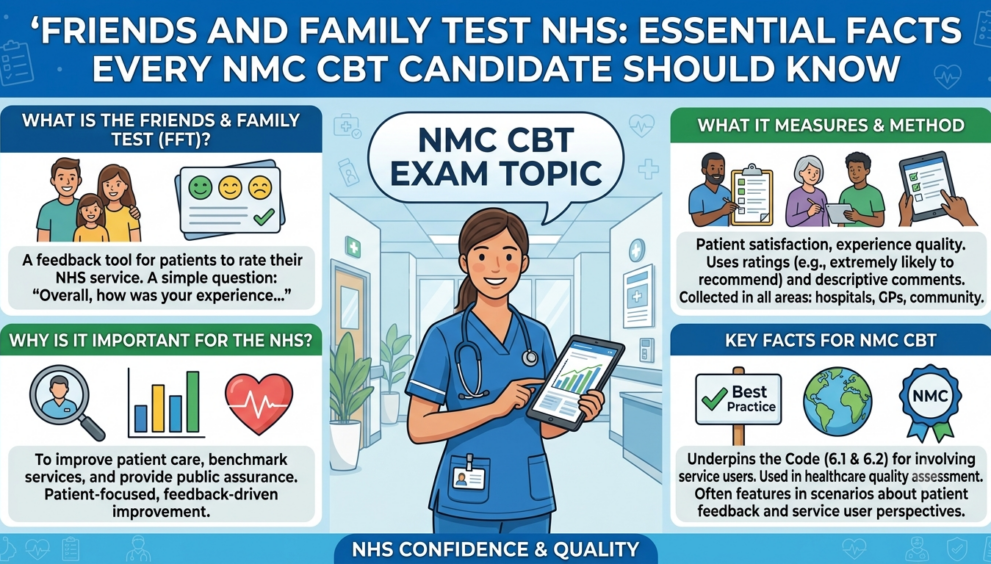
The Friends and Family Test (FFT) is a simple, anonymous feedback tool used across the NHS. It asks patients, service users, or carers about their overall experience of the service they received, framing it around whether they would recommend it to friends and family if they needed similar care or treatment.
Rather than acting as a static rating, the FFT is designed to gather real continuous feedback. Patients rank their experience from “very good” to “very poor” and are invited to give an open-ended reason for their answer. This provides qualitative context that numbers alone cannot capture.
Key Purpose: The real purpose of the FFT is to help NHS organisations hear the patient voice more quickly and clearly. It highlights what is working well and pinpoints exactly where service improvements are needed.
Why Should NMC CBT Candidates Learn About the FFT?
At first glance, the Friends and Family Test might seem like a management metric rather than an exam topic. In reality, it supports the core themes tested throughout the NMC CBT. The CBT assesses whether you can think like a safe, accountable, and responsive nurse working in the UK.
When studying the FFT, you are diving into key concepts of UK healthcare delivery:
- The Patient Experience Asset: If a patient feels ignored, confused, or unsafe, that is treated as vital clinical and operational feedback.
- A Continuous Learning Culture: The NHS actively transforms feedback, safety reviews, and local audits into service improvement.
- Scenario Logic: Many CBT questions present clinical scenarios dealing with communication breakdowns, consent issues, or dignity. Choosing the correct answer relies on applying this exact patient-centred mindset.
How the Friends and Family Test Connects to the NMC Code
The underlying principles of patient feedback align precisely with the four fundamental pillars of the NMC Code.
1. Prioritise People
The FFT reflects the necessity of putting patients first. Nurses must support choice, communicate honestly, and recognize that each patient’s physical and emotional experience is central to care quality.
2. Practise Effectively
Effective practice is not just technical skill. It encompasses clear explanations, active listening, and smooth interdisciplinary teamwork. A technically flawless clinical intervention can still result in a poor patient experience if delivered without respect or explanation.
3. Preserve Safety
Safety includes listening when patient feedback reveals hidden or recurring operational risks. Repeated negative comments regarding call bell delays, poor handovers, or inadequate pain management act as early warning indicators for patient safety issues.
4. Promote Professionalism and Trust
Public trust depends heavily on day-to-day interactions. Courtesy, empathy, and accountability shape how patients view the profession. The FFT provides a window into whether that trust is being consistently earned at the bedside.
Common Themes in Patient Feedback That CBT Candidates Should Understand
You do not need to memorise a long list of specific feedback data for the exam. Instead, you should understand the core structural patterns that frequently appear in patient feedback and how they relate to best practice:
Feedback Theme Clinical Context for CBT Communication Did staff explain procedures, waiting times, medications, and next steps clearly? Respect and Dignity Was visual and auditory privacy maintained? Was the patient addressed politely? Responsiveness Did staff answer call bells promptly and address pain management requests without delay? Kindness and Empathy Did the patient feel listened to, emotionally supported, and valued as an individual? Coordination of Care Did the service run smoothly, or did the patient experience organizational confusion? Could the FFT Appear Directly on the Exam?
While you may not see a direct question asking you to define the “Friends and Family Test,” the principles are heavily embedded in scenario questions.
For instance, if a question asks how a nurse should handle a patient expressing dissatisfaction or confusion, the correct answer in the UK context will always point toward openness, active listening, documenting the concern, escalating trends, and actively adapting care—rather than dismissing or hiding the issue.How Fortuwest International Can Help You Prepare
Mastering the NMC CBT involves moving past simple rote memorisation to understand how UK clinical decisions are framed. This is where structured guidance makes the difference.
Fortuwest International’s CBT Crack Course is explicitly engineered to help international nurses break down the exam successfully. The course fully covers both Part A (Numeracy) and Part B (Clinical Knowledge) while aligning strictly with the latest NMC standards.
By utilizing comprehensive mock tests, detailed rationales, and dedicated scenario practices, Fortuwest International ensures you build the specific professional judgement required to pass the first time. For those seeking support throughout their entire journey, Fortuwest International also offers robust OET language preparation and NMC OSCE practical skills coaching to transition you confidently into full NHS employment.Frequently Asked Questions
What is the primary question asked in the NHS Friends and Family Test?
The test asks service users to rate their overall experience of the service, followed by an opportunity to explain their score in their own words to collect both quantitative ratings and qualitative details.
Is the Friends and Family Test important for NMC CBT preparation?
Yes. While it is a quality assurance tool, it embodies key CBT pillars like patient-centred communication, clinical governance, quality improvement, and professional accountability.
How does patient feedback affect a nurse’s daily practice in the UK?
Feedback is actively used by multi-disciplinary teams to drive quality improvement. If recurring trends are spotted (e.g., poor discharge explanations), wards will modify their practices, leaflets, or handover styles accordingly.
What mistakes should CBT candidates avoid regarding patient experience?
Never assume that technical tasks override communication or emotional care in clinical priority. In UK nursing culture, failing to explain a procedure or ignoring a patient’s mild dissatisfaction can result in exam failure on scenario choices.
If you want to build exceptional exam confidence and master the UK nursing mindset, explore the tailored revision solutions at Fortuwest International to accelerate your registration journey today.
Lorem ipsum dolor sit amet, consectetur adipiscing elit. Ut elit tellus, luctus nec ullamcorper mattis, pulvinar dapibus leo.