

Many OET candidates approach the speaking test with significant anxiety, worrying that even a small mistake during the role play will catastrophically ruin their overall score. This fear is understandable, given that the OET is a critical examination for healthcare professionals seeking to work in English-speaking countries.
However, it is essential to understand that OET examiners assess overall communication effectiveness, not absolute perfection. What matters most is not whether you make mistakes, but how you recover from them and continue to maintain patient-centred communication throughout the role play.
This comprehensive guide by Fortu West International will walk you through practical strategies, real examples, and mindset shifts that will help you recover smoothly when mistakes occur during your OET speaking role play, ensuring you maintain the confidence and professionalism that high-scoring candidates demonstrate.
Understanding the Reality of OET Speaking Assessment
Before diving into specific recovery techniques, it is crucial to understand how OET speaking is actually assessed. The OET speaking subtest consists of two role-plays, each lasting approximately 5 minutes. During these role-plays, you are graded across several criteria split into two major blocks:
Linguistic Criteria
- Intelligibility: Pronunciation, intonation, and accent.
- Fluency: The natural rate of speech and flow.
- Appropriateness of Language: Tone, professionalism, and choice of vocabulary.
- Resources of Grammar and Expression: Accuracy and variety of grammatical structures.
Clinical Communication Criteria
- Relationship Building: Demonstrating empathy, respect, and attentiveness.
- Understanding & Incorporating the Patient’s Perspective: Valuing the patient’s views and anxieties.
- Providing Structure: Organizing the conversation and using bridging phrases.
- Information Gathering: Active listening and using appropriate questioning techniques.
- Information Giving: Checking understanding and avoiding medical jargon.
The reality is that minor mistakes do not automatically reduce your score. What truly impacts your performance is how you respond to those mistakes. Staying calm and continuing naturally is far more important than achieving a flawless delivery. Examiners recognise that spoken language under high pressure includes natural variations, brief pauses, and occasional slips.
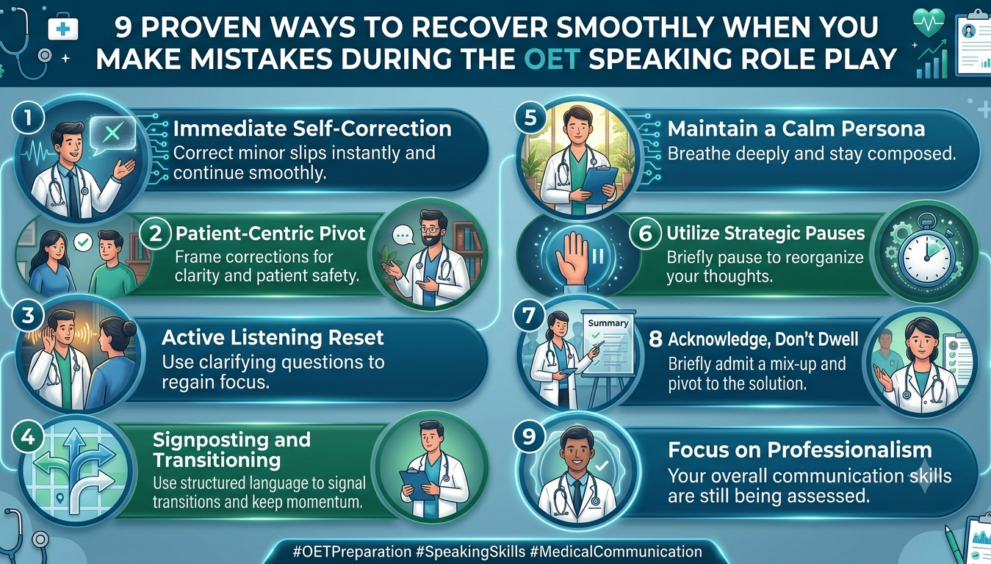
9 Best Practices for Smooth Mistake Recovery
1. Remember: Mistakes Are Normal and Acceptable
The first and perhaps most important step in recovering smoothly is to accept that mistakes are completely normal. Every candidate makes them, even those who achieve straight Grade A results. Minor slips, such as mispronouncing a medical term, using slightly awkward phrasing, or forgetting a non-critical detail, will not break your score if you maintain your composure.
When you notice a mistake, do not let it cascade into panic. Acknowledge it internally, take a quick breath, reset your focus, and move forward.
2. Don’t Panic if You Forget a Point From the Task Card
The task card outlines specific target information you need to gather or convey during the interaction. Missing a point early on often causes candidates to panic. However, you can easily introduce the missed point later in the conversation in a completely natural way.
Example: If you forgot to ask about the patient’s current medications during your initial information gathering, you can reintroduce this point smoothly toward the end:
“Before we discuss your follow-up care, I’d also like to quickly confirm whether you’re currently taking any over-the-counter or prescription medications?”This demonstrates that you are thorough and patient-centred, while showing the examiner your flexibility in structuring a consultation.
3. Correct Yourself Naturally Without Over-Apologising
If you realise you have provided incorrect clinical instructions—such as a wrong dosage frequency or an incorrect timeline—it is your professional duty to fix it. Appropriate self-correction is normal and actually demonstrates linguistic awareness and attention to accuracy.
However, avoid over-apologising with dramatic phrases like “Oh no, I’m so sorry, I made a terrible mistake. Let me start over.” This breaks the illusion of a real clinic room. Instead, keep corrections concise:
Keep it minimal and move forward confidently.4. Clarify If You Misunderstand the Patient
During OET role-plays, the interlocutor may deliberately throw a curveball or express an unexpected concern. If you mishear or misunderstand them, do not nod along blindly. In real healthcare settings, guessing can be dangerous, and examiners look for safe practitioners.
Use standard professional clarification expressions:
- “Could you please explain that a little more?”
- “Just to make sure I’ve understood your concern correctly, are you saying that…”
- “Could you repeat that last part for me, please?”
5. Use Bridging Phrases to Maintain Flow
Bridging phrases are excellent structural tools that allow you to transition seamlessly between ideas, jump back to forgotten points, or move past an awkward moment without sounding disjointed.
Functional Goal Recommended Professional Phrases Reintroducing a Missed Point “Going back to what we discussed earlier…” or “There is one more thing I’d like to check before we move on.” Changing the Topic Smoothly “Moving on to the next aspect of your treatment plan…” or “Now let’s talk about how we can manage this at home.” Adding Supplementary Data “In addition to what we’ve talked about, it’s also vital to consider…” 6. Avoid Rigid Memorisation: Focus on Active Listening
A critical mistake many candidates make is trying to memorize an entire script for specific medical scenarios before the test. This approach breaks down instantly if the interlocutor reacts differently than expected.
Instead of treating the role play like an acting script, treat it as an active consultation. Learn functional frames (how to explain a diagnosis, how to reassure an anxious parent, how to negotiate a lifestyle change) rather than fixed sentences.7. Recover From Long Pauses Gracefully
If you experience a sudden mental block, do not panic or fill the silence with repetitive apologies. Instead, use professional filler phrases that buy you time to look at your task card while maintaining control of the interaction:
- “Let me take a look at your chart for a moment to ensure I’ve covered everything…”
- “This is an important point, so let me make sure I explain it to you clearly…”
- “Before I continue, let me just organize my thoughts on your next steps…”
8. Use Empathy to Rebuild the Conversation
If a mistake creates temporary confusion or distress, pivot directly to empathy. Empathy shifts the focus away from your linguistic performance and places it squarely on the patient’s emotional well-being.
- “I understand that this information can feel quite overwhelming at first.”
- “It’s completely understandable to have these concerns, and I am here to help guide you through this.”
- “Thank you for pointing that out. I want to make absolutely sure you feel confident about your care.”
9. Finish Strong with a Clear Summary and Aftercare Plan
Regardless of any minor hiccups that occurred during the 5 minutes, a strong, organized conclusion leaves a lasting positive impression on the assessor. Always structure your closing around three core steps:
1. Reassurance ➔ 2. Clear Action Plan ➔ 3. Opportunity for Final QuestionsAlways conclude by asking: “Is there anything else you would like me to clarify before you go today?” This ensures you meet the criteria for providing a clean structure and verifying patient understanding.
Common OET Speaking Myths: Reality vs. Misconception
| Myth | Reality |
|---|---|
| One clinical slip results in an automatic failure. | False. Examiners grade your aggregate performance across the entire 5 minutes. |
| You must speak fast without any hesitation. | False. Natural pauses for thought are a normal part of clear professional speech. |
| Grammar errors instantly disqualify you from a Grade B. | False. Global communication impact and clarity override minor structural slips. |
How Fortu West International Can Transform Your Preparation
Turning theoretical communication frameworks into fluent, real-time performance under exam pressure requires expert guidance. That is exactly what we specialize in.
At Fortu West International, we provide specialized, station-based coaching designed to help international healthcare professionals build clinical English fluency. Through our comprehensive OET training tracks, we don’t just teach you what to say—we train you on how to naturally navigate unexpected turns, handle stressful interactions, and recover seamlessly from errors.
Beyond OET preparation, Fortu West International offers end-to-end support for your UK registration journey, including targeted NMC CBT Crack Courses and immersive NMC OSCE practical simulation bootcamps.
Frequently Asked Questions
Will I fail if I don’t finish every bullet point on the OET task card?
Not necessarily. While you should aim to address the card fully, prioritizing patient safety, active listening, and addressing the patient’s immediate questions can override a strict task card timeline if your global communication remains excellent.
How should I correct a medical term error during the role play?
Correct it immediately and smoothly using phrases like: “Apologies, what I meant to say was…” and then continue without over-apologizing.
Does the interlocutor grade my OET speaking performance?
No. The interlocutor simply acts as the patient or relative to record the audio. Your voice recording is securely transmitted and assessed independently by certified OET examiners using strict criteria.
If you are ready to stop memorizing scripts and start communicating like a confident UK professional, explore the interactive prep tools and expert-led mock sessions at Fortu West International today.