


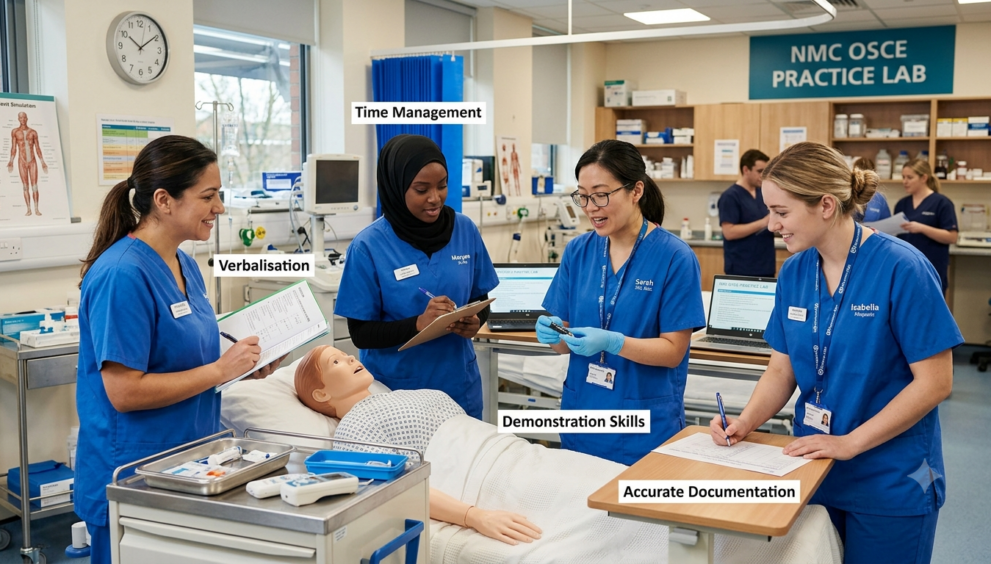
Preparing for the NMC OSCE (Objective Structured Clinical Examination) can be both exciting and challenging. For internationally educated nurses aspiring to register with the Nursing and Midwifery Council (NMC) in the UK, the NMC OSCE represents the final step before joining the nursing workforce. While many candidates dedicate significant time to studying clinical procedures and reviewing guidelines, success in the NMC OSCE requires much more than theoretical knowledge.
The NMC OSCE is designed to assess whether a candidate can demonstrate safe, effective, and professional nursing care to the patient. In the NMC OSCE, examiners evaluate how you communicate, perform procedures, manage time, and document care. Therefore, candidates who focus solely on memorising procedures often find themselves struggling during the examination.
Through years of OSCE preparation and candidate feedback, four key elements consistently emerge as the foundation of success:
- Verbalisation
- Time Management
- Accurate Demonstration of Equipment and Procedure
- Accurate and Legible Documentation
These four components form the accurate preparation of every OSCE station and directly impact a candidate’s performance. Mastering them can significantly improve confidence, reduce anxiety, and increase the chances of passing the examination on the first attempt.
This blog explores each element in detail and provides practical strategies to help candidates prepare effectively.
1. Verbalisation: Speak Your Clinical Thinking
One of the biggest differences between real clinical practice and the OSCE environment is the need to verbalise your actions. In a clinical setting, experienced nurses often perform procedures without explaining every step aloud. However, in the NMC OSCE, examiners cannot assess what is happening inside your mind. They can only assess what they see and hear. This is why verbalisation is one of the most important skills for OSCE success.
Why Verbalisation Matters
Verbalisation allows examiners to understand:
- Your clinical reasoning
- Your understanding of patient safety
- Your communication skills
- Your knowledge of nursing principles
- Your decision-making process
Even when a procedure is performed correctly, failing to verbalise critical actions may result in lost marks because the examiner may not know your rationale.
Verbalisation Throughout the Station
Verbalisation should occur continuously throughout the station.
- During Introduction: Introduce yourself clearly: “Hello, my name is Sarah, and I am one of the nurses looking after you today.” Explain the procedure: “I would like to perform a blood glucose monitoring assessment. I will explain each step as we go along.” Gain consent: “Do I have your consent to proceed?” These statements demonstrate professionalism and patient-centred care.
- During the Procedure: As you perform each action, explain what you are doing and why. Examples include: “I am checking the patient’s identity using two identifiers,” “I am checking the expiry date and integrity of the equipment,” or “I am applying PPE according to infection control requirements.”
- During Patient Communication: Remember that communication should remain patient-friendly. Simple language improves patient understanding and demonstrates effective communication skills.
- During Conclusion: Before ending the station, verbalise your next actions: “I will ensure the patient is comfortable,” “I will dispose of equipment safely,” and “I will document my findings accurately.”
Common Verbalisation Mistakes
Many candidates:
- Perform actions silently
- Speak too softly
- Use incomplete explanations
- Forget to verbalise safety checks
- Focus only on the procedure and ignore communication
How to Improve Verbalisation
Practice regularly by speaking aloud while practicing in front of a mirror, recording yourself to review your performance, and practicing with a mentor to seek feedback. Initially, verbalising may feel unnatural, but with repetition, it becomes fluent and greatly enhances performance.
2. Time Management: The Skill That Saves Candidates from Failure
Time management is one of the most underestimated aspects of NMC OSCE preparation. Many students possess excellent clinical knowledge but fail because they cannot complete the station within the allocated time. The NMC OSCE is designed to assess both competence and efficiency; nurses must provide safe care while working within time constraints, and the examination reflects this reality.
Why Time Management Is Important
Every station has a predetermined duration. When time expires, the station ends immediately, incomplete tasks may lose marks, and documentation may remain unfinished.
Common Causes of Time Loss
Candidates often lose valuable minutes due to:
- Over-Explaining: Some candidates provide lengthy explanations for every action. While verbalisation is important, excessive talking consumes time. Be clear and concise.
- Lack of Familiarity: If you are unsure about equipment or procedural steps, valuable seconds are lost deciding what to do next. Frequent practice improves efficiency.
- Repeated Checking: Students sometimes repeatedly check equipment because they lack confidence. While safety checks are important, unnecessary repetition wastes time.
- Poor Documentation: Leaving all documentation until the final moments can create unnecessary pressure. Practice completing documentation quickly and accurately.
Effective Time Management Strategies
- Practice with a Timer: Always simulate examination conditions. Set a timer during practice sessions and complete stations within the allocated timeframe to develop an awareness of pacing.
- Follow a Structured Approach: A simple structure helps maintain focus:
- Introduction (1–2 Minutes): Introduce yourself, confirm patient identity, explain the procedure, and obtain consent.
- Main Procedure (Majority of Time): Perform the assessment or skill, maintain communication, and demonstrate safety.
- Conclusion and Documentation (Final Minutes): Ensure patient comfort, dispose of waste safely, and complete documentation.
- Prioritise Critical Points: Focus first on patient safety, infection prevention, correct technique, and communication, as these areas carry significant weight in OSCE marking criteria.
- Practice Under Pressure: The more realistic your practice environment, the better prepared you will be. Practice with a mentor, engage in mock OSCEs, and do timed station verbalisations to reduce anxiety and improve speed.
3. Accurate Demonstration of Equipment and Procedure
The NMC OSCE is fundamentally a practical examination. Students are expected to demonstrate clinical skills accurately, safely, and professionally. Knowing a procedure theoretically is not enough; the examiner assesses whether you can perform the skill according to the NMC standards by following the marking criteria.
Why Accurate Demonstration Matters
Patients rely on nurses to perform procedures safely. An incorrect technique in real practice can result in harm to patients, infection risks, medication errors, or delayed treatment. The OSCE reflects these professional expectations.
Understanding the Marking Criteria
Every OSCE station follows a structured marking framework. Candidates should familiarise themselves with station objectives, expected steps to follow, equipment requirements, safety checks, and documentation requirements to avoid missed steps.
Equipment Checks & Organisation
Before beginning any procedure, always verbalise and demonstrate that packaging is intact, equipment is clean, expiry dates are valid, and items are functioning correctly. Preparing and organising all necessary items before starting saves time, reduces stress, and creates a professional impression.
Infection Prevention and Control
Infection prevention is a critical component of every OSCE station. Candidates should consistently demonstrate:
- Hand Hygiene: Perform hand hygiene before patient contact, before procedures, after procedures, and after glove removal.
- Appropriate PPE: Use gloves and aprons when required.
- Aseptic Technique: Where applicable, maintain sterile fields, avoid contamination, and handle equipment correctly. Even minor contamination can lead to lost marks.
Patient Safety, Comfort, and Waste Disposal
Safe nursing practice extends beyond technical skills. Always ensure privacy (closing curtains, maintaining dignity), comfort (positioning patients appropriately, offering reassurance), and never begin without obtaining explicit consent.
Furthermore, demonstrate safe waste disposal (clinical waste, sharps, and domestic waste). Improper disposal can result in a loss of marks because it represents a direct patient safety issue.
4. Accurate Documentation: The Final Step That Completes the Nursing Process
Documentation is often treated as an afterthought during OSCE preparation. However, documentation is a professional responsibility and an essential part of nursing care, providing evidence of care delivered, communication between healthcare professionals, continuity of care, and accurate patient records.
Characteristics of Good Documentation
- Clear: Easy to understand to avoid confusion.
- Accurate: Record exactly what occurred; never guess or estimate findings.
- Relevant: Include information directly related to the assessment or procedure.
- Structured: Follow the format required by the station.
Common Documentation Errors
Candidates frequently lose marks due to illegible handwriting, missing signatures, missing dates, missing times of the procedure, or recording incorrect values.
To combat this, ensure your handwriting is neat, consistent, and easy to interpret. Every entry should include your signature, date, and time where applicable. Before concluding the station, do a quick review to check if everything is complete, values and units are accurate, and you have signed appropriately.
Bringing All Four Elements Together
The most successful OSCE candidates do not focus on a single area of preparation. Instead, they integrate all four elements into every practice session. For example, during a blood glucose monitoring practice station: verbalise every action, complete the station within the allocated time, demonstrate equipment handling accurately, and complete documentation correctly.
Success in the NMC OSCE is achieved through a combination of communication, organisation, technical competence, and professionalism. By incorporating these principles into your preparation, you will approach the NMC OSCE with greater confidence and be well-equipped to demonstrate the safe and professional nursing practice expected by the Nursing and Midwifery Council.
Frequently Asked Questions
1. How many stations are asked in the OSCE?
The OSCE is a 10-station practical exam which includes APIE (Assessment, Planning, Implementation, Evaluation), 4 clinical skills, 1 Professional values and behaviours, and 1 Evidence-based practice.
2. Why is verbalisation important in the NMC OSCE?
Verbalisation allows examiners to understand your clinical reasoning, decision-making, and knowledge. Since examiners cannot assess your thoughts, you must clearly explain your actions and rationale throughout the procedure.
3. How can I improve my verbalisation skills?
You can improve by practicing stations aloud, recording yourself and reviewing your performance, participating in mock OSCE sessions, and receiving feedback from a mentor.
4. How should I divide my time during a station?
A general guide is:
- Introduction: 1–2 minutes
- Main Procedure: Majority of the station time
- Conclusion and Documentation: Final few minutes
5. What should I prioritise if I am running out of time?
Always prioritise patient safety, infection prevention and control, critical assessment findings, and essential documentation.
Read our detailed blog – “4 Proven Components of an Outstanding NMC OSCE Evaluation Handover” – to ensure your journey stays on track.
Why Wait? Just Fortuwest It!
Lorem ipsum dolor sit amet, consectetur adipiscing elit. Ut elit tellus, luctus nec ullamcorper mattis, pulvinar dapibus leo.