

Preparing for the NMC CBT means learning more than facts and definitions. You also need to understand how professional values guide every nursing decision. One of the most important ideas you will meet is patient-centred care for NMC CBT. This concept appears in communication questions, consent scenarios, safeguarding situations, delegation decisions, and everyday nursing care.
For international nurses—especially those navigating the transition to UK healthcare with the help of Fortu West International—patient-centred care can feel broad at first. But once you connect it to the NMC Code, it becomes clearer. In simple terms, patient-centred care means seeing the patient as a whole person, respecting their dignity, involving them in decisions, listening carefully, and delivering safe, kind, and evidence-based care that fits their needs, values, and preferences.
In this guide, we will break down what patient-centred care means for the CBT, explain how the NMC Code supports it, and give you practical examples plus practice questions. If you want to strengthen your exam technique and prepare for UK nursing practice, this article will help you study with confidence.
Why Patient-Centred Care Matters in the NMC CBT
The NMC CBT does not only test memory. It tests judgement. You may be asked what a nurse should do first, how to communicate safely, how to obtain consent, when to escalate concerns, or how to protect a vulnerable patient. In many of these questions, the best answer reflects patient-centred care.
Patient-centred care matters because UK nursing practice is built on respect, safety, partnership, and accountability. The nurse should not make assumptions, ignore the patient’s wishes, or focus only on the disease. Instead, the nurse must listen, explain, involve, document, and act in the person’s best interests. This is especially important when caring for patients with communication barriers, cognitive impairment, different cultural backgrounds, or reduced capacity.
For CBT candidates, this means you should look carefully at words in the scenario:
- Does the patient understand?
- Have they been informed?
- Are they being treated with dignity?
- Is the nurse listening?
- Is consent valid?
- Is the action safe, lawful, and compassionate?
These are clues that help you choose the right answer.
What is Patient-Centred Care in Nursing?
Patient-centred care in nursing means planning and delivering care around the person, not just the condition. It recognises that each patient has individual needs, beliefs, preferences, values, communication styles, and life circumstances. Good nursing care should therefore be personalised, respectful, and collaborative.
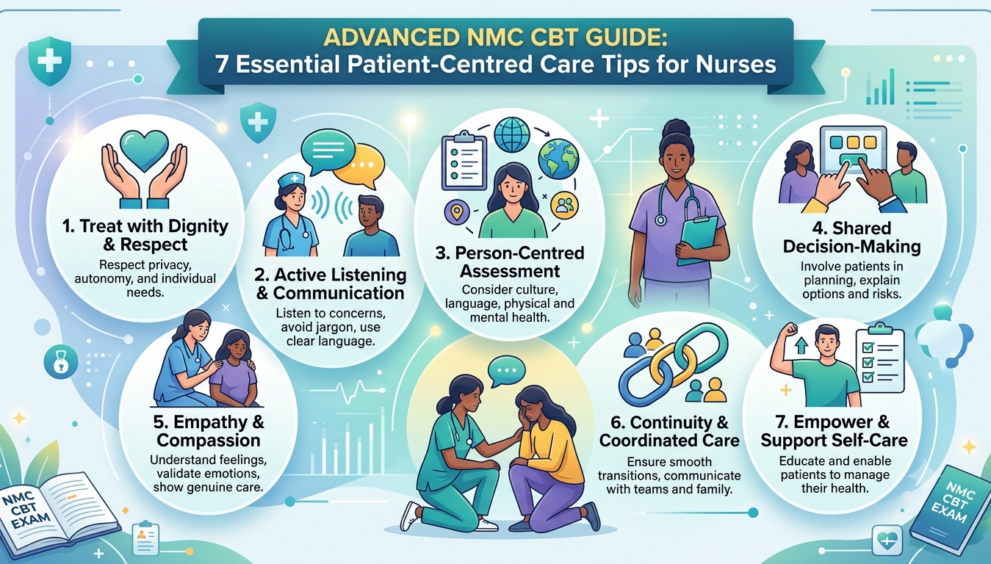
In practice, patient-centred care includes:
- Listening actively to the patient
- Respecting dignity, privacy, and autonomy
- Giving information in a clear way
- Checking understanding through teach-back
- Involving patients in decisions whenever possible
- Considering culture, language, and health literacy
- Seeking valid consent
- Working in the patient’s best interests when capacity is impaired
- Coordinating safe, evidence-based, and compassionate care
This links strongly with key CBT areas such as communication, safeguarding, consent and capacity, documentation, delegation, and professional behaviour. It is also highly relevant for nurses planning to work in the NHS, where shared decision-making and respectful care are central expectations.
NMC Code Breakdown: How the Code Supports Patient-Centred Care
The NMC Code is structured under four core themes. If you understand these four parts well, many CBT questions become easier:
1. Prioritise People
This is the strongest section for patient-centred care. Nurses must treat people as individuals and uphold their dignity. They must listen to people, respond to their preferences and concerns, and make sure care needs are recognised and assessed. Nurses should also respect the patient’s right to accept or refuse care when they have capacity.
CBT Tip: The right answer often includes listening first, protecting dignity, involving the patient, maintaining confidentiality, and avoiding judgemental language. If an option sounds task-focused but ignores the person, it is rarely the best choice.
2. Practise Effectively
Patient-centred care depends on good communication and teamwork. Nurses must share information clearly, keep accurate records, communicate in a way the person can understand, and work cooperatively with colleagues. Effective practice includes recognising communication barriers and using interpreters, communication aids, or accessible language where needed.
3. Preserve Safety
Being patient-centred does not mean agreeing with everything without professional judgement. Nurses must preserve safety. This includes raising concerns, safeguarding adults at risk, recognising deterioration, escalating when needed, and taking action when patients lack capacity or face abuse, neglect, or exploitation.
4. Promote Professionalism and Trust
Trust is at the heart of patient-centred care. Nurses must be honest, respectful, professional, and accountable. They should communicate openly, keep clear records, maintain boundaries, and demonstrate integrity. Patients are more likely to share concerns and engage in care when they feel respected and safe.
Key Principles of Patient-Centred Care for CBT Scenarios
- Respect for Dignity and Individuality: Every patient should be treated as an individual, not as a diagnosis or bed number. Respect privacy during personal care and use preferred names.
- Accessible Communication: Speak clearly, avoid medical jargon, ask open questions, and use the “teach-back” method to verify understanding. If there is a language barrier, always utilize official translation support rather than guessing.
- Consent and Autonomy: Valid consent is central. Patients with capacity have the right to refuse treatment. The best answer in CBT questions often includes explaining options and checking whether the patient understands.
- Capacity and Best Interests: Under the Mental Capacity Act 2005, a person must be assumed to have capacity unless proved otherwise. If they lack capacity, decisions must be made in their best interests and in the least restrictive way.
- Compassion and Advocacy: Compassionate responses involve reassurance, presence, and calm listening. Advocacy means speaking up for the patient, especially when they are at risk or unable to speak for themselves.
Common CBT Scenario Types to Revise
Patient-centred care can appear in many forms in the exam. Be ready for:
- Communication scenarios: Choosing the most appropriate way to explain, listen, or respond.
- Consent questions: Identifying whether consent is informed and valid.
- Capacity scenarios: Applying MCA principles and best-interest thinking.
- Safeguarding questions: Recognising abuse, neglect, or exploitation and escalating concerns immediately.
- Dementia or confusion scenarios: Adapting communication and protecting dignity.
- Delegation questions: Ensuring safe delegation without compromising person-centred care.
- Cultural awareness questions: Adapting communication respectfully without stereotyping.
How to Answer Patient-Centred Care Questions: A 5-Step Strategy
- Identify the main issue: Is it consent, communication, safety, safeguarding, or capacity?
- Look for the patient’s perspective: What does the patient understand, want, or need?
- Apply the NMC Code: Which answer best prioritises people, practises effectively, preserves safety, and maintains professionalism?
- Eliminate bad options: Cross out answers that are dismissive, unsafe, judgemental, or outside the nurse’s role.
- Choose the best path: Select the option that is kind, lawful, evidence-based, and properly accountable.
Practice Questions: Patient-Centred Care for NMC CBT
Question 1
A patient is about to receive a procedure but says, “I do not really understand why this is needed.” What should the nurse do first?
- A. Ask the patient to sign the form quickly so the ward is not delayed
- B. Explain the procedure clearly, answer questions and check understanding
- C. Tell the patient the doctor has already decided
- D. Ask a relative to give consent instead
Correct answer: B
Rationale: Patient-centred care requires clear information, informed consent, and respect for autonomy. The nurse should support understanding before any consent process continues.
Question 2
An older adult with hearing difficulty seems confused during discharge teaching. What is the most patient-centred action?
- A. Speak faster to finish the explanation
- B. Hand over written instructions only and leave
- C. Reduce background noise, speak clearly and use teach-back
- D. Ask another patient to explain later
Correct answer: C
Rationale: The best option adapts communication to the patient’s needs and checks understanding. This reflects both effective communication and person-centred care.
Question 3
A patient with capacity refuses a recommended treatment after the nurse explains the risks and benefits. What should the nurse do?
- A. Respect the decision, document it and inform the appropriate team member
- B. Ignore the refusal because the treatment is important
- C. Ask the family to force the patient to agree
- D. Administer the treatment when the patient is asleep
Correct answer: A
Rationale: A capable adult has the right to refuse treatment. Patient-centred care respects autonomy while ensuring proper documentation and escalation.
Question 4
A nurse suspects neglect in a dependent adult patient. What is the best response?
- A. Say nothing because it may upset the family
- B. Record concerns factually and follow safeguarding procedures without delay
- C. Post concerns in a staff messaging group
- D. Wait a week to see if the problem continues
Correct answer: B
Rationale: Patient-centred care includes protection and advocacy. Factual documentation and prompt safeguarding action support patient safety and dignity.
Question 5
A patient with dementia repeatedly asks to go home. What is the most appropriate patient-centred response?
- A. Argue and insist that the hospital is now their home
- B. Ignore the comment because it is repetitive
- C. Reassure the patient, explore the feeling behind the request and respond calmly
- D. Tell the patient to stop asking
Correct answer: C
Rationale: This highlights the need to avoid arguing, reassure safety, and explore emotional meaning. This is a strong example of patient-centred communication.
Question 6
Before delegating a task, what should a registered nurse consider first?
- A. Whether the task can be completed quickly
- B. Whether the person is competent and the delegation is safe for the patient
- C. Whether the nurse wants a lighter workload
- D. Whether the patient will notice
Correct answer: B
Rationale: Safe delegation protects patient interests. Person-centred care is compromised when tasks are delegated without checking competence, supervision, and risk.
Question 7
A patient speaks limited English and appears anxious during assessment. What should the nurse do?
- A. Continue using complex medical language
- B. Use an appropriate interpreter or language support and simple explanations
- C. Ask a child visitor to translate clinical details
- D. Skip the assessment
Correct answer: B
Rationale: Patient-centred care requires accessible communication. Appropriate support improves safety, consent, and trust.
Study Tips & Global Relocation Support
To master these concepts, ensure you revise the four themes of the NMC Code regularly and practice scenario-based questions rather than just memorising clinical facts.
If you are preparing seriously for UK registration, structured coaching can make all the difference.Fortuwest International NMC CBT Crack Course supports international nurses with focused exam guidance, question practice, and practical explanations linked directly to UK standards.
Furthermore, if you are looking for comprehensive guidance through your relocation journey, Fortu West International works alongside candidates to ensure a smooth transition, helping you manage your international recruitment milestones alongside your exam preparation. Fortu West International provide the ultimate ecosystem for your transition to NHS nursing—supporting you through the OET, NMC CBT, and the practical NMC OSCE.
Conclusion
Understanding patient-centred care for the NMC CBT is essential because it sits at the center of safe and professional nursing practice in the UK. When you link person-centred care to the NMC Code, the concept becomes much easier to apply. Prioritise people, communicate clearly, respect autonomy, support informed consent, safeguard vulnerable patients, and act with professionalism.
Frequently Asked Questions
What is patient-centred care in the NMC CBT?
It means delivering care that respects the patient’s dignity, values, choices, safety, and understanding. It heavily impacts questions regarding communication, consent, capacity, and safeguarding.
Can a patient refuse treatment in CBT scenarios?
Yes. If the patient has capacity and has been properly informed, they have the right to refuse treatment. The nurse must respect the decision, document it clearly, and escalate the information to the multidisciplinary team.
How can I improve my score on these specific questions?
Focus on the practical application of the NMC Code. Look for the answers that actively protect the patient’s dignity, safety, and autonomy without bypassing professional boundaries.
Why Wait?Just Fortu West International!
[Chat now with a Mentor for a Free Consultation]
+44 7378 467245
+91 79944 44788
Lorem ipsum dolor sit amet, consectetur adipiscing elit. Ut elit tellus, luctus nec ullamcorper mattis, pulvinar dapibus leo.