


Confused Between CELPIP and IELTS? Here’s Everything You Need to Know!
If you’re planning to study, work, or immigrate abroad, proving your English language proficiency is often a mandatory requirement. Among the most recognized English language tests are CELPIP (Canadian English Language Proficiency Index Program) and the International English Language Testing System (IELTS).
Although both assess your English skills, they serve different purposes and are accepted by different countries and organizations. Understanding these differences will help you choose the right exam based on your goals.
In this guide, we’ll compare CELPIP and IELTS in detail, covering their format, scoring, acceptance, difficulty level, and which test is best for you.
What is CELPIP?
CELPIP (Canadian English Language Proficiency Index Program) is an English language test specifically designed to assess the English proficiency of individuals who wish to immigrate to Canada or obtain Canadian citizenship.
It evaluates real-life English communication used in everyday Canadian settings and is available in two versions:
- CELPIP-General – For Canadian permanent residency and professional designation.
- CELPIP-General LS – Assesses Listening and Speaking only, primarily for Canadian citizenship applications.
What is IELTS?
IELTS (International English Language Testing System) is one of the world’s most widely accepted English language tests.
It is recognized by:
- Universities
- Employers
- Professional licensing bodies
- Immigration authorities
IELTS is accepted in over 140 countries, including the United Kingdom, Canada, Australia, New Zealand, the United States, and Ireland.
There are two versions:
- IELTS Academic – For higher education and professional registration.
- IELTS General Training – For work, migration, and some training programs.
CELPIP vs IELTS: Quick Comparison
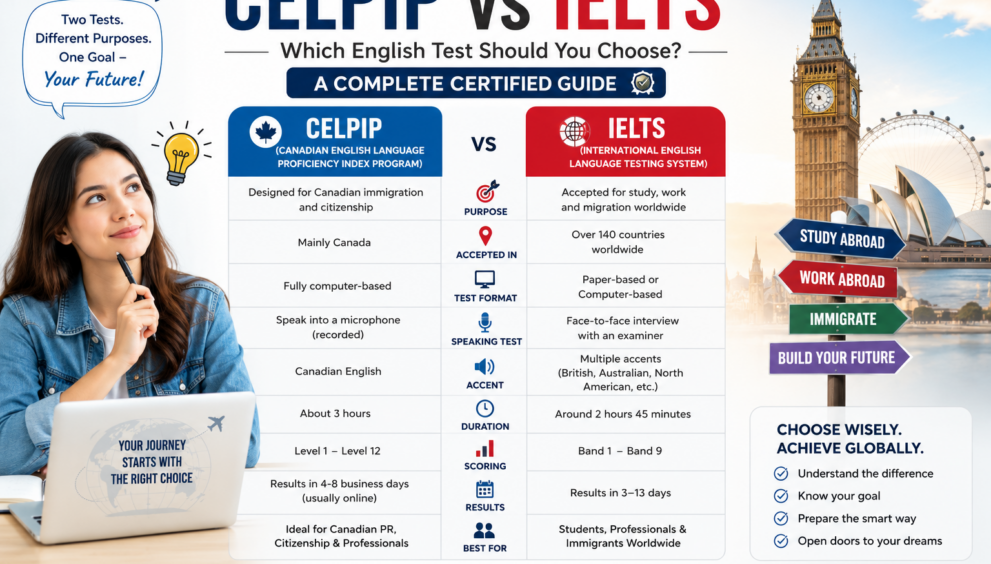
| Feature | CELPIP | IELTS |
|---|---|---|
| Primary Purpose | Canadian immigration and citizenship | Study, work, migration, and professional registration |
| Accepted In | Mainly Canada | Worldwide |
| Test Format | Fully computer-based | Paper-based or computer-based (depending on location) |
| Speaking Test | Recorded on a computer | Face-to-face interview with an examiner |
| Accent | Canadian English | Multiple English accents (British, Australian, North American, etc.) |
| Test Duration | About 3 hours | Around 2 hours 45 minutes |
| Writing | Computer typed | Typed (computer) or handwritten (paper version) |
| Reading | Computer-based | Paper or computer-based |
| Listening | Canadian English focus | Multiple international accents |
Test Structure
CELPIP
The CELPIP-General exam consists of four sections:
Listening
Tests your ability to understand spoken English in everyday Canadian contexts.
Reading
Assesses your ability to understand emails, articles, advertisements, and informational texts.
Writing
Includes practical writing tasks such as emails and survey responses.
Speaking
Candidates respond to prompts by speaking into a computer microphone.
IELTS
IELTS also assesses four language skills:
Listening
Features conversations and monologues using a variety of English accents.
Reading
Includes academic or general texts depending on the test type.
Writing
Requires essay writing and task-based responses.
Speaking
A live interview with a certified IELTS examiner, including a discussion and a short speech on a given topic.
CELPIP scores range from Level 1 to Level 12.
Scoring System
CELPIP
Higher levels indicate greater English proficiency.
IELTS
IELTS uses the internationally recognized Band Score system ranging from Band 1 to Band 9.
Most universities require Band 6.0 to 7.5, while immigration requirements vary depending on the program and country.
- Plan to study abroad.
- Want worldwide acceptance.
- Need a test accepted by universities and employers globally.
- Prefer interacting with a human examiner during the speaking test.
Which Test is Easier?
The answer depends on your strengths.
Choose CELPIP if you:
- Plan to immigrate to Canada.
- Prefer a fully computer-based test.
- Feel more comfortable speaking into a microphone than to an examiner.
- Are familiar with Canadian English.
Choose IELTS if you:
Neither test is universally easier—success depends on preparation and familiarity with the exam format.
Advantages of CELPIP
- Fully computer-delivered.
- Canadian-focused content.
- Single sitting with no separate speaking interview.
- Quick online score access.
- Ideal for Canadian immigration applicants.
Advantages of IELTS
- Accepted globally.
- Required by thousands of universities.
- Suitable for study, work, and migration.
- Widely recognized by professional councils.
- Offers both paper-based and computer-based options.
Preparation Tips
No matter which exam you choose:
- Practice English daily through reading, listening, speaking, and writing.
- Familiarize yourself with the official test format.
- Take full-length mock tests under timed conditions.
- Build a strong vocabulary and improve grammar.
- Work on time management.
- Review your mistakes and focus on weak areas.
CELPIP is primarily accepted for Canadian immigration, citizenship, and some professional purposes within Canada. It is not as widely accepted internationally as IELTS.
Frequently Asked Questions (FAQs)
Is CELPIP accepted outside Canada?
Is IELTS accepted in Canada?
Yes. IELTS is accepted by Canadian immigration authorities, educational institutions, employers, and professional organizations.
Can I use CELPIP to study in the UK?
Generally, no. Most UK universities require IELTS or another internationally recognized English language test.
Which test should nursing students choose?
For students planning to study nursing in the UK, Australia, Ireland, or New Zealand, IELTS is typically the preferred choice because it is widely accepted by universities and nursing regulatory bodies. Those pursuing Canadian immigration pathways may find CELPIP more suitable, depending on the specific requirements.
Final Verdict
Both CELPIP and IELTS are respected English proficiency tests, but the right choice depends on your destination and purpose.
- Choose CELPIP if your goal is Canadian immigration or citizenship and you prefer a fully computer-based experience.
- Choose IELTS if you’re applying to universities, seeking professional registration, or planning to work or migrate to a variety of countries.
Before booking your test, always verify the language test accepted by your chosen university, employer, immigration program, or licensing authority. Selecting the correct exam from the start can save time, money, and unnecessary stress.
Prepare smart, practice consistently, and choose the test that aligns with your future goals. Your international journey begins with the right English language qualification.