


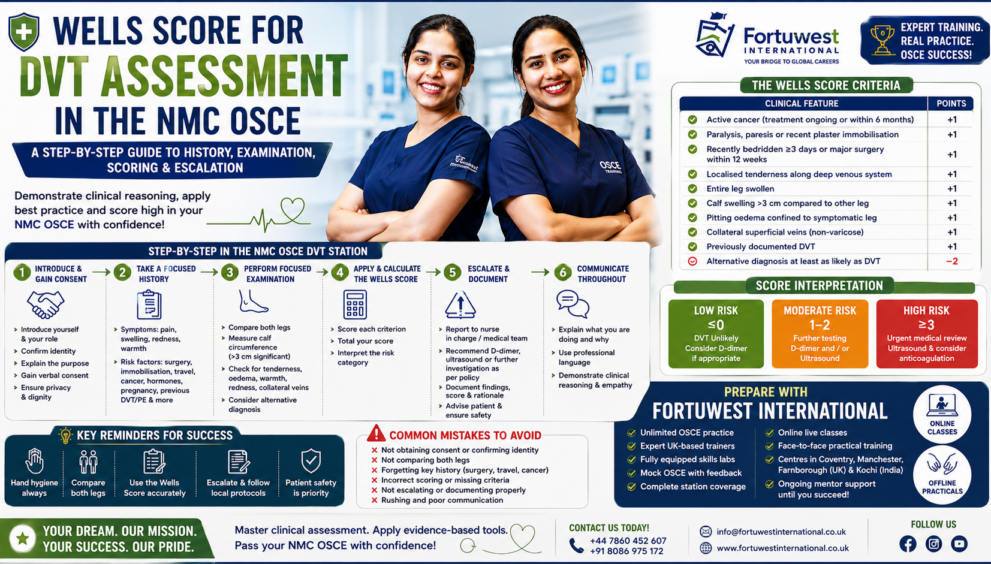
Deep Vein Thrombosis (DVT) is one of the clinical scenarios that internationally educated nurses are most likely to encounter in the NMC OSCE (Nursing and Midwifery Council Objective Structured Clinical Examination). Examiners want to see that you can systematically assess a patient’s risk, apply a validated clinical tool, and communicate your reasoning clearly — all within a tightly timed station.
The Wells Score (also called the Wells Criteria) is the standard bedside tool used across the UK NHS to estimate the pre-test probability of DVT. Knowing how to apply it confidently is essential for passing your OSCE and for safe clinical practice once you’re registered.
In this guide, we break down exactly how to assess DVT using the Wells Score, station by station, the way it’s expected to be demonstrated in the NMC OSCE.
What Is the Wells Score?
The Wells Score is a clinical prediction rule that helps nurses and clinicians estimate the likelihood that a patient’s signs and symptoms are due to a DVT, before any imaging (such as a Doppler ultrasound) is performed. It converts a set of clinical findings into a numerical score, which then places the patient into a low, moderate, or high probability category.
Using a structured tool like this — rather than relying on gut feeling — is exactly the kind of evidence-based, systematic practice the NMC OSCE is designed to test.
Step-by-Step: Assessing DVT Using the Wells Score in the OSCE
1. Introduce Yourself and Gain Consent
As with every NMC OSCE station, begin with:
- Full introduction (name and role)
- Confirming the patient’s identity (name and date of birth)
- Explaining the purpose of the assessment
- Gaining informed verbal consent
- Ensuring privacy and dignity
2. Take a Focused History
Before scoring, gather relevant history, including:
- Onset, location, and duration of leg pain or swelling
- Recent surgery, immobilisation, or long-haul travel
- History of previous DVT or pulmonary embolism (PE)
- Active cancer or cancer treatment within the last 6 months
- Use of hormonal contraception or hormone replacement therapy
- Family history of clotting disorders
3. Perform a Focused Physical Examination
Examine both legs and compare them, looking for:
- Swelling — measure calf circumference 10 cm below the tibial tuberosity; a difference of more than 3 cm between legs is significant
- Pitting oedema, confined to the symptomatic leg
- Localised tenderness along the deep venous system
- Collateral superficial veins (non-varicose)
- Skin changes — warmth, redness, or discolouration
- Signs of an alternative diagnosis (e.g., cellulitis, muscle strain, Baker’s cyst)
4. Apply the Wells Score Criteria
Score one point for each of the following present:
| Clinical Feature | Points |
|---|---|
| Active cancer (treatment ongoing or within 6 months) | +1 |
| Paralysis, paresis, or recent plaster immobilisation of the leg | +1 |
| Recently bedridden ≥3 days, or major surgery within 12 weeks | +1 |
| Localised tenderness along the deep venous system | +1 |
| Entire leg swollen | +1 |
| Calf swelling >3 cm compared to the asymptomatic leg | +1 |
| Pitting oedema confined to the symptomatic leg | +1 |
| Collateral superficial veins (non-varicose) | +1 |
| Previously documented DVT | +1 |
| Alternative diagnosis at least as likely as DVT | −2 |
5. Interpret the Score
- Score ≤0: Low probability of DVT
- Score 1–2: Moderate probability of DVT
- Score ≥3: High probability of DVT
In most NHS Trust protocols, this score is used alongside a D-dimer test and/or referral for Doppler ultrasound, depending on the probability category.
6. Escalate and Document
In the OSCE, examiners are looking for safe escalation, not just scoring. You should clearly state that you would:
- Report findings to the nurse in charge or medical team
- Recommend appropriate next steps (D-dimer, ultrasound, anticoagulation review) per local protocol
- Document the assessment, score, and rationale accurately in the patient’s notes
- Advise the patient not to massage the leg and to avoid prolonged standing while awaiting further assessment
7. Communicate Clearly Throughout
Examiners specifically mark on communication. Narrate what you’re doing and why as you go — for example: “I’m going to compare the circumference of both your calves, as swelling on one side can be an important sign we need to check.”This demonstrates clinical reasoning, not just task completion.
Common Mistakes Candidates Make
- Forgetting to compare both legs
- Failing to ask about recent surgery, travel, or cancer history
- Not verbalising the score or its clinical significance to the examiner
- Skipping safety-netting and escalation steps
- Rushing the station and missing consent or hand hygiene
Final Tips for OSCE Success
- Practise the Wells Score assessment as a full sequence, not isolated steps — timing matters
- Always link your findings back to patient safety and escalation
- Revise the score components until you can recall them without hesitation
- Use mock OSCE stations to build confidence under exam conditions
Prepare with Fortuwest International
Mastering high-stakes stations like DVT assessment takes structured practice, not just theory. Fortuwest Internationalsupports internationally educated nurses preparing for the NMC OSCE with focused clinical skills training, mock OSCE sessions, and expert guidance on scoring tools like the Wells Score — helping candidates build the confidence and precision examiners are looking for.
If you’re preparing for your NMC OSCE, structured, guided practice can make the difference between a near-miss and a pass. Reach out to Fortuwest International to find out how their OSCE preparation support can help you get exam-ready.
This article is for educational purposes and general OSCE preparation guidance. Always follow the current NMC OSCE circular and your local clinical protocols for the most up-to-date assessment criteria.