

Patient safety is at the heart of healthcare in the UK. Every nurse has a responsibility to protect patients, report concerns, and contribute to continuous improvement in the quality of care. Three essential components that support this are safeguarding, incident reporting, and clinical audit.
For international nurses preparing for the NMC CBT, OSCE, or a career in the NHS, understanding how these three areas work together is crucial. While they may appear to be separate topics, they form an interconnected system that helps healthcare professionals identify risks, respond effectively, and improve patient outcomes.
In this guide, we’ll explain each concept and why they matter in everyday UK nursing practice.
What Is Safeguarding?
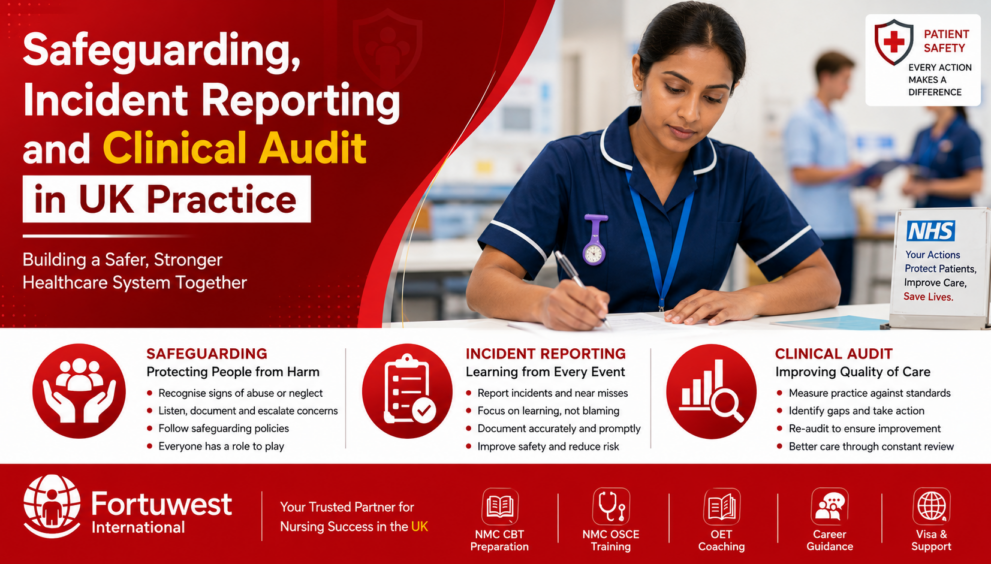
Safeguarding means protecting children and vulnerable adults from abuse, neglect, exploitation, or avoidable harm. It is both a legal and professional responsibility for every healthcare worker in the UK.
Safeguarding concerns may involve:
- Physical or emotional abuse
- Neglect or self-neglect
- Financial abuse
- Domestic violence
- Modern slavery
- Discriminatory abuse
As a nurse, you should:
- Recognise possible signs of abuse.
- Listen carefully to the patient.
- Document your observations accurately.
- Escalate concerns immediately through the appropriate safeguarding pathway.
- Follow your organisation’s safeguarding policy.
The NMC Code requires nurses to prioritise people, preserve safety, and act promptly whenever patient welfare is at risk.
What Is Incident Reporting?
Incident reporting is the formal process of recording events that caused, or could have caused, harm to patients, staff, or visitors.
Examples include:
- Medication errors
- Patient falls
- Pressure ulcers
- Equipment failure
- Documentation errors
- Infection control breaches
- Near misses
Many nurses worry that reporting incidents means blaming someone. In reality, the NHS promotes a learning culture, where reporting helps organisations identify system weaknesses, prevent future incidents, and improve patient safety.
Whenever an incident occurs, nurses should:
- Ensure the patient’s immediate safety.
- Inform the appropriate senior staff member.
- Document the event accurately.
- Complete the organisation’s incident reporting system according to local policy.
What Is Clinical Audit?
Clinical audit is a quality improvement process that compares current practice against recognised healthcare standards.
It helps answer one simple question:
“Are we providing care that meets the expected standard?”
Common clinical audits include:
- Hand hygiene
- Medication safety
- Pressure ulcer prevention
- Documentation quality
- NEWS2 observations
- Falls prevention
- Safeguarding documentation
Clinical audits help organisations identify gaps, introduce improvements, and measure whether those changes have been successful.
How They Work Together
Safeguarding, incident reporting, and clinical audit are closely connected.
For example, if a nurse notices signs of neglect in an elderly patient:
- The concern is raised through the safeguarding process.
- If harm has occurred, an incident report is completed.
- If similar incidents continue to occur, a clinical audit may be conducted to identify system failures and improve practice.
Together, these processes help healthcare organisations:
- Protect vulnerable patients
- Learn from mistakes
- Reduce future risks
- Improve the quality of care
The Nurse’s Role
Every nurse contributes to patient safety by:
- Identifying safeguarding concerns
- Reporting incidents and near misses
- Keeping clear and accurate documentation
- Escalating concerns promptly
- Following the NMC Code
- Participating in quality improvement activities
Good documentation is essential because it supports safeguarding investigations, incident reviews, legal processes, and clinical audits.
Why This Matters for NMC CBT and OSCE
Questions on safeguarding, incident reporting, and clinical audit frequently appear in the NMC CBT and are commonly assessed during the OSCE.
Examiners expect candidates to demonstrate that they can:
- Prioritise patient safety.
- Escalate concerns appropriately.
- Document accurately.
- Follow professional standards.
- Make safe clinical decisions.
Understanding these principles will help you succeed in your exams and prepare you for safe practice within the NHS.
How Fortuwest International Can Help
Preparing for UK nursing registration can feel overwhelming, but you don’t have to do it alone.
Fortuwest International provides comprehensive guidance for international nurses, including:
- NMC CBT preparation
- NMC OSCE guidance
- OET coaching
- UK nursing career counselling
- Documentation assistance
- Visa support
- Admission and registration guidance
Our experienced team is committed to helping healthcare professionals achieve their dream of working in the UK with confidence and success.
Conclusion
Safeguarding, incident reporting, and clinical audit are fundamental to patient safety in the NHS. Together, they help healthcare professionals recognise risks, report concerns, improve systems, and deliver high-quality care.
For international nurses preparing for the NMC CBT, OSCE, and NHS employment, mastering these topics is essential for both examination success and professional practice.
With expert support from Fortuwest International, you can build the knowledge, confidence, and skills needed to excel in your UK nursing journey.
Frequently Asked Questions (FAQs)
1. What is safeguarding in UK healthcare?
Safeguarding protects children and vulnerable adults from abuse, neglect, exploitation, and avoidable harm.
2. Why is incident reporting important?
It helps healthcare organisations learn from mistakes, prevent future incidents, and improve patient safety.
3. What is a clinical audit?
A clinical audit compares healthcare practice against recognised standards to improve the quality of patient care.
4. Do nurses report near misses?
Yes. Near misses should be reported because they identify risks before serious harm occurs.
5. How can Fortuwest International help?
Fortuwest International provides expert guidance for NMC CBT, OSCE, OET, UK nursing registration, visa support, and career counselling to help international nurses build successful NHS careers.