

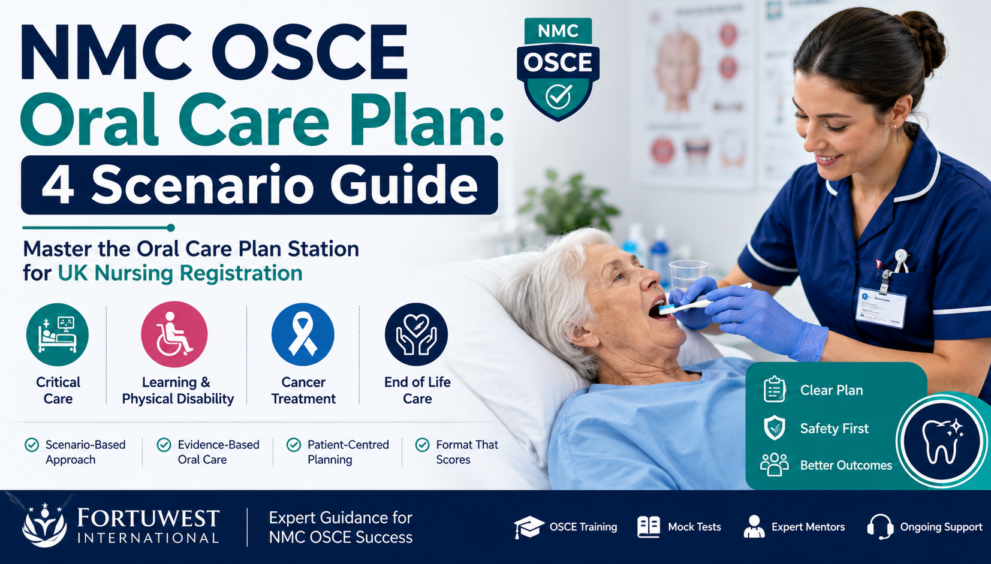
Preparing for the NMC Objective Structured Clinical Examination (OSCE) can be challenging, especially when it comes to the Oral Care Plan Station. Many international nurses underestimate this station because it appears straightforward. However, the key to scoring well is not simply knowing basic oral hygiene—it is demonstrating that you can create a safe, patient-centred, and scenario-specific care plan.
In this guide, we’ll explain what the OSCE Oral Care Plan Station involves, the four common patient scenarios you should prepare for, and how Fortuwest International can help you succeed in your UK nursing journey.
What Is the NMC OSCE Oral Care Plan Station?
The Oral Care Plan Station is one of the silent stations in the NMC OSCE. During this station, candidates are given a patient scenario and asked to write an appropriate oral care plan.
Examiners assess your ability to:
- Identify the patient’s oral health needs.
- Recognise potential risks.
- Plan evidence-based nursing interventions.
- Document care clearly and professionally.
- Deliver patient-centred care.
Remember, every patient is different. A generic oral care plan may lose valuable marks. Your interventions should always match the patient’s condition.
A Simple Structure for Success
To avoid missing important points during the exam, follow this easy structure:
- Oral cleaning
- Moisture and hydration
- Pain and comfort management
- Safety and risk prevention
- Support patient independence
- Reassessment and documentation
This simple approach helps you organise your answer under exam pressure.
Scenario 1: Critical Care Patient
Critically ill patients often have reduced consciousness, endotracheal tubes, or difficulty swallowing, increasing the risk of infection and aspiration.
Your care plan should include:
- Gentle oral cleaning with a soft toothbrush.
- Regular mouth moisturising.
- Lip care to prevent dryness.
- Suctioning when required.
- Aspiration prevention measures.
- Regular reassessment of oral health.
The focus should always be on maintaining oral hygiene while protecting the patient’s airway.
Scenario 2: Learning or Physical Disability
This scenario assesses your ability to provide person-centred care while promoting dignity and independence.
Consider including:
- Assisted or supervised tooth brushing.
- Adaptive equipment where appropriate.
- Encouraging self-care whenever possible.
- Mouth hydration.
- Lip care.
- Skin protection if drooling is present.
Supporting independence is just as important as providing care.
Scenario 3: Cancer Treatment
Patients receiving chemotherapy or radiotherapy may experience:
- Mouth ulcers
- Dry mouth
- Oral pain
- Difficulty eating or drinking
A suitable care plan may include:
- Gentle oral hygiene using a soft toothbrush.
- Regular hydration.
- Oral moisturisers.
- Artificial saliva if required.
- Lip balm.
- Pain management before oral care.
- Frequent reassessment.
Comfort should always be your priority.
Scenario 4: End-of-Life Care
At the end of life, oral care focuses on comfort rather than treatment.
Your care plan should include:
- Gentle mouth cleansing.
- Moistening the mouth regularly.
- Cleaning dentures where applicable.
- Lip moisturising.
- Supporting comfort and dignity.
- Frequent reassessment according to the patient’s condition.
Small comfort measures can significantly improve a patient’s quality of life.
Common Mistakes to Avoid
Many candidates lose marks by making simple mistakes, such as:
- Writing the same care plan for every patient.
- Forgetting reassessment.
- Ignoring patient comfort.
- Missing aspiration risks.
- Forgetting denture care.
- Overlooking patient independence.
- Poor organisation or unclear documentation.
Taking a few seconds to understand the scenario before writing can make a significant difference.
Quick Memory Tip
During the exam, remember this simple sequence:
Clean → Moisturise → Protect → Comfort → Support → Review
Using this method will help you write a complete and structured oral care plan for almost every OSCE scenario.
How Fortuwest International Can Help You Prepare
Success in the NMC OSCE requires more than memorising answers—it requires understanding how to apply clinical knowledge to different patient situations.
Fortuwest International offers expert guidance for international nurses preparing for UK nursing registration.
Our support includes:
- NMC OSCE Training
- Scenario-Based Practice Sessions
- Mock OSCE Assessments
- CBT Preparation
- OET Preparation
- One-to-One Mentoring
- Interview Preparation
- Professional NHS CV Preparation
Our experienced trainers help candidates build confidence, improve clinical reasoning, and develop effective exam techniques to maximise their chances of success.
Final Thoughts
The NMC OSCE Oral Care Plan Station is an opportunity to demonstrate your clinical judgement, communication skills, and patient-centred approach. By understanding the patient’s condition, adapting your care plan, and documenting clearly, you can significantly improve your OSCE performance.
If you’re preparing for your UK nursing career, let Fortuwest International guide you every step of the way. From OSCE and CBT preparation to NHS CV writing and interview coaching, our expert team is dedicated to helping international nurses achieve their dream of working in the UK.
Start your journey with Fortuwest International today and take one step closer to your NHS career.