

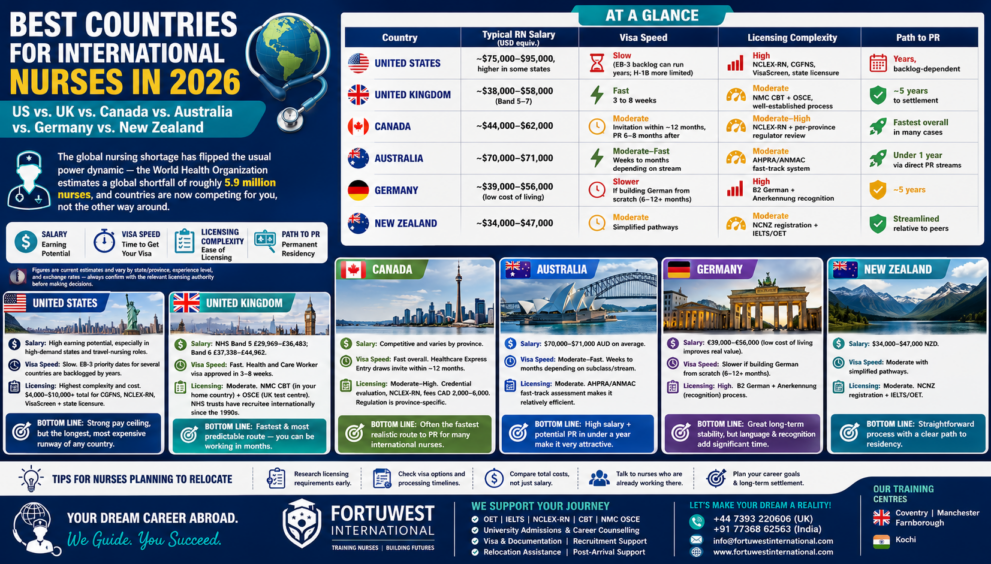
The global nursing shortage has flipped the usual power dynamic — the World Health Organization estimates a global shortfall of roughly 5.9 million nurses, and countries are now competing for you, not the other way around. But “in demand” doesn’t mean “easy to get to.” Salary, visa speed, and licensing complexity vary enormously by country, and the destination with the biggest paycheck isn’t always the one that gets you working the fastest. Here’s how the six most active recruiting countries actually compare.
At a Glance
| Country | Typical RN Salary (USD equiv.) | Visa Speed | Licensing Complexity | Path to PR |
|---|---|---|---|---|
| United States | ~$75,000–$95,000, higher in some states | Slow (EB-3 backlog can run years; H-1B more limited) | High — NCLEX-RN, CGFNS, VisaScreen, state licensure | Years, backlog-dependent |
| United Kingdom | ~$38,000–$58,000 (Band 5–7) | Fast — 3 to 8 weeks | Moderate — NMC CBT + OSCE, well-established process | ~5 years to settlement |
| Canada | ~$44,000–$62,000 | Moderate — invitation within ~12 months, PR 6–8 months after | Moderate-high — NCLEX-RN + per-province regulator review | Fastest overall in many cases |
| Australia | ~$70,000–$71,000 | Moderate-fast — weeks to months depending on stream | Moderate — AHPRA/ANMAC fast-track system | Under 1 year via direct PR streams |
| Germany | ~$39,000–$56,000 (low cost of living) | Slower if building German from scratch (6–12+ months) | High — B2 German + Anerkennung recognition process | ~5 years |
| New Zealand | ~$34,000–$47,000 | Moderate — simplified pathways | Moderate — NCNZ registration + IELTS/OET | Streamlined relative to peers |
Figures are current estimates and vary by state/province, experience level, and exchange rates — always confirm with the relevant licensing authority before making decisions.
United States
Salary: The U.S. remains one of the higher-paying options on paper, with hospitals directly sponsoring international nurses under the EB-3 category and travel-nursing roles in high-demand states like Texas paying particularly well.
Visa speed: This is the U.S.’s biggest drawback. As covered in our Visa Bulletin series, EB-3 priority dates for several countries — India especially — are backlogged by years, not months. Candidates must also clear the CGFNS exam and assemble a full documentation package including transcripts and recommendation letters</cite> before licensing even begins.
Licensing complexity: The heaviest of the six. Total costs typically run $4,000–$10,000 covering CGFNS credential evaluation, NCLEX-RN, and VisaScreen certification, on top of state-by-state licensure differences once you arrive.
Bottom line: Strong pay ceiling, but plan for the longest and most expensive runway of any country on this list — especially if you’re from a backlogged country.
United Kingdom
Salary: Lower than the U.S. on paper — NHS Band 5 newly qualified RN pay runs roughly £29,969–£36,483, rising to £37,338–£44,962 at Band 6 — but paired with NHS pension, paid leave, and public healthcare that raise the real value of the package.
Visa speed: The fastest of the six. The UK’s Health and Care Worker visa is typically approved in 3 to 8 weeks, and reduced visa fees plus exemption from the Immigration Health Surcharge lower the upfront cost further.
Licensing complexity: Moderate and well-trodden. The NMC process involves a Computer-Based Test that can be taken in your home country, followed by an in-person OSCE at a UK test centre — structured, predictable, and supported by NHS trusts that have been recruiting internationally since the 1990s and often run dedicated international recruitment teams.
Bottom line: If speed and process predictability matter most to you, the UK is hard to beat — you can realistically be working within a couple of months of a job offer.
Canada
Salary: Competitive and province-dependent, generally in the same range as UK pay once cost of living is factored in.
Visa speed: Healthcare-specific Express Entry draws mean candidates with competitive CRS scores are typically invited within 12 months of entering the pool, and Canada’s dedicated healthcare draws have accepted CRS scores as low as 438, noticeably lower than general Express Entry cutoffs. A newer Home Support Worker pilot route also lets qualifying candidates bring their whole family to PR status simultaneously.
Licensing complexity: The catch is regulatory fragmentation — credential evaluation, NCLEX-RN, and immigration fees typically run CAD 2,000–6,000, and because nursing regulation is province-specific</cite>, your registration process depends heavily on where you land, adding a layer of complexity the UK and Australia don’t have.
Bottom line: Often the fastest realistic route to permanent residency of any country here, especially through the specialized healthcare and caregiver pilot streams — but expect provincial variability in the licensing details.
Australia
Salary: Nurses in Australia can earn up to roughly $71,000 on average, with strong demand backed by structural need — the country faces a projected shortfall of about 70,000 nurses by 2035.
Visa speed: Skills in Demand visa processing has run 20–30% faster since a February 2026 shift to digital filing and tighter occupation targeting, with Core Skills stream applications often resolved within 30 to 75 days depending on percentile.Combined with the Skilled Migration Program, nurses can transition to permanent residency in under a year in many cases.
Licensing complexity: Moderate. AHPRA runs a dedicated fast-track recognition system for nurses and allied health workers, and Australia has an established track record actively recruiting from the UK, India, and the Philippines with a clear pathway to permanent residency once registered.
Bottom line: A strong all-rounder — solid pay, genuinely fast-moving visa processing in 2026, and a streamlined registration system, provided you meet the typical one-year-experience expectation many employers look for.
Germany
Salary: The lowest headline number of the six — average salaries run roughly €36,000 to €48,000 (about $39,000–$52,000) — but Germany’s lower cost of living and strong job security narrow the real-world gap considerably.
Visa speed: Highly dependent on your starting German level. Germany’s timeline can stretch well beyond other countries if you’re building language skills from scratch, though bilateral agreements with India and the Philippines are designed to accelerate recruitment specifically for nurses from those countries.
Licensing complexity: The most language-dependent pathway here. The Anerkennung recognition process requires B2-level German, and Germany offers free language training as part of its active recruitment push— a real benefit, but one that still adds months to your timeline compared to English-speaking destinations.
Bottom line: Best suited to nurses willing to invest in German language training upfront in exchange for strong job security, funded language support, and a genuinely welcoming recruitment environment — Germany currently needs over 100,000 nurses, predominantly in elder care.
New Zealand
Salary: Average pay runs roughly NZD 55,000–75,000— modest by U.S. or Australian standards, but paired with a genuinely simplified immigration process.
Visa speed: New Zealand has streamlined its immigration pathways specifically for nurses, making it one of the more approachable options for nurses who want a shorter, less bureaucratic process even if the paycheck is smaller.
Licensing complexity:Registration runs through the Nursing Council of New Zealand, with IELTS or OET required — a familiar structure for anyone who has already prepared for UK or Australian English-language requirements.
Bottom line: A strong option if lifestyle and process simplicity matter more to you than maximizing salary — and a natural pairing for nurses who’ve already sat IELTS or OET for another English-speaking destination.
Which Country Actually Fits You?
- Want the fastest visa process, period? The UK’s 3–8 week Health and Care Worker visa timeline is unmatched among these six.
- Want the fastest realistic route to permanent residency? Canada’s healthcare-specific Express Entry draws and pilot programs currently outperform the rest.
- Want the highest ceiling on pay and willing to wait? The U.S. still offers strong compensation, but only if you can absorb a multi-year EB-3 backlog — check your country’s current priority date in our Visa Bulletin series before committing to this path.
- Want a genuine all-rounder? Australia currently balances speed, pay, and licensing simplicity better than most, backed by real structural demand through 2035.
- Willing to invest in a new language for long-term security? Germany’s funded language training and pressing elder-care shortage make it worth serious consideration.
- Prioritizing lifestyle and a simple process over maximizing salary? New Zealand offers the most straightforward pathway on this list.
No country here is objectively “best” — the right choice depends on how you weigh speed against salary against how much bureaucracy you’re willing to navigate. Whichever direction you’re leaning, start your licensing and language prep as early as possible: in every one of these six countries, preparation time — not job availability — is what actually determines how soon you’re working.