

Ask an internationally educated nurse which country’s licensing system frustrated them most, and you’ll often hear the same complaint about the US: it isn’t one system, it’s fifty-plus overlapping ones. Compare that to Australia, where a single national body handles every nurse in every state, and the contrast tells you a lot about why some countries feel dramatically more navigable than others — even when the clinical standards being tested are similar.
How the US System Actually Works
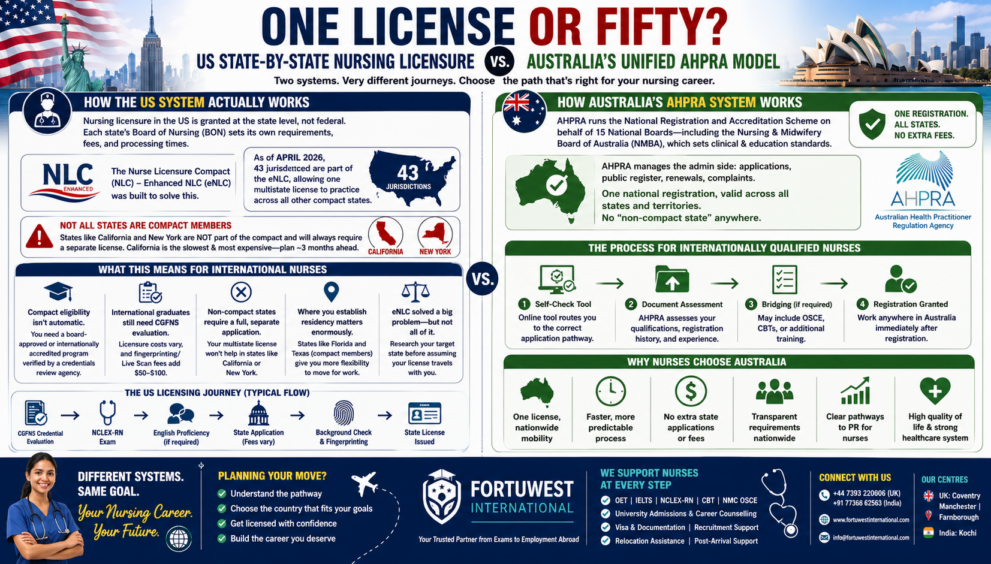
Nursing licensure in the US is granted at the state level, not the federal level. Each state’s Board of Nursing (BON) sets its own requirements, fees, and processing times, which historically meant a license from one state carried zero weight in the next.
The Nurse Licensure Compact (NLC) — and its updated version, the Enhanced NLC (eNLC) — was built to fix exactly this problem. As of April 2026, 43 jurisdictions are part of the eNLC (Nurse.org, “Compact Nursing States List 2026”), allowing a nurse whose primary state of residence is a compact member to hold one multistate license and practise across every other compact state without paying for a separate application, a new license fee, or waiting out a separate approval period in each one (Prolink, “Nursing Compact States in 2026”).
That sounds like a unified system — until you look at who’s missing. States like California and New York are not part of the compact and will always require a separate, individually issued license, regardless of where a nurse is licensed elsewhere, and California in particular is flagged as the slowest and most expensive state to get licensed in, with applicants advised to plan roughly three months ahead (CATSOL, “41 Nursing Compact States 2026”).
What this means for international nurses specifically:
- Compact eligibility isn’t automatic just because you’re licensed somewhere. Uniform eNLC requirements include graduating from a board-approved program or an internationally accredited program verified by an independent credentials review agency, and passing an English proficiency exam if your program wasn’t taught in English or English isn’t your native language (Nursa, “Nursing Licensure Compact States in 2026”).
- International graduates still need CGFNS evaluation on top of standard licensure costs, and fingerprinting or Live Scan fees typically add another $50–$100 beyond the application itself (CATSOL).
- If your first US job is in a non-compact state like California or New York, your multistate license from elsewhere won’t help you — you’re back to a full, separate state application.
- Where you choose to establish residency matters enormously. States like Florida and Texas are often recommended specifically because they’re compact members (CATSOL), giving nurses far more flexibility to relocate for work later without repeating the licensing process.
In short: the eNLC has meaningfully reduced the “fifty separate systems” problem, but it hasn’t eliminated it. You still need to research your specific target state before assuming your license travels with you.
How Australia’s AHPRA System Works
Australia takes the opposite approach entirely. The Australian Health Practitioner Regulation Agency (AHPRA) runs the National Registration and Accreditation Scheme on behalf of 15 National Boards (Australian Visa Online, “AHPRA Registration for Migration 2026 Guide”) — including the Nursing and Midwifery Board of Australia (NMBA), which sets the actual clinical and educational standards nurses must meet. AHPRA itself handles the administrative side: applications, the public register, renewals, and complaints (Australian Visa Online).
The key structural difference: AHPRA operates one national registration system, valid across all states and territories, with no equivalent of a “non-compact state” anywhere in the country (OneDoorway International, “AHPRA Registration for Indian Nurses: 2026 Guide”). Once you’re registered, you can legally work as a registered nurse in Perth, Sydney, or a rural clinic in Queensland without a single additional application or fee.
The process for internationally qualified nurses:
- Your specific application pathway depends on where you trained, where you’ve practised, and your professional experience (TalentQuarter, “Your Complete Guide to AHPRA Registration in 2026”) — AHPRA runs an online Self-check tool to route you correctly before you spend money on exams you might not need.
- Nurses from what AHPRA calls “comparable jurisdictions” — currently the UK, Ireland, the US, British Columbia and Ontario in Canada, Singapore, and Spain — may qualify for a streamlined pathway (The Nursing Central, “AHPRA Registration for Nurses 2026: A Step-by-Step Guide”), provided they meet experience thresholds.
- That threshold is generally at least 1,800 hours of recent practice as a registered nurse (The Nursing Central), on top of clean registration history and other standard requirements.
- A significant 2026 update: nurses who meet the 1,800-hour threshold from a comparable jurisdiction can now skip both the OSCE and NCLEX-style theory exam entirely (BJay Education & Visa Services, “AHPRA Registration 2026 Guide”) under an expedited pathway introduced this year, following an April 2025 overhaul of Internationally Qualified Registered Nurse assessment following the Kruk Review (Global Nurse Guide, “The 2026 Guide to AHPRA’s Streamlined Nursing Registration”).
- Nurses who don’t meet that experience bar are routed to the standard assessment stream, which does require sitting the theory exam and OSCE.
Cost and timeline: The AHPRA skills assessment and registration fee for overseas-qualified nurses runs around AUD 805 (OneDoorway International), with a complete skills assessment typically taking 6 to 8 months — and importantly, this must be finished before you can even lodge a visa expression of interest (OneDoorway International). Applicants who need a full bridging program, common for older or non-Bachelor qualifications, should expect it to run 12 to 18 months at an accredited university (OneDoorway International).
Side-by-Side: What Actually Differs
| United States | Australia | |
|---|---|---|
| Regulatory structure | 50+ state boards, partially unified via eNLC | Single national body (AHPRA) across all states/territories |
| Portability once licensed | Full portability only within eNLC’s 43 compact jurisdictions | Full portability everywhere, no exceptions |
| Key non-compact/gap states | California, New York, and others require separate licensure | None — the system has no equivalent gap |
| Fast-track for experienced international nurses | No national equivalent; varies by state | Expedited 2026 pathway skips OSCE/NCLEX for 1,800+ hours from comparable jurisdictions |
| Typical cost (international applicant) | $4,000–$10,000 across CGFNS, NCLEX, VisaScreen, and state fees | ~AUD 805 for the AHPRA assessment itself, plus English testing and any bridging program |
| Where you live matters | Significantly — determines your compact status and application difficulty | Not at all — registration is identical nationwide |
What This Means for Your Planning
If you’re weighing the US, the practical lesson isn’t “avoid it” — it’s “pick your first state deliberately.” A nurse who establishes primary residency in a compact state can move around the country later with minimal friction. A nurse who lands in California or New York first, often because that’s where the job offer happened to be, takes on a slower and more expensive path with less flexibility to relocate afterward.
If you’re weighing Australia, the system removes that geographic gamble entirely — but it replaces it with an experience-hours gamble instead. Nurses just under the 1,800-hour comparable-jurisdiction threshold, or from a country not currently on AHPRA’s comparable-jurisdiction list, still face the full assessment pathway, OSCE included.
Neither system is simply “easier.” The US rewards nurses who research state-level compact status before committing to a location. Australia rewards nurses who can document extensive, recent, verifiable practice hours from a small list of recognized countries. Know which lever you’re actually pulling before you commit to either path.