


By Fortu West International
3 minutes read
Introduction
Success in the OET Writing sub-test depends not only on your English skills but also on your ability to interpret medical case notes accurately. One symbol that often confuses candidates is the question mark (?). Misunderstanding this symbol can lead to inaccurate statements in your referral, discharge, or transfer letter.
In this guide, Fortu West International explains what the question mark means in OET case notes and shares five practical strategies to help you write clear, professional, and accurate letters.
What Does the Question Mark (?) Mean?
In OET Writing, a question mark (?) usually indicates that a diagnosis, condition, or treatment has not yet been confirmed. It suggests that the healthcare professional suspects a condition but requires further assessment, investigations, or specialist review before making a definitive diagnosis.
Your writing should reflect this uncertainty. Avoid presenting a suspected condition as if it has already been confirmed.
Where Can You Find the Question Mark?
The question mark may appear in different sections of the case notes, including:
- Admission diagnosis
- Presenting complaint
- Assessment
- Treatment or management plan
- Referral recommendations
Always consider the surrounding information before deciding how to express it in your letter.
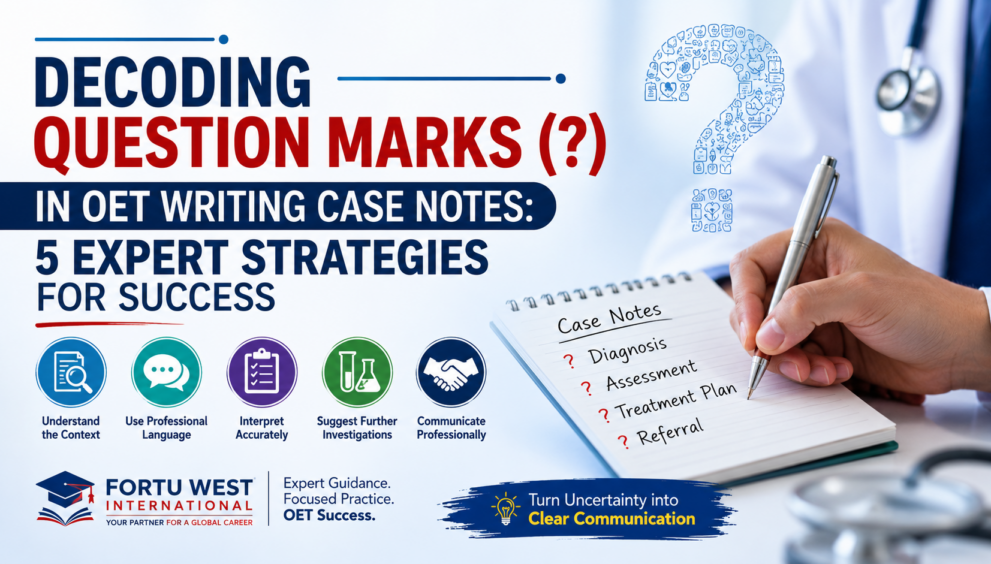
5 Expert Strategies for Handling Question Marks
1. Recognize That It Indicates Uncertainty
Remember that ? means “possible,” “suspected,” or “provisional.” Never describe it as a confirmed diagnosis.
Example:
Case Note:
Diagnosis: ? Acute Pancreatitis
Appropriate Sentence:
A provisional diagnosis of acute pancreatitis has been considered, and further investigations are being undertaken.
2. Use Professional Medical Language
Choose formal expressions that communicate uncertainty appropriately.
Useful phrases include:
- There is a suspicion of…
- A provisional diagnosis of…
- The symptoms are suggestive of…
- It is possible that…
- Further investigations are required to confirm…
- The patient is being assessed for…
These phrases demonstrate professional communication expected in OET.
3. Let the Context Guide Your Writing
Do not translate the question mark literally. Read the entire case note to understand why the diagnosis is being considered.
Example:
Case Note:
Assessment: ? Bronchial Asthma
Sentence:
The patient’s symptoms are suggestive of bronchial asthma, and further assessment is planned to confirm the diagnosis.
4. Avoid Overstating the Diagnosis
One of the most common mistakes is writing:
❌ The patient has pulmonary embolism.
Instead, write:
✅ Pulmonary embolism is currently being considered as a possible diagnosis.
This demonstrates accurate interpretation of the case notes.
5. Link the Suspicion to the Next Step
Whenever possible, mention the investigation or referral that follows the suspected diagnosis.
Example:
Case Note:
? Pulmonary Embolism
Plan: CT Pulmonary Angiogram
Sentence:
A provisional diagnosis of pulmonary embolism is being considered, and a CT pulmonary angiogram has been arranged for further evaluation.
Practice Examples
Example 1
Case Note
Complaint: Fever, fatigue, headache
Assessment: ? Infectious Mononucleosis
Possible OET Sentence
The patient’s symptoms raise the possibility of infectious mononucleosis, and further clinical assessment is recommended.
Example 2
Case Note
Diagnosis: ? Diabetic Ketoacidosis
Possible OET Sentence
A provisional diagnosis of diabetic ketoacidosis is being considered based on the presenting symptoms, with further investigations planned to confirm the condition.
Example 3
Case Note
Treatment Plan: ? Referral to Dietitian
Possible OET Sentence
A referral to a dietitian is being considered to provide dietary assessment and appropriate nutritional advice.
Common Mistakes to Avoid
- Writing a suspected diagnosis as confirmed.
- Ignoring the question mark completely.
- Using informal language.
- Making assumptions not supported by the case notes.
- Omitting planned investigations or referrals.
Conclusion
Understanding the meaning of the question mark (?) is an essential skill for achieving a high score in the OET Writing sub-test. It reminds you to communicate medical uncertainty accurately while maintaining a professional tone. By using appropriate expressions and carefully interpreting the context, you can produce referral letters that meet OET standards.
At Fortu West International, we help healthcare professionals master every aspect of the OET exam through expert guidance, realistic practice materials, and personalized feedback. With consistent practice and the right strategies, you can approach your OET Writing test with confidence and improve your chances of success.
Join Fortu West International’s OET preparation program today and take the next step toward your international healthcare career.