


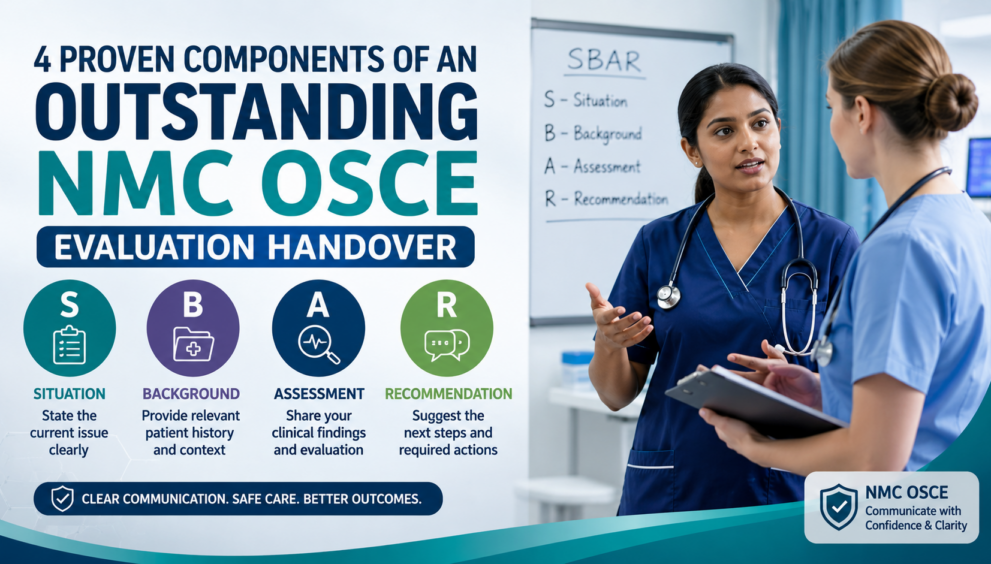
The NMC OSCE evaluation handover station is an important opportunity to demonstrate how effectively you can communicate clinical information. In this station, candidates are expected to organise patient information, identify important changes in the patient’s condition, and communicate their findings professionally.
The evaluation station lasts 8 minutes, so managing your time and presenting information in a structured way is essential.
One of the most useful frameworks for organising a nursing handover is SBAR:
- S – Situation
- B – Background
- A – Assessment
- R – Recommendation
Using SBAR helps you avoid giving unnecessary information while ensuring that important clinical details are not missed.
For NMC OSCE candidates, the goal is not simply to remember four letters. You need to understand what information belongs under each section and how to communicate it confidently.
What Is SBAR in NMC OSCE?
SBAR is a structured communication method used by healthcare professionals to communicate important patient information.
It provides a logical sequence for a handover:
Situation → Background → Assessment → Recommendation
SBAR can be useful when communicating with doctors, nurses, dietitians, tissue viability specialists and other members of the multidisciplinary team.
In an NMC OSCE scenario, it can help you demonstrate:
- Professional communication
- Clinical prioritisation
- Patient safety awareness
- Appropriate escalation
- Clinical reasoning
- Teamwork and accountability
The most important principle is relevance. You do not need to repeat every piece of information from the scenario. Select the information that the receiving professional needs to know.
1. S – Situation: Explain What Is Happening Now
The Situation is the opening section of your handover. It should immediately explain who you are, which patient you are discussing and why you are handing over the patient.
Keep this section brief and focused.
What Should You Include?
Depending on the scenario, relevant information may include:
- Your name and professional role
- Your department or clinical area
- Patient’s name
- Relevant patient identifiers
- Reason for admission or visit
- Current reason for the handover
- Any immediate concern
For example:
“Hello, my name is Jenny and I am the registered nurse working in the surgical unit. I am handing over Mr John Smith, who was admitted following hernia surgery. I am concerned about changes in his latest observations and would like to discuss his current condition.”
The exact wording will depend on your scenario.
Why Is Situation Important?
A strong opening allows the receiving professional to understand the purpose of your communication immediately.
Avoid spending too much time describing the patient’s history before explaining the current concern.
Common Mistakes
Candidates may:
- Take too long to explain the situation
- Give unnecessary background information
- Forget to identify the patient
- Delay explaining the reason for escalation
- Speak without a clear structure
NMC OSCE Tip
Lead with the reason for your handover. If the patient has deteriorated, make that concern clear rather than hiding it among less important information.
2. B – Background: Give Relevant Clinical Context
The Background section provides information that helps the receiving professional understand the patient’s current situation.
However, background does not mean everything you know about the patient.
Only include information that is relevant to the current problem and handover.
Information That May Be Relevant
Depending on the scenario, you may need to discuss:
- Reason for admission
- Current diagnosis
- Relevant medical history
- Previous treatment
- Regular medications
- Allergies and reactions
- Relevant social circumstances
- Factors affecting activities of daily living
- Important risks associated with the patient’s condition
For example, if a patient is being handed over because of a wound concern, information about diabetes may be relevant because it can affect wound healing.
Similarly, an allergy may be particularly important if medication or treatment is being considered.
Avoid Information Overload
One of the biggest challenges in an OSCE handover is deciding what to leave out.
Ask yourself:
“Does the receiving professional need this information to understand or manage the current problem?”
If the answer is no, it may not need to be included.
NMC OSCE Tip
Before beginning your verbal handover, quickly identify the three or four most relevant background points from the scenario.
This will help you remain concise while demonstrating safe clinical communication.
3. A – Assessment: Explain Your Findings and Clinical Concerns
Assessment is often one of the most important sections of the handover because it demonstrates your ability to recognise and communicate changes in the patient’s condition.
Here, you should explain what you have assessed and what has changed.
What Can Be Included?
Depending on the scenario, relevant assessment information may include:
- Latest vital signs
- Previous or baseline observations
- NEWS2 score where applicable
- Pain score
- Relevant assessment tools
- Blood glucose results
- Wound assessment
- Medication administered
- Patient-reported symptoms
- Health education provided
- Referrals already made
- Changes in the patient’s condition
A particularly useful approach is to compare previous findings with current findings.
For example:
“Initially, the patient’s temperature was 37.8°C, respiratory rate was 18 breaths per minute and blood pressure was 130/90 mmHg. His NEWS2 score was 0. Following surgery, his latest temperature is 38.4°C, respiratory rate is 22 breaths per minute and blood pressure is 108/59 mmHg. His observations have therefore changed from the initial assessment and require further review.”
The figures you use must always come from the specific OSCE scenario.
Objective and Subjective Information
Good assessment communication can include both types of information.
Objective information may include:
- Temperature
- Pulse
- Respiratory rate
- Blood pressure
- Oxygen saturation
- Blood glucose
- NEWS2 score
Subjective information may include:
- Pain
- Nausea
- Dizziness
- Breathlessness
- Fatigue
- Other symptoms reported by the patient
Combining these findings gives the receiving professional a clearer picture of the patient’s condition.
Don’t Forget Interventions
If relevant to your scenario, explain what you have already done.
For example:
- Medication administered
- Pain relief provided
- Wound assessed
- Patient repositioned
- Monitoring undertaken
- Health education provided
- Appropriate referral initiated
Then explain the patient’s response where appropriate.
NMC OSCE Tip
Don’t simply read out observations. Compare them and explain why the change matters.
This demonstrates that you are thinking clinically rather than simply listing numbers.
4. R – Recommendation: Clearly State What Needs to Happen Next
The final component of SBAR is Recommendation.
This is where you explain what you need from the receiving healthcare professional.
A handover should not simply end after describing the patient’s condition. The receiving professional should understand what action or review is required.
Depending on the Scenario, You May Recommend:
For a doctor:
- Patient review
- Review of abnormal observations
- Medication review
- Further investigations
- Additional treatment
- Appropriate referral
For a dietitian:
- Nutritional assessment
- Review of MUST score where applicable
- Development of an appropriate dietary plan
- Advice regarding nutritional requirements
- Consideration of relevant food allergies
For a tissue viability nurse:
- Wound review
- Appropriate dressing assessment
- Further wound management
- Wound swab where clinically indicated
- Review for signs of infection
- Patient and caregiver education
Your recommendation should always be based on the information in the scenario and within the scope of the professional receiving the handover.
Be Clear About Urgency
If the patient requires urgent attention, communicate this clearly.
Avoid vague endings such as:
“Please have a look when you get time.”
Instead, communicate the required level of urgency professionally and appropriately.
NMC OSCE Tip
Think:
“What do I want the receiving professional to do next?”
That question can help you formulate a clear Recommendation.
How SBAR Helps You in the NMC OSCE
Using SBAR provides a simple structure when you are under examination pressure.
It can help you:
Stay Organised
The four sections give you a logical order for presenting information.
Prioritise Important Details
You can focus on information that affects the patient’s care and safety.
Communicate More Confidently
A clear structure can reduce the chance of becoming confused during the handover.
Demonstrate Professional Practice
Structured communication reflects the importance of teamwork, accountability and patient safety in nursing.
How to Prepare for the 8-Minute Evaluation Station
Time management is particularly important in this station.
A practical approach is to use the beginning of the station to identify your key points before delivering your handover.
Step 1: Read the Scenario Carefully
Identify:
- Who the patient is
- Why the patient is receiving care
- What has changed
- Which information is relevant
- Who you are handing over to
Step 2: Organise Your Notes Using SBAR
Quickly divide your information into:
S – What is happening?
B – What background is relevant?
A – What have I found?
R – What needs to happen next?
Step 3: Compare Initial and Current Findings
Where the scenario provides previous and current observations, identify the important changes.
Pay particular attention to:
- Temperature
- Respiratory rate
- Blood pressure
- Pulse
- Oxygen saturation
- NEWS2
- Pain
- Other relevant assessment findings
Step 4: Practise Speaking, Not Just Writing
Reading SBAR notes silently is not enough.
Practise speaking your handover aloud. This helps you develop:
- Fluency
- Confidence
- Appropriate pace
- Professional tone
- Better time management
Step 5: Record Your Practice
Recording yourself can help you identify:
- Repeated information
- Unclear sentences
- Excessive pauses
- Missing recommendations
- Unnecessary details
Common SBAR Handover Mistakes to Avoid
Even when candidates know the SBAR framework, several common mistakes can affect their communication.
Giving Too Much Information
A long handover does not necessarily demonstrate better communication.
Focus on relevant information.
Missing Important Changes
If current observations differ significantly from the initial assessment, make sure the change is communicated clearly.
Forgetting Allergies
Where relevant, allergies and previous reactions are important patient-safety information.
Listing Numbers Without Interpretation
Don’t simply read observations. Explain relevant changes and their significance.
Ending Without a Recommendation
Make sure the receiving professional knows what action, review or follow-up you are requesting.
Speaking Too Quickly
Being concise does not mean rushing.
Speak clearly, professionally and at a pace that allows the receiving person to understand the information.
A Simple SBAR Memory Guide
When practising, remember these four questions:
S – What is happening now?
B – What does the professional need to know about the patient’s background?
A – What have I found and what has changed?
R – What needs to happen next?
If you can answer these four questions clearly, you have a strong foundation for your NMC OSCE handover.
Final Takeaway
The NMC OSCE evaluation handover is an opportunity to demonstrate more than your ability to remember clinical information. It allows you to show that you can prioritise, assess, communicate and escalate appropriately.
The four components of SBAR provide a practical structure:
- Situation – Clearly explain the immediate concern.
- Background – Provide relevant clinical context.
- Assessment – Communicate your findings and identify important changes.
- Recommendation – Clearly explain what should happen next.
Remember that effective handover is about relevant information, clear communication and patient safety, not simply speaking for a long time.
Practise different scenarios, compare initial and current findings, organise your notes using SBAR and become comfortable speaking your recommendations aloud.
With consistent preparation and structured practice, you can approach the NMC OSCE evaluation handover with greater confidence.
Fortuwest International supports aspiring international nurses with guidance and preparation resources for their healthcare career journey.