


By Fortu West International
3 minutes read
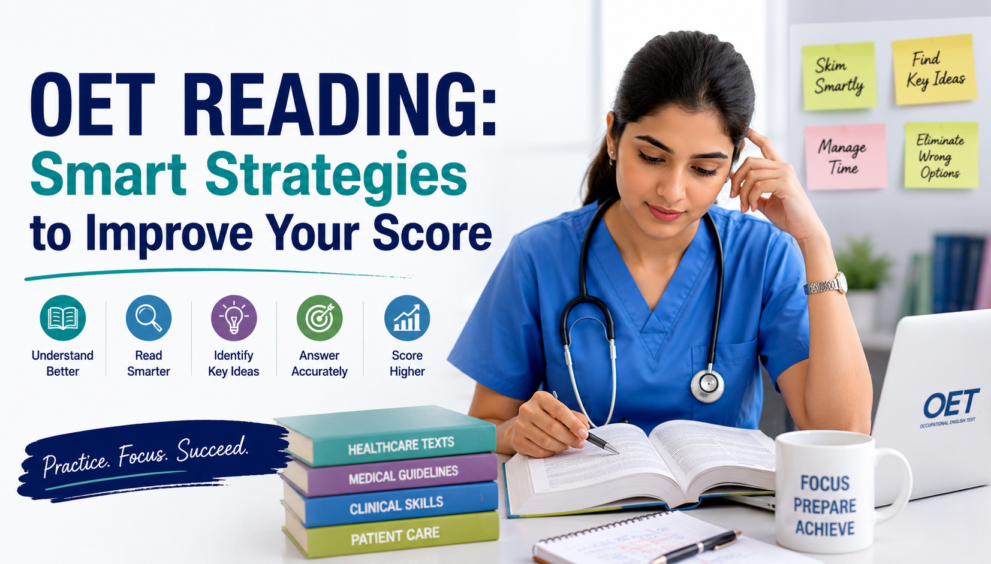
OET Reading Part B can be challenging because the questions are designed to test how well you understand short healthcare-related texts, not simply whether you can find matching words.
For many candidates, the difficulty comes from similar-looking answer options, unfamiliar workplace language, and distractors that seem correct at first glance. The key to performing well is to focus on the main message, purpose, tone, and meaning of each text.
With the right approach and regular practice, you can improve your accuracy and confidence in OET Reading Part B.
Understanding OET Reading Part B
Reading Part B focuses on short texts commonly found in healthcare workplaces. These may include:
- Hospital notices
- Workplace guidelines
- Healthcare policies
- Staff communications
- Professional instructions
- Safety procedures
- Internal memos
Each text is followed by a multiple-choice question. The question usually asks you to identify the main purpose, meaning, or key message of the text.
Because the texts are short, every sentence can be important. However, you should avoid trying to memorise every word. Instead, concentrate on understanding what the writer is trying to communicate.
1. Read the Question First
Before reading the entire text, look carefully at the question.
The question gives you a purpose for reading and helps you identify the information you need.
For example, if the question asks:
“What is the main purpose of this notice?”
you should focus on the overall message rather than searching for one particular detail.
If the question asks what staff should do, pay particular attention to instructions, recommendations, and actions mentioned in the text.
Reading the question first can help you avoid spending too much time on information that is not relevant to the answer.
2. Focus on the Main Message
Part B is primarily about understanding the gist of a workplace communication.
After reading the text, ask yourself:
“What is the writer trying to tell the reader?”
Do not become distracted by individual medical or technical terms. A difficult word does not necessarily prevent you from understanding the overall message.
For example, a notice may contain several details about a new procedure, but its main purpose may simply be to inform staff about a change in workplace practice.
Identifying this central message can make the correct answer much easier to recognise.
3. Pay Attention to Verbs
Verbs can make a significant difference in multiple-choice questions.
Consider the difference between:
- Suggest
- Recommend
- Require
- Encourage
- Allow
- Prohibit
These words do not have exactly the same meaning.
For example, if a workplace notice says that staff are required to complete a particular procedure, an answer suggesting that staff are merely encouraged to do it would change the meaning.
Always check whether the answer option accurately reflects the strength of the instruction in the text.
4. Look for Paraphrasing
One of the most common mistakes in OET Reading Part B is choosing an answer because it contains the same words as the passage.
The correct answer may use completely different vocabulary while expressing the same idea.
For example:
Text:
“Staff should be given an opportunity to contribute to decisions regarding patient care.”
Answer option:
“Healthcare workers should be involved in care-related decisions.”
The wording is different, but the meaning is similar.
Train yourself to recognise ideas and synonyms, rather than simply matching individual words.
5. Watch for Signal Words
Certain words can help you understand the direction of a workplace message.
Pay attention to words such as:
- However
- Although
- Therefore
- Because
- As a result
- In addition
- Instead
- Importantly
Words such as however and although often introduce an important contrast.
Similarly, therefore and as a result can introduce a consequence or conclusion.
Recognising these signal words can help you understand the relationship between different ideas in the text.
6. Identify the Tone
The tone of a workplace communication can also provide clues.
A text may be:
- Informative
- Advisory
- Supportive
- Cautious
- Urgent
- Critical
- Instructional
Be careful with answer options that sound much stronger or more negative than the original text.
For example, if the writer is simply advising staff to consider a new procedure, an answer saying that the writer is demanding immediate action may be too strong.
The correct answer should match the overall tone and intention of the text.
7. Eliminate Distractors
You do not always need to immediately identify the correct answer. Sometimes it is easier to eliminate the wrong ones.
Ask yourself:
Does this option actually answer the question?
Then check:
- Does it change the meaning?
- Is it too extreme?
- Does it introduce information not mentioned in the text?
- Does it focus on a minor detail instead of the main message?
- Does it misunderstand the writer’s intention?
Eliminating even one or two incorrect options can significantly improve your chances of selecting the correct answer.
Build Your OET Reading Skills
Improving your Part B performance requires regular exposure to professional English.
Try practising for a short period each day. Read workplace notices, healthcare information, professional articles, and other relevant texts.
After reading each text, summarise it in one sentence.
If you can explain the main message clearly, you are developing the skill needed for Part B.
You can also keep a vocabulary notebook containing:
- Common healthcare terms
- Workplace expressions
- Useful synonyms
- Instructional verbs
- Linking and signal words
This will gradually improve both your reading speed and comprehension.
OET Reading Part B Test-Day Checklist
| Strategy | Why It Matters |
|---|---|
| Read the question first | Gives you a clear reading purpose |
| Identify the main message | Helps you focus on the overall meaning |
| Analyse important verbs | Prevents mistakes caused by changes in meaning |
| Look for paraphrases | Helps you recognise the correct answer |
| Watch for signal words | Shows relationships between ideas |
| Check the tone | Helps eliminate overly strong options |
| Eliminate distractors | Narrows down your choices |
| Manage your time | Prevents one difficult question from affecting your performance |
Final Thoughts
Success in OET Reading Part B is not about understanding every single word. It is about quickly identifying the purpose and main message of a short healthcare communication.
Read the question carefully, focus on meaning, watch the verbs, recognise paraphrases, and eliminate distractors. With consistent practice, these strategies can help you approach Part B with greater confidence and accuracy.
Prepare smart. Practise consistently. Achieve your OET goals with Fortu West International.