


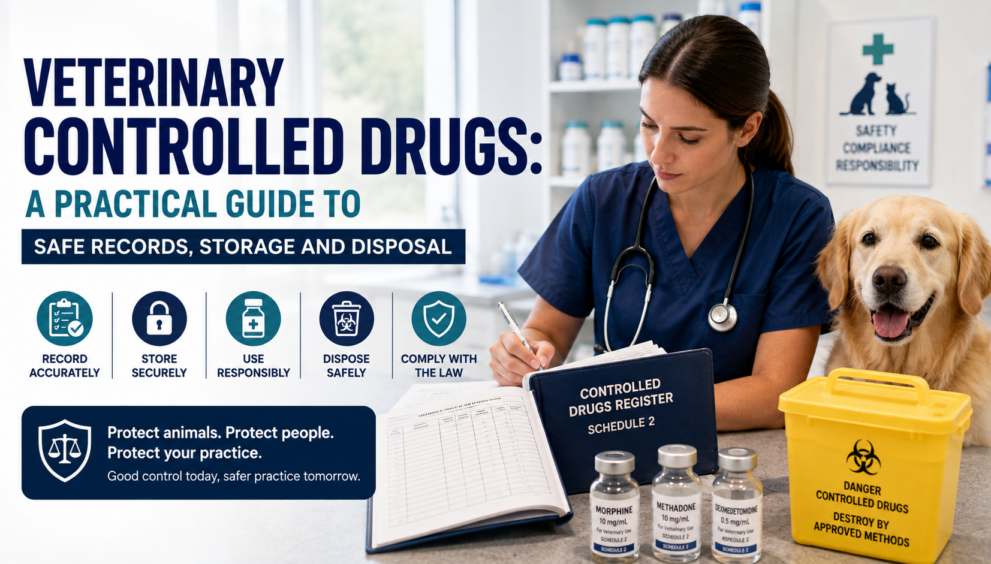
Controlled drugs require careful handling at every stage in veterinary practice. From the moment a medicine is received until it is used, recorded, stored or disposed of, veterinary professionals must follow the relevant legal and professional requirements.
This simplified guide highlights the key areas every veterinary team should understand.
1. Keep Accurate Controlled Drug Records
Practices handling Schedule 2 controlled drugs must maintain an appropriate Controlled Drugs register. Records should provide a clear audit trail of medicines received, supplied, administered and destroyed.
The register should be kept securely, completed in chronological order and retained for the required period. If an error is made, it should be corrected in a way that preserves the original entry and provides a clear record of the correction.
2. Record Medicines When They Are Received
When controlled drugs enter the practice, accurate details should be recorded, including the date, supplier and quantity received.
These records form the beginning of the medicine’s audit trail and help practices account for stock throughout its lifecycle.
3. Record Supply and Administration Carefully
When a Schedule 2 controlled drug is supplied or administered, the relevant details must be documented accurately.
A clear record helps demonstrate who received the medicine, the authority under which it was supplied and the quantity involved. Good documentation is essential for accountability and safe stock management.
4. Monitor Stock Balances
Maintaining a running balance and carrying out regular physical stock checks are important safeguards. Comparing the recorded balance with the actual quantity held can help identify discrepancies early.
Any difference should be investigated and appropriately documented.
5. Manage Wastage Transparently
Small amounts of medicine may be lost during preparation or administration. This can occur because of unavoidable residual amounts remaining in syringes or other equipment.
The key is to minimise avoidable waste, use suitable equipment and maintain clear records. Where wastage occurs, it should be accounted for according to the applicable guidance and practice procedures.
6. Understand the Difference Between Stock and Waste
A useful distinction is whether a remaining controlled drug is still usable.
A usable quantity may be treated as stock and can be subject to specific destruction and witnessing requirements. Medicine that is genuinely unusable or has been prepared but not administered may be treated as waste, with different disposal arrangements.
7. Follow the Correct Destruction Process
Controlled drugs should never be disposed of casually. Depending on the drug, location and whether the medicine is classed as stock or waste, specific legal requirements may apply.
Where witnessing is required, the destruction must take place with an appropriately authorised or independent witness. The date, quantity and relevant signatures should also be recorded.
8. Make Medicines Irretrievable Before Disposal
Before disposal, controlled drugs must be rendered irretrievable using an appropriate method. Practices should follow approved procedures and ensure the resulting pharmaceutical waste is managed through the correct waste-disposal arrangements.
9. Remember That Regional Rules Can Differ
Requirements may vary between Great Britain and Northern Ireland. Veterinary professionals should always check the guidance that applies to the location in which they practise.
Final Thoughts
Controlled drug compliance is built on consistent habits: accurate records, secure storage, regular stock checks, careful management of wastage and correct disposal procedures.
By making these steps part of everyday practice, veterinary teams can improve accountability, support patient safety and remain prepared for inspection.
Fortu West International supports learners and professionals with clear educational guidance to help them understand important professional practices and requirements.