


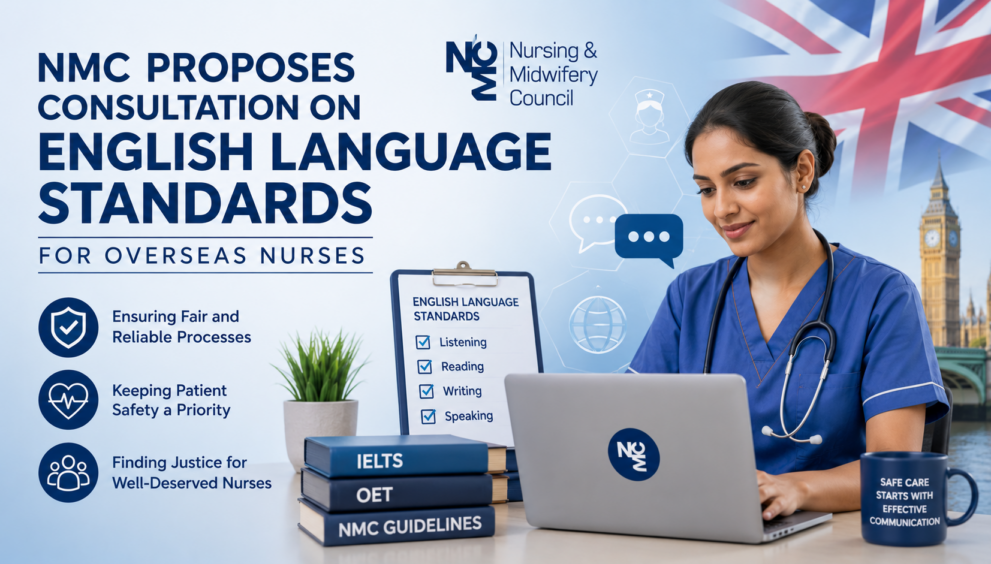
For internationally educated nurses and midwives planning to join the UK register, demonstrating the ability to communicate effectively in English is an essential part of the Nursing and Midwifery Council (NMC) registration process.
In 2022, the NMC launched a public consultation to review its English language requirements. The consultation explored whether the existing approach could be made more flexible and inclusive while continuing to protect patient safety and maintain professional standards.
This article looks at the key issues raised during that consultation, the possible changes that were considered, and what overseas nurses should understand about the current NMC English language evidence routes.
Why Did the NMC Review Its English Language Requirements?
Internationally educated nurses, midwives and other healthcare professionals make an important contribution to the UK’s health and social care system. The NMC recognised the need to review whether its English language requirements provided fair and reliable ways for applicants to demonstrate their ability to communicate safely and effectively.
However, the central principle remained unchanged: English language competence is essential for safe and effective nursing and midwifery practice.
The 2022 consultation therefore explored ways to provide additional flexibility without lowering the standards required to protect patients and the public.
The Main Areas Considered in the 2022 Consultation
The consultation focused on three important areas.
1. Changes to IELTS and OET Score Requirements
One of the areas considered was whether changes could be made to the English language test requirements, including the way applicants combine scores from more than one test sitting.
The discussion examined whether candidates who had demonstrated strong English ability overall could have more flexibility when combining scores, while still ensuring that minimum standards were maintained across all four language skills:
- Listening
- Reading
- Writing
- Speaking
The consultation was particularly important for internationally educated professionals who had experienced difficulty achieving all required scores in a single test sitting.
2. Considering Additional Evidence of English Language Competence
Another important proposal involved exploring whether some applicants could provide additional evidence of English language competence.
This included the possibility of using supporting information from employers in certain circumstances.
The consultation considered factors such as:
- The applicant’s role
- Their work experience
- The length of their employment
- The type of evidence an employer could provide
- Whether the evidence could demonstrate safe and effective communication in English
This approach recognised that professional experience may provide useful evidence of an applicant’s ability to communicate effectively in a healthcare environment.
3. Recognising Relevant Qualifications Taught in English
The consultation also considered whether certain postgraduate qualifications taught and examined in English could be accepted as evidence of English language competence.
The purpose was to explore whether applicants who had completed relevant higher education programmes in English could use this educational experience as part of their registration evidence.
These proposals demonstrated the NMC’s intention to consider different sources of evidence while maintaining appropriate professional and patient safety standards.
What Are the Current NMC English Language Evidence Options?
The 2022 consultation has now passed, and applicants should not rely on old consultation proposals alone when preparing an NMC application.
The NMC currently provides several routes through which applicants may demonstrate their knowledge of English, depending on their individual circumstances. These include:
- Accepted English language tests
- Qualifying in English through an eligible pre-registration qualification
- Recent practice in English in an accepted country
- Supporting information from an employer, where eligibility requirements are met
IELTS Academic Requirements
For the IELTS Academic test, the NMC currently requires:
| Skill | Required Score |
|---|---|
| Listening | 7 |
| Reading | 7 |
| Writing | 6.5 |
| Speaking | 7 |
Applicants may also be able to combine scores from two eligible IELTS test sittings, subject to the NMC’s current score, timing and minimum-score requirements.
OET Requirements
For the Occupational English Test (OET), the current required grades are:
| Skill | Required Grade |
|---|---|
| Listening | B (350 or above) |
| Reading | B (350 or above) |
| Writing | C+ (300 or above) |
| Speaking | B (350 or above) |
The NMC also allows eligible applicants to combine scores across two OET test sittings, provided they meet the required overall scores and minimum scores for each sitting.
Score Combining: An Important Option for Some Applicants
One of the significant areas of flexibility within the current system is the ability, in eligible circumstances, to combine scores from two test sittings.
According to the NMC’s current guidance, applicants using IELTS or OET may combine scores across two sittings if they meet the relevant requirements for:
- Required scores across the two tests
- Minimum scores in each sitting
- The permitted time period between tests
- The validity period when the NMC assesses the completed application
The current NMC guidance states that the two test sittings must be within 12 months of each other, and both tests must be no more than two years old when the NMC assesses the completed application.
Because score-combining rules are detailed and depend on the applicant’s individual results, candidates should always check the latest official NMC guidance before submitting an application.
Supporting Information From Employers
Employer-supported evidence is now recognised within the NMC’s English language requirements for some eligible applicants.
The NMC refers to this route as Supporting Information from Employers (SIFE). Whether an applicant can use this option depends on their individual circumstances and whether they meet the relevant requirements.
The employer evidence is intended to provide additional assurance about an applicant’s ability to communicate safely and effectively in English.
Using a Qualification Taught in English
Applicants may also be able to demonstrate English language competence through an eligible pre-registration qualification.
The NMC’s current guidance explains that, depending on where and how the qualification was completed, applicants may need to demonstrate the extent to which their programme involved patient interaction and communication in English.
For example, the NMC considers requirements relating to clinical interaction and the proportion of those interactions conducted in English when assessing certain qualifications.
Recent Practice in English
Another possible route is recent professional practice in a country where English is a majority-spoken language.
For nurses and midwives, the NMC’s current guidance states that applicants may need to demonstrate at least one year of recent registered practice, alongside other evidence relating to registration and English language assessment. The NMC may also seek confirmation from employers regarding the applicant’s English language competence.
What Does This Mean for Overseas Nurses?
The evolution of the NMC’s English language requirements reflects an important balance between two priorities:
Fairness for International Professionals
Overseas nurses come from diverse educational and professional backgrounds. A flexible system can allow eligible applicants to demonstrate their English competence through more than one recognised route.
Patient Safety
At the same time, nurses and midwives must be able to communicate clearly and effectively with patients, families and healthcare professionals.
For this reason, the NMC continues to assess English language competence carefully as part of the registration process. The requirements are designed to support safe and effective professional practice in the UK.
Important Advice Before Starting Your NMC Application
NMC regulations and registration guidance can change over time. Information from older articles, including proposals made during the 2022 consultation, should therefore be treated as historical context rather than as the current rule.
Before taking an English language test or submitting evidence, make sure you:
- Check the latest NMC English language requirements.
- Confirm which evidence route applies to your circumstances.
- Review the current IELTS or OET score requirements.
- Check whether your scores may be eligible for combining.
- Understand the validity and timing requirements for your evidence.
- Review whether employer-supported evidence or qualification-based evidence may be available to you.
Get Career Guidance for Your UK Nursing Journey
Planning an international nursing career involves understanding several important stages, including NMC registration requirements, English language evidence, the Test of Competence and other professional documentation.
If you are an overseas nurse exploring your career options and need guidance in understanding the process, Fortu West International can support you with career guidance and help you understand the next steps in your professional journey.
Contact Fortu West International for Career Guidance
Take the next step towards understanding your international nursing career pathway with the right information and professional guidance.
Contact Fortu West International for career guidance and support for your professional journey.
Disclaimer: This article includes historical information about the NMC’s 2022 consultation alongside current NMC guidance. English language requirements, eligibility criteria and registration procedures may change. Always check the latest information directly from the NMC before making decisions or submitting an application.