


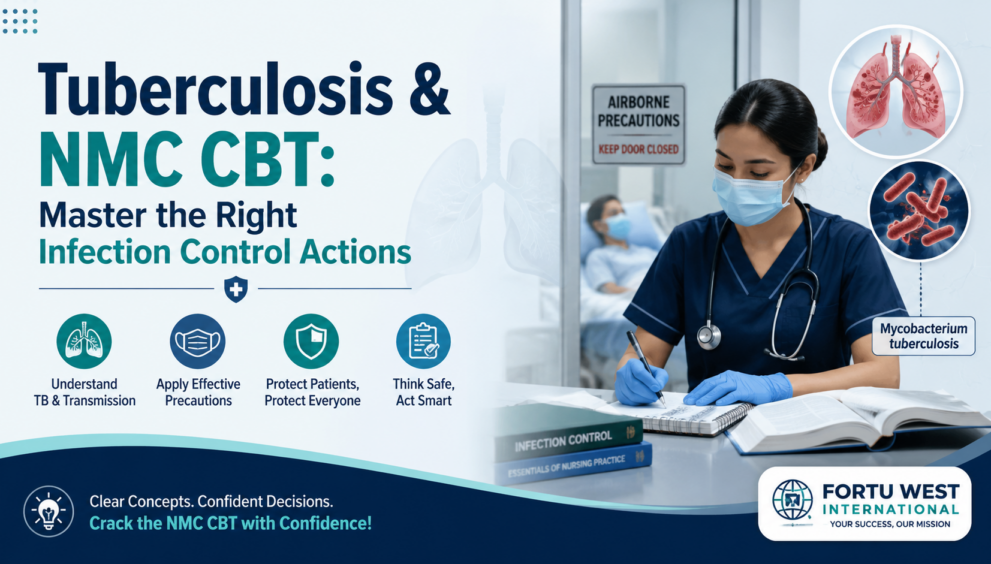
Preparing for the NMC CBT is not just about memorising medical facts. Nurses must understand how to apply infection prevention principles to real clinical situations. Tuberculosis (TB) is an important CBT topic because questions can test your knowledge of transmission, isolation, PPE, escalation, and patient safety.
For international nurses preparing for UK registration, understanding TB can help you approach infection-control questions with greater confidence.
What Is Tuberculosis?
Tuberculosis is an infectious disease mainly caused by Mycobacterium tuberculosis. It most commonly affects the lungs, known as pulmonary TB, although it can also affect other parts of the body.
For the NMC CBT, it is important to understand the difference between active TB and latent TB. A person with latent TB does not have active disease and is not infectious in the same way as someone with infectious pulmonary TB.
Common symptoms that may appear in CBT scenarios include:
- Persistent cough
- Sputum production
- Fever
- Night sweats
- Fatigue
- Unexplained weight loss
- Haemoptysis
When these symptoms occur together, particularly in a patient with relevant risk factors or exposure history, TB may need to be considered.
How Does TB Spread?
Infectious pulmonary or laryngeal TB is mainly transmitted through the air. An infectious person can release tiny airborne particles when coughing, sneezing, speaking, or singing. Other people may inhale these particles.
This is why infectious pulmonary TB is associated with airborne precautions.
A common NMC CBT mistake is confusing TB with infections that are primarily spread by respiratory droplets. Remember:
Infectious pulmonary TB → airborne transmission → appropriate airborne precautions.
What Infection-Control Measures Should Nurses Know?
When infectious TB is suspected or confirmed, the nurse should follow the relevant local infection-prevention policy.
Important measures include:
- Arrange appropriate isolation, generally using a suitable single room.
- Use appropriate respiratory protective equipment according to local policy.
- Continue standard precautions, particularly effective hand hygiene.
- Reduce unnecessary patient movement.
- Follow respiratory hygiene measures where appropriate.
- Clean and handle equipment safely.
- Escalate concerns promptly to the appropriate clinical and infection-prevention teams.
PPE requirements can vary according to the healthcare setting and current guidance. For the CBT, focus on understanding why respiratory protection and isolation are required, rather than memorising one item of PPE for every situation.
Standard Precautions vs Transmission-Based Precautions
This is an important infection-control concept for the NMC CBT.
Standard precautions apply to all patients. They include hand hygiene, appropriate PPE based on risk assessment, respiratory hygiene, safe sharps handling, and safe management of equipment, linen, waste, and the environment.
Transmission-based precautions are additional measures used when a particular infection requires extra protection.
For infectious pulmonary TB, the relevant route is airborne transmission.
Therefore, transmission-based precautions do not replace standard precautions. Both should be followed.
What Should the Nurse Do First?
NMC CBT questions often test your ability to identify the safest immediate action.
For example, imagine a patient has a persistent cough, fever, night sweats, and other symptoms suggesting possible pulmonary TB.
Think:
Recognise the risk → reduce exposure → apply appropriate precautions → escalate for assessment.
Avoid unnecessary movement of a potentially infectious patient around a busy clinical area. The priority is to reduce the risk of transmission while appropriate assessment and management are arranged.
Patient-Centred Isolation Nursing
Infection control does not mean forgetting the patient’s emotional needs.
A patient being investigated for TB may feel frightened, embarrassed, or concerned about stigma. Nurses should explain the reason for isolation calmly and respectfully and maintain the patient’s dignity and privacy.
This connects closely with the NMC principles of prioritising people, practising effectively, preserving safety, and promoting professionalism and trust.
Isolation should protect other people without making the patient feel neglected or judged.
Common NMC CBT Mistakes
When answering TB-related questions, remember:
- Infectious pulmonary TB is associated with airborne transmission.
- Do not confuse airborne precautions with ordinary droplet precautions.
- Continue standard precautions.
- Consider early appropriate isolation.
- Use respiratory protection according to current policy.
- Limit unnecessary patient movement.
- Escalate concerns promptly.
- Communicate respectfully with the patient.
- If asked for the first action, prioritise immediate safety.
Quick TB Revision Formula
For quick NMC CBT revision, remember:
TB → Airborne transmission → Appropriate isolation → Respiratory protection → Reduce exposure → Escalate → Preserve safety.
Rather than memorising isolated facts, practise applying these principles to clinical scenarios. Ask yourself:
What is the transmission route? Is the patient potentially infectious? What action reduces immediate risk? Who needs to be informed?
This approach can make infection-control questions easier to understand.
Frequently Asked Questions
Is pulmonary TB airborne?
Yes. Infectious pulmonary or laryngeal TB can spread through the air, which is why airborne precautions are important.
Does every patient with TB require the same precautions?
No. The approach depends on whether the patient has active infectious disease. Latent TB is different from infectious pulmonary TB.
What is the most important TB point for the NMC CBT?
Remember that infectious pulmonary TB is associated with airborne transmission and requires appropriate infection-control measures.
What should a nurse do when TB is suspected?
Recognise the risk, reduce exposure, apply appropriate precautions according to local policy, and escalate promptly for further assessment.
Conclusion
Understanding tuberculosis for the NMC CBT is about more than remembering a definition. You need to recognise possible infectious TB, understand airborne transmission, know the importance of appropriate isolation and respiratory protection, and prioritise patient and public safety.
For international nurses preparing for UK registration, practising TB through clinical scenarios can strengthen both infection-control knowledge and clinical reasoning.
Remember: Recognise the risk. Reduce exposure. Apply precautions. Escalate. Preserve safety.
For structured nursing exam preparation and guidance for international healthcare professionals, Fortu West International supports candidates in building the knowledge and confidence needed for their professional journey.
Why Wait? Just Fortu West It!