

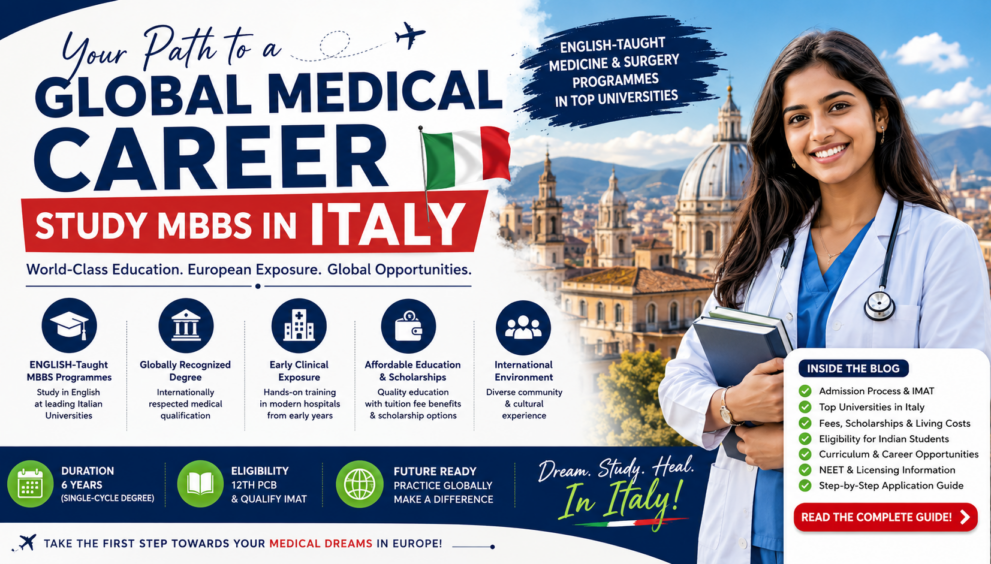
Italy has become an increasingly attractive destination for international students who want to study medicine in Europe. With several public universities offering Medicine and Surgery programmes in English, internationally oriented curricula, and opportunities to experience European healthcare systems, Italy can be an excellent option for students looking beyond traditional study destinations.
For students from India, one of the biggest attractions is that it is possible to study medicine in English without needing to learn Italian before starting the degree at universities offering English-taught medical programmes.
Why Study MBBS in Italy?
Italy offers a combination of European medical education, internationally recognised universities, and English-taught programmes.
Some key advantages include:
- English-taught Medicine and Surgery programmes
- European medical education and clinical exposure
- Public universities with comparatively competitive tuition structures
- International student environment
- Opportunities for academic exchange and international experiences
- Six-year integrated medical programmes
- Access to modern hospitals and clinical training
For example, the University of Bologna’s 2026/27 Medicine and Surgery programme is a six-year degree taught entirely in English and includes clinical clerkships from the first year.
Is MBBS Taught in English in Italy?
Yes. Several Italian universities offer Medicine and Surgery degrees in English for international students.
The Italian qualification is generally structured as a single-cycle degree in Medicine and Surgery, rather than being divided into a separate undergraduate MBBS and postgraduate medical degree.
The University of Milan’s International Medical School, for example, offers a six-year Medicine and Surgery programme taught in English, carrying 360 ECTS credits.
Admission to Medicine in Italy
Admission to English-taught medical programmes in Italy is competitive.
For English-taught Medicine and Surgery programmes, the IMAT (International Medical Admissions Test) has traditionally been an important part of the admission process. The University of Bologna states that IMAT is the admission test for Medicine and Surgery programmes taught in English with nationally restricted access.
The test has assessed areas including:
- Biology
- Chemistry
- Physics
- Mathematics
- Logical reasoning
- General knowledge
The University of Milan describes the IMAT as a 100-minute, multiple-choice admission test covering these subject areas.
Important: Admission rules and testing arrangements can change between academic years, so students should always check the official admission call for the year in which they intend to apply.
Eligibility for Indian Students
Students planning to apply for Medicine in Italy generally need to satisfy the academic requirements specified by the university and the Italian authorities.
Indian students should normally prepare:
- Class 10 academic documents
- Class 12 academic documents
- Biology qualification
- Chemistry qualification
- Physics qualification
- Passport
- Academic transcripts
- Proof of language proficiency where required
- Other documents requested by the university or Italian authorities
Students should also check the requirements applicable to their specific qualification and admission category before applying.
NEET and Studying Medicine in Italy
Indian students should pay particular attention to NEET requirements.
If your goal is to study medicine abroad and eventually practise medicine in India, you should check the current requirements of the National Medical Commission (NMC) before choosing a university.
NEET requirements, foreign medical graduate regulations and recognition rules can change. Therefore, students should verify the rules applicable to their admission year rather than relying on older information available online.
Duration of MBBS in Italy
Medicine and Surgery programmes in Italy are generally structured as six-year single-cycle medical degrees.
For example:
University of Bologna
- Duration: 6 years
- Language: English
- Degree: Medicine and Surgery
- 2026/27 programme: 160 places
University of Milan – International Medical School
- Duration: 6 years
- Language: English
- 360 ECTS credits
The curriculum typically progresses from foundational medical sciences to clinical subjects, practical training and clerkships.
What Will You Study?
A medical degree in Italy covers both basic medical sciences and clinical medicine.
Typical areas include:
Pre-clinical subjects
- Anatomy
- Histology
- Biology
- Biochemistry
- Physiology
- Genetics
- Microbiology
- Pathology
- Pharmacology
Clinical subjects
- Internal Medicine
- General Surgery
- Paediatrics
- Obstetrics and Gynaecology
- Psychiatry
- Neurology
- Cardiology
- Emergency Medicine
- Intensive Care
- Other medical specialties
The University of Milan’s 2026/27 curriculum, for example, includes subjects such as anatomy, biochemistry, biostatistics, clinical and surgical pathology, and emergency-related training.
Top Italian Universities Offering Medicine in English
Some universities that have offered English-taught medical programmes include:
- University of Bologna
- University of Milan
- University of Milan-Bicocca
- University of Pavia
- University of Padua
- University of Rome Tor Vergata
- University of Naples Federico II
- University of Turin
- University of Siena
- University of Messina
However, the availability of English-taught Medicine programmes, number of seats, admission requirements and application procedures can change each academic year. Students should therefore verify the latest official university information before applying.
Tuition Fees for Medicine in Italy
One of the reasons Italy attracts international students is the availability of public universities, where tuition can be substantially different from private medical schools.
However, there is no single tuition fee for all medical universities.
The actual amount can depend on:
- University
- Student’s financial circumstances
- International student status
- Family income documentation
- Scholarship or fee-waiver eligibility
- Specific university regulations
Students should check the current fee structure of each university before making a financial decision.
Scholarships for International Students
Italy is also known for financial-support opportunities for eligible international students.
Depending on the region and university, students may find opportunities involving:
- Tuition-fee reductions
- Scholarships
- Accommodation assistance
- Meal benefits
- Other student support
Eligibility and application procedures vary, so students should carefully check the relevant university and regional scholarship announcements.
Cost of Living in Italy
The cost of living depends heavily on the city.
Students need to budget for:
- Accommodation
- Food
- Transportation
- Study materials
- Health insurance and other required expenses
- Personal expenses
Cities such as Milan and Bologna can have different living costs from smaller university cities. Students should prepare a realistic monthly budget before choosing their university.
Do You Need to Learn Italian?
For an English-taught medical degree, the academic programme may be delivered in English. However, learning Italian is highly recommended.
Why?
Medical students interact with patients during clinical training. Patients may communicate primarily in Italian, particularly outside international university environments.
Learning Italian can therefore help with:
- Patient communication
- Clinical placements
- Daily life
- Understanding the local healthcare environment
- Social integration
So, although English may be sufficient for the classroom, Italian can become increasingly useful during clinical training.
Career Opportunities After Studying Medicine in Italy
After completing a medical degree, graduates need to follow the professional registration and licensing requirements of the country where they intend to practise.
Students planning to return to India should carefully review the latest NMC regulations for foreign medical graduates before enrolling.
Students who want to work elsewhere in Europe should similarly check the professional recognition and licensing requirements of the destination country.
MBBS in Italy vs Other Countries
Italy can be particularly attractive for students who want:
European medical education + English-taught Medicine + international exposure + public-university options.
However, students should not choose a country solely because tuition appears inexpensive.
Before applying, compare:
- University recognition
- Admission requirements
- Language of instruction
- Clinical training
- Total cost of education
- Cost of living
- Licensing requirements
- Post-graduation opportunities
- Requirements for returning to India
- Scholarship availability
How to Apply for Medicine in Italy
A typical application journey can involve:
Step 1: Check eligibility
Review the university’s academic and admission requirements.
Step 2: Shortlist universities
Compare English-taught medical programmes, locations, fees, seats and curriculum.
Step 3: Prepare for the admission process
For programmes requiring an admission test, prepare well in advance.
Step 4: Complete the application
Follow the university’s official application procedure and deadlines.
Step 5: Check ranking and admission results
Admission is competitive, so meeting minimum requirements does not necessarily guarantee a place.
Step 6: Complete university enrolment
Successful applicants must complete the required enrolment procedures.
Step 7: Complete visa procedures
Non-EU students may need to complete the appropriate Italian student-visa process.
Step 8: Begin your medical journey
Once enrolled, students can begin their six-year medical education.
Is Italy a Good Choice for Indian Medical Students?
Italy can be a strong option for Indian students who want to study medicine in Europe, particularly those looking for an English-taught medical programme at a public university.
However, studying medicine abroad is a major decision. Students should evaluate the complete pathway—from admission and finances to clinical training and eventual medical licensing—before making a final choice.
Final Thoughts
Studying MBBS in Italy can provide Indian students with the opportunity to experience European medical education in an international environment. With English-taught Medicine and Surgery programmes available at universities such as Bologna and Milan, Italy deserves consideration by students planning an international medical career.
The most important step is to verify the latest admission rules, university requirements, tuition fees, scholarship conditions and NMC regulations for your specific admission year.
If you are planning to apply for the 2027 intake, start preparing your academic documents and admission-test strategy well in advance.