


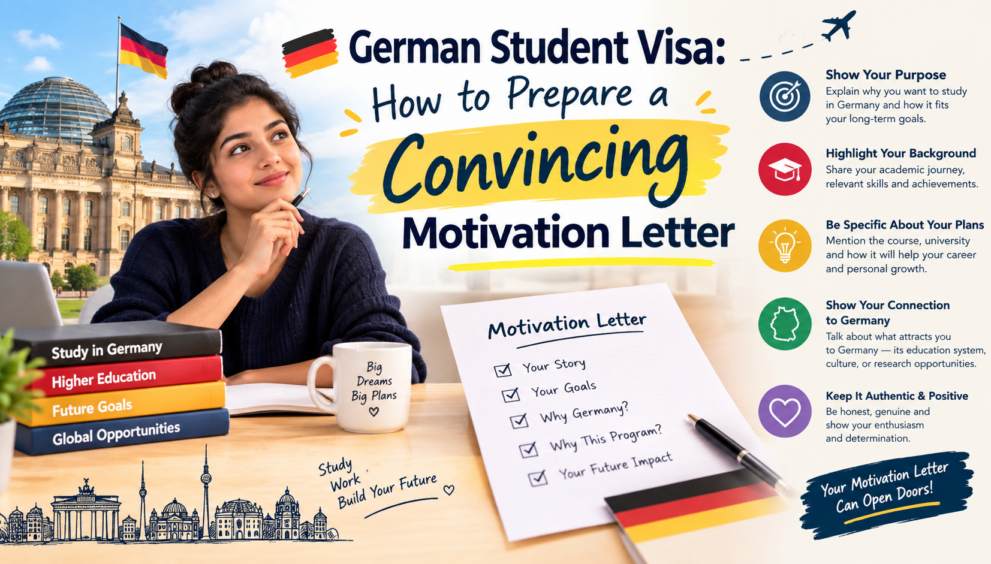
Applying to study in Germany requires careful preparation, and your motivation letter can be an important part of that process. It gives you an opportunity to explain your educational background, your reasons for choosing a particular programme, and how your studies relate to your future career plans.
A good motivation letter should not simply repeat the information already available in your academic documents. Instead, it should present a clear story about where you have come from academically, what you want to study, why you have chosen Germany, and what you hope to achieve in the future.
Whether you are preparing for bachelor’s, master’s, or doctoral studies, understanding how to write a focused and authentic motivation letter can make your application more organised and effective.
Understanding the Purpose of a Motivation Letter
A motivation letter is a personal statement prepared for a university or, where required, as part of a visa application.
It allows you to explain aspects of your application that may not be obvious from your certificates or CV.
Your letter can cover:
- Your previous education
- Your academic interests
- Relevant experience and achievements
- Your reasons for selecting a particular programme
- Your reasons for choosing Germany
- Your short-term academic objectives
- Your long-term career plans
The exact requirements differ between universities and visa authorities, so applicants should always follow the instructions applicable to their specific application.
Why Your Letter Needs to Be Personal
Many students make the mistake of using a generic motivation letter template and changing only the university name.
This can make the letter sound artificial.
Instead, your motivation letter should reflect your own academic journey. Explain what influenced your choice of subject and what you expect to gain from the programme.
For example, rather than simply writing that you are interested in business, engineering, healthcare, information technology, or another field, explain what experiences developed that interest and why further education is important for your career objectives.
Specific and truthful information is much more valuable than impressive-sounding statements.
Explain Why You Chose Germany
Your letter should provide a genuine explanation of why Germany fits your educational plans.
You might discuss relevant factors such as:
- The structure of your chosen programme
- The academic approach of the institution
- Research opportunities
- Practical learning
- Programme specialisations
- The relevance of the qualification to your career plans
- The international academic environment
Avoid making broad claims without connecting them to your own goals.
The important question is not simply “Why Germany?”, but rather:
“Why is studying this particular programme in Germany a logical step in my academic and professional development?”
Explain Why You Selected the Programme
One of the strongest parts of a motivation letter is a clear explanation of your programme choice.
Research the official programme information before writing.
Look at:
- Course modules
- Areas of specialisation
- Teaching methods
- Research opportunities
- Practical components
- Entry requirements
- Programme duration
Then identify the aspects that genuinely connect with your interests and career plans.
This demonstrates that you are making an informed academic decision rather than applying without understanding the programme.
Connect Your Previous Education With Your Future
Your academic history should have a logical connection with your proposed studies.
If your previous qualification is directly related to your chosen programme, explain how it prepared you for the next stage.
If you are changing fields, explain the reason for the change and how your previous education or experience has contributed to your new academic interest.
The reader should be able to understand the progression:
Previous education → academic interest → chosen programme → skills and knowledge → career objective
This gives your application a coherent direction.
Discuss Relevant Experience
Academic qualifications are not the only experiences you can mention.
Depending on your background, relevant examples may include:
- Internships
- Academic projects
- Research
- Employment
- Volunteering
- Professional training
- Competitions
- Leadership activities
- Field-specific experience
Do not simply create a list.
Explain what you learned from those experiences and how they influenced your decision to pursue the programme.
Present Your Career Plans Clearly
Your future plans should be realistic and connected to the programme you have selected.
Explain what knowledge and skills you hope to develop and how they can contribute to your professional development.
For example, you might explain:
- What area you want to specialise in
- What professional skills you want to develop
- What type of career you are working towards
- How the qualification supports your professional objectives
For a visa application, make sure your explanation is consistent with your overall application and supporting documents.
A Simple Structure for Your Motivation Letter
A practical structure can make the writing process easier.
Opening
Introduce yourself and clearly state the programme you are applying for.
Briefly mention your academic background and your main reason for pursuing the programme.
Academic Background
Explain your previous studies and the knowledge or skills you developed.
Mention particularly relevant subjects, projects, or experiences.
Reasons for Choosing the Programme
Explain why this specific programme interests you.
Refer to relevant elements of the curriculum rather than making general statements.
Reasons for Choosing Germany and the Institution
Explain why Germany and the selected institution fit your academic objectives.
Show that you have researched your choice.
Career Goals
Describe how the programme supports your future professional plans.
Keep your plans realistic and consistent with your academic history.
Conclusion
Briefly summarise your motivation and your readiness to pursue the programme.
End professionally and positively.
Common Errors Students Should Avoid
Writing a Generic Letter
A motivation letter should be specific to your application.
Copying Online Templates
Templates can help you understand structure, but your final letter should use your own experiences and ideas.
Using Excessively Complicated Language
You do not need sophisticated vocabulary to make a strong impression. Clear and professional writing is more effective.
Repeating Your CV
Use the letter to explain your experiences rather than simply listing them again.
Giving Unclear Career Plans
Your future objectives should make sense in relation to your chosen programme.
Including Incorrect Information
Check every date, qualification, programme name, institution name, and other important detail before submission.
Ignoring Official Requirements
Universities and visa authorities may have their own requirements for format, length, language, or content. Follow the current instructions that apply to your application.
Final Review Before You Submit
Before submitting your motivation letter, check:
- Is the programme name correct?
- Is the university name correct?
- Have I explained my academic background?
- Have I explained why I chose the programme?
- Have I given specific reasons for choosing Germany?
- Are my career goals clear?
- Is the information consistent with my other documents?
- Have I followed the required format?
- Have I checked grammar and spelling?
- Does the letter sound like my own genuine story?
Taking time to review these points can prevent avoidable mistakes.
Career Guidance With Fortu West International
Choosing the right programme and preparing an effective application can be challenging, particularly when you are comparing different academic options and planning your future career.
Fortu West International provides career guidance to help students understand their academic options and plan their next steps. Professional guidance can be useful when evaluating programmes, organising application documents, and developing a clear academic and career direction.
Students should also verify the latest university admission and German visa requirements through the relevant official sources before submitting an application.
Conclusion
A successful motivation letter should give the reader a clear understanding of your academic background, your reasons for choosing the programme, your interest in Germany, and your future career direction.
Instead of trying to make your letter sound impressive, focus on making it genuine, specific, organised, and easy to understand.
Your motivation letter is your opportunity to connect your past education with your future ambitions. With careful research, honest writing, thorough proofreading, and the right career guidance, you can prepare a stronger and more meaningful application for your German education journey.