

Your Essential UK University Application & Student Visa Document Checklist — Featuring Fortuwest International
Planning to study in the UK is an exciting step, but preparing the right documents at the right stage is just as important as choosing the right university and course.
From academic certificates and English-language evidence to your passport, university offer, CAS and Student visa documents, keeping your paperwork organised can make the application process much smoother.
The exact requirements vary according to your university, course, nationality, age and individual circumstances. For a UK Student visa, GOV.UK currently lists a valid passport/travel document and CAS as core documents, while financial evidence, ATAS, TB test results and other documents may be required depending on the applicant. (GOV.UK)
This comprehensive guide explains the documents international students should start preparing—and how Fortuwest International can support students through their UK study journey.
Why Should You Prepare Your Documents Early?
One of the most common mistakes students make is waiting until they receive an offer or begin the visa process before organising their paperwork.
A better approach is to create a UK Study Document File from the beginning.
Early preparation can help you:
- Identify missing documents
- Check whether names and dates are consistent
- Arrange certified translations where necessary
- Obtain academic transcripts
- Prepare English-language evidence
- Organise financial documentation
- Respond more quickly to university requests
- Reduce last-minute application stress
GOV.UK also states that documents that are not in English or Welsh generally require a certified translation when supporting a visa application. (GOV.UK)
UK Study Documents Checklist
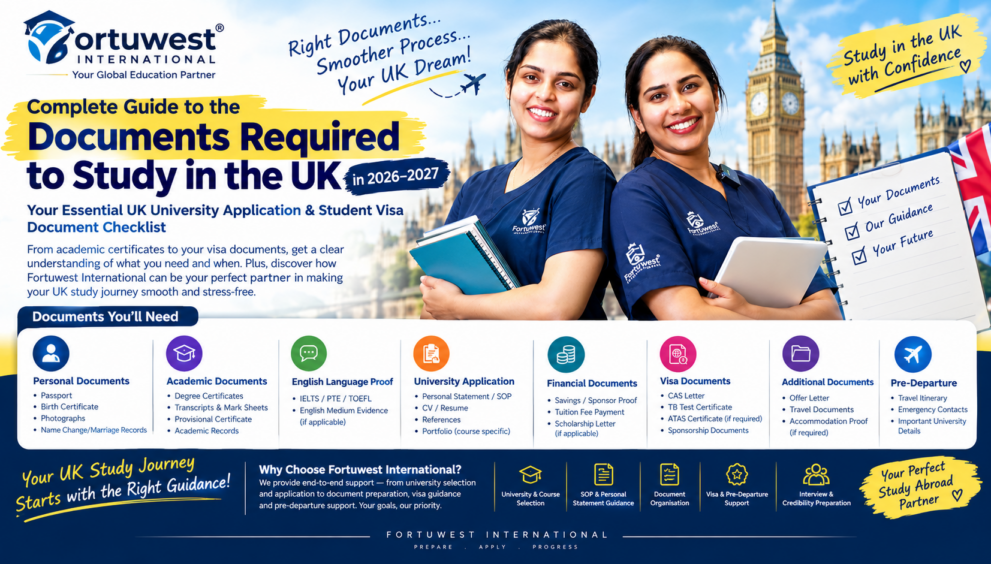
A student’s documents can broadly be divided into several categories:
1. Personal documents
2. Academic documents
3. English-language documents
4. University application documents
5. Financial documents
6. Visa documents
7. Additional documents
8. Pre-departure documents
Let’s look at each category in detail.
1. Passport & Personal Documents
Your passport is one of the most important documents in your UK application.
Prepare:
- Valid passport
- Previous passports, where relevant
- Passport-size photographs if requested
- Birth certificate, where applicable
- National identity documents, where applicable
- Name-change documentation, if applicable
- Marriage certificate, if applicable
Your personal details should be consistent across your application.
Check carefully:
Name → Date of birth → Passport number → Nationality
If your academic certificates contain a different name spelling from your passport, resolve the discrepancy as early as possible.
For Student visa applications, GOV.UK specifically requires a current passport or another valid travel document. (GOV.UK)
2. Academic Documents
Your academic documents demonstrate that you meet the university’s entry requirements.
Depending on your level of study, you may need:
For undergraduate applicants
- Class 10 certificate
- Class 12 certificate
- Class 12 mark sheets
- School leaving certificate, where applicable
- Entrance examination results, if relevant
- Other academic qualifications
For postgraduate applicants
- Bachelor’s degree certificate
- Bachelor’s transcripts
- Semester-wise/year-wise mark sheets
- Provisional certificate, where applicable
- Master’s qualification, if relevant
- Academic transcripts
- Professional qualifications
For PhD applicants
You may additionally need:
- Previous degree certificates
- Academic transcripts
- Research proposal
- Research publications, if relevant
- Academic CV
- References
- Evidence of research experience
Important: The exact academic documentation requested varies between universities and courses.
3. Academic Transcripts
A degree certificate confirms that you completed a qualification, while a transcript provides details of your academic performance.
A transcript may contain:
- Subjects/modules
- Marks or grades
- Credits
- Semester results
- Overall classification
Keep both original documents and high-quality digital copies where possible.
4. English Language Documents
Many international students need to demonstrate their English-language ability.
Depending on the university and your circumstances, this could include:
- IELTS
- IELTS for UKVI, where specifically required
- PTE Academic
- TOEFL
- Other accepted English-language qualifications
- Evidence of a previous qualification taught in English, where accepted
The important point is:
Do not assume that one English test is accepted by every university or for every purpose.
The university’s admission requirements and UK immigration rules can differ.
GOV.UK states that students may demonstrate English proficiency through specified qualifications or an approved English test, depending on their circumstances. (GOV.UK)
5. Statement of Purpose / Personal Statement
Your SOP or personal statement explains your academic journey and motivation.
Depending on the university and application route, you may need to provide:
- Personal statement
- Statement of purpose
- Course-specific statement
- Additional written responses
A strong statement should explain:
Why this subject?
Why this course?
Why this university?
What relevant experience do you have?
What are your career goals?
Avoid submitting a generic statement to every university.
6. CV / Resume
Some UK courses may request or recommend a CV, particularly postgraduate and professional programmes.
Your academic CV may include:
- Education
- Work experience
- Internships
- Research
- Projects
- Certifications
- Professional experience
- Volunteering
- Relevant skills
- Achievements
For healthcare applicants, relevant clinical experience and professional training can be particularly important where the course requires them.
7. Letters of Recommendation
Some universities or courses may ask for references.
Depending on the programme, these could come from:
- Teachers
- Lecturers
- Professors
- Academic supervisors
- Employers
- Professional supervisors
Choose someone who can provide specific and relevant information about your academic or professional abilities.
8. Portfolio or Additional Academic Evidence
Certain programmes may require additional evidence.
For example:
Art & Design
- Portfolio
- Creative work
- Design projects
Architecture
- Portfolio
- Design work
- Project documentation
Research programmes
- Research proposal
- Publications
- Academic writing samples
Professional courses
- Professional registration
- Work experience evidence
- Relevant certifications
Always check the individual course requirements.
9. University Offer Letter
Once a university assesses your application, you may receive an offer.
The offer can be:
Conditional offer
You still need to satisfy certain conditions.
For example:
- Achieve required grades
- Submit a final certificate
- Provide English-language evidence
- Provide another required document
Unconditional offer
The university has confirmed that you have met its stated conditions.
Keep your offer letter safely stored.
10. Tuition Fee Payment Evidence
Depending on the university and stage of the application, you may need evidence related to tuition fees.
Keep records of:
- Tuition fee payments
- Deposit payment receipts
- Scholarship confirmation
- Sponsorship letters
- University payment confirmations
These records can become useful during the university and visa process.
11. CAS — Confirmation of Acceptance for Studies
The CAS is a crucial document/reference for students applying for a UK Student visa.
Your education provider issues the CAS once the relevant requirements have been satisfied.
The CAS contains information about your course and sponsorship.
For Student visa applications, GOV.UK lists the CAS from your course provider among the documents you need. (GOV.UK)
Before applying for your visa:
Check your CAS details carefully, including:
- Name
- Passport details
- Course title
- Course dates
- Tuition fee information
- Sponsoring institution
- Any other information provided by the university
If you notice an error, contact the university promptly.
12. Financial Documents
Financial evidence can be one of the most important parts of a Student visa application when you are required to provide it.
GOV.UK states that applicants may need to prove they have enough money to support themselves and pay for their course, depending on their circumstances. (GOV.UK)
Potential evidence can include documentation relating to:
- Personal savings
- Parent’s finances where permitted
- Official sponsorship
- Student loans where accepted
- Other permitted financial evidence
Important
Don’t prepare financial documents based on random social-media advice.
The amount required and the evidence rules can change, so students should check the current GOV.UK requirements and their university’s guidance before submitting a visa application.
13. TB Test Certificate
Some applicants need to provide evidence of a tuberculosis test.
Whether you need one depends on your circumstances, including the country from which you are applying.
GOV.UK specifically identifies a TB test result as a document that may be required for a Student visa application. (GOV.UK)
Students should check the current official requirements rather than assuming that everyone needs the same documentation.
14. ATAS Certificate
Some students applying for certain postgraduate or research programmes may need an Academic Technology Approval Scheme (ATAS) certificate.
ATAS requirements depend on factors such as the course and nationality.
GOV.UK confirms that an ATAS certificate is required for certain courses and circumstances. (GOV.UK)
If your course requires ATAS, don’t leave this until the last minute.
15. Sponsorship Documents
If your education is being funded by an official sponsor, you may need relevant sponsorship documentation.
This could include:
- Sponsorship letter
- Scholarship confirmation
- Government sponsorship evidence
- Employer sponsorship documentation
For Student visa applications, GOV.UK notes that written consent from a financial sponsor may be required in certain circumstances, including where the sponsor has funded course fees and living costs within the previous 12 months. (GOV.UK)
16. Documents for Students Under 18
Students under 18 may have additional requirements.
GOV.UK states that under-18 Student visa applicants need written consent covering their visa application, living/care arrangements and travel, with evidence of their relationship to the parent or guardian. (GOV.UK)
This may include:
- Birth certificate
- Parental consent
- Parent/guardian identification
- Evidence of relationship
- Care/living arrangement documentation
17. Certified Translations
This is often overlooked.
If an important document is not in English or Welsh, you may need a certified translation.
The translation requirements should be checked carefully before submitting documents.
GOV.UK states that visa applicants generally need certified translations for documents that are not in English or Welsh. (GOV.UK)
Never rely on:
❌ Google Translate alone
❌ Informal translations
❌ Uncertified copies when certification is required
18. Visa Application Documents
Once you have progressed to the Student visa stage, create a separate Visa Document Folder.
Depending on your circumstances, this may contain:
- Valid passport
- CAS reference
- Financial evidence, if required
- TB certificate, if required
- ATAS certificate, if required
- English-language evidence, where required
- Sponsorship consent, if applicable
- Parental consent documents, if under 18
- Certified translations, where applicable
- Other documents requested during the application
The official GOV.UK checklist should always take priority over generic online checklists. (GOV.UK)
19. Keep Digital Copies of Everything
Create a secure digital folder before travelling.
Suggested folder structure:
UK STUDY 2027
📁 01 — Passport
📁 02 — Academic Documents
📁 03 — English Test
📁 04 — University Applications
📁 05 — Offer Letters
📁 06 — Financial Documents
📁 07 — CAS
📁 08 — Visa Documents
📁 09 — Accommodation
📁 10 — Travel Documents
Use clear filenames.
For example:
Passport_Name.pdfClass12_Marksheet_Name.pdfIELTS_TRF_Name.pdfUniversity_Offer_Name.pdf
This can make it much easier to find documents when you need them.
Documents to Carry When Travelling to the UK
Don’t rely entirely on your phone or cloud storage.
Keep important documents accessible while travelling.
Your travel folder could include:
- Passport
- Visa/eVisa-related information
- CAS details
- University offer information
- Accommodation confirmation
- University contact information
- Emergency contacts
- Important academic documents
- Copies of financial/sponsorship documents where appropriate
Your immigration status is now increasingly managed digitally through the UK eVisa system; GOV.UK advises successful applicants to access their eVisa and link their travel document to their UKVI account. (GOV.UK)
The Ultimate UK Study Document Checklist
| Document | University Application | Visa Stage |
|---|---|---|
| Passport | ✅ | ✅ |
| Academic certificates | ✅ | May be required depending on circumstances |
| Academic transcripts | ✅ | Sometimes |
| English test | Often | Sometimes |
| Personal statement/SOP | Often | ❌ |
| CV | Course-dependent | ❌ |
| References | Course-dependent | ❌ |
| Portfolio | Course-dependent | ❌ |
| Offer letter | ✅ | Useful |
| Tuition payment evidence | Sometimes | Sometimes |
| CAS | ❌ | ✅ |
| Financial evidence | ❌ | If required |
| TB certificate | ❌ | If required |
| ATAS certificate | ❌ | If required |
| Sponsorship evidence | If applicable | If required |
| Certified translations | If applicable | If required |
| Parental consent | If applicable | If required |
Remember: this is a preparation checklist, not a substitute for the specific requirements of your university or the current UK immigration rules.
How Fortuwest International Can Help
Preparing to study in the UK involves much more than submitting an application.
Students need to coordinate:
Course selection → University selection → Application → Documents → Offer → CAS → Visa preparation → Pre-departure
This is where Fortuwest International positions itself as a study-abroad and career guidance partner. Its official website states that it provides overseas education consultancy, career guidance and global university admissions support alongside its healthcare and language-exam training services. (Fortuwest International)
With the right preparatory guidance, students can work on:
🎓 University & Course Selection
Identify courses that align with your academic background and career objectives.
📝 Application Preparation
Organise the information and supporting documents needed for applications.
📄 SOP & Personal Statement Guidance
Present your academic journey, motivation and future plans clearly.
🇬🇧 UK Study Guidance
Understand the major stages involved in preparing for UK study.
📑 Document Organisation
Create a structured checklist so important paperwork is not overlooked.
🎯 Interview & Credibility Preparation
Practise explaining your academic choices, course motivation and future plans clearly.
For students pursuing healthcare-related pathways, Fortuwest also provides preparation for examinations such as IELTS, OET, CBT and OSCE, alongside overseas education and career support. (Fortuwest International)
Why Choose a Preparatory Partner?
A good preparation partner should not simply tell students “upload these documents.”
The more valuable approach is helping students understand:
What is required?
Why is it required?
When is it required?
Who needs to provide it?
Does the document need translation or certification?
Does the university or visa authority have additional requirements?
This systematic approach can help students avoid preventable delays and confusion.
Final Advice: Start Your Document Preparation Early
Your UK study journey becomes considerably easier when your documents are organised before deadlines approach.
Start with the basics:
Step 1
Check your passport.
Step 2
Collect your academic certificates and transcripts.
Step 3
Prepare your English-language evidence.
Step 4
Prepare your SOP/personal statement and CV where required.
Step 5
Organise references and additional course-specific documents.
Step 6
Track university offers and conditions.
Step 7
Prepare for CAS issuance.
Step 8
Check the latest Student visa requirements on GOV.UK.
Step 9
Prepare financial, TB, ATAS or sponsorship evidence only where applicable.
Step 10
Create both digital and physical document folders before departure.
Conclusion
Studying in the UK can be a life-changing academic opportunity, but successful preparation begins long before you board your flight.
From academic certificates and transcripts to your passport, English-language evidence, offer letter, CAS and visa documentation, every stage requires careful organisation.
The most important rule is simple:
Don’t wait until the deadline to start collecting your documents.
Begin early, verify requirements from official sources, keep your documents organised and seek professional guidance where you need it.
With structured preparation and the right support, your journey from application to UK university can be much more organised and confident.
Fortuwest International — Your Preparatory Guide for Your UK Study Journey.