


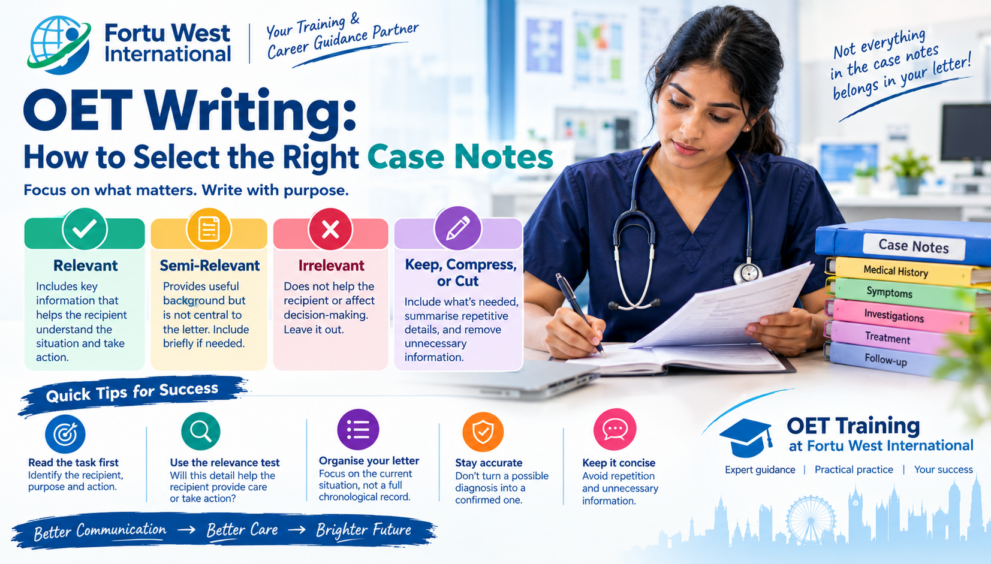
In OET Writing, you are not expected to copy every detail from the case notes. Your task is to select the information that is relevant to the reader and the purpose of the letter.
During the five-minute reading period, focus on three questions:
- Who are you writing to?
- Why are you writing?
- What does the recipient need to know or do?
These questions help you decide which information should be included, summarised or removed.
Identify Relevant Information
Relevant information directly supports the purpose of your letter. Depending on the task, this may include:
- The patient’s current condition
- Important symptoms and findings
- Relevant investigation results
- Treatment already provided
- Medication affecting care
- Important risks or precautions
- The patient’s current status
- The requested follow-up or action
For example, when referring a patient with worsening knee pain, information about the duration of symptoms, examination findings, imaging results, previous treatment and mobility may be important.
Understand Semi-Relevant Information
Some information may provide useful background but may not be central to the referral. Its importance depends on the recipient and purpose of the letter.
For example, a patient’s history of osteoarthritis may be useful when referring them for chronic knee pain. However, it may have little value in a letter concerning an unrelated condition.
If background information is useful, include it briefly rather than allowing it to take attention away from the main clinical information.
Remove Irrelevant Details
Information that does not help the recipient understand the patient’s current situation or take appropriate action should generally be excluded.
This can include:
- Unrelated previous illnesses
- Unnecessary family or social history
- Repeated information
- Old events that do not affect current care
- Details outside the recipient’s role
The key question is:
Will this information help the recipient provide care or take the requested action?
If not, it probably does not need to be included.
Keep, Compress or Cut
A simple way to manage case notes is to divide information into three categories.
Keep: Include information that the reader needs.
Compress: Summarise related or repetitive information instead of describing every event separately.
Cut: Remove information that has no clear connection to the purpose of the letter.
This approach helps you produce a focused and professional letter without unnecessary details.
Avoid Copying the Medical Record
Case notes may contain a long sequence of consultations, investigations and treatments. Your letter should not simply reproduce this chronology.
Instead, organise information around the current situation and the reason for writing.
A useful structure may include:
- Reason for writing and current situation
- Relevant history, symptoms and findings
- Investigations and treatment
- Current status and requested action
The exact organisation will depend on the task.
Preserve Accuracy
When summarising notes, make sure you do not change the meaning of the information.
For example:
Case note:
? pneumonia
Accurate:
Pneumonia is suspected.
Do not change an uncertain diagnosis into a confirmed diagnosis.
Similarly:
Case note:
SOB on exertion – 2 weeks – worsening
Professional sentence:
She has experienced worsening shortness of breath on exertion for the past two weeks.
Transform notes into clear sentences while maintaining the original meaning.
Do Not Add Information Just to Reach the Word Count
OET Writing recommends a 180–200-word body for the letter. However, you should not add irrelevant information simply to increase the length.
If your letter is too long, look for:
- Repeated information
- Excessive background history
- Unnecessary consultation details
- Information already known to the recipient
If your letter is too short, check whether you have included all the important information needed to support the purpose.
A Five-Minute Selection Strategy
During the reading period:
Step 1: Read the task first and identify the recipient and purpose.
Step 2: Understand the patient’s current situation.
Step 3: Mark information that supports the purpose.
Step 4: Group related symptoms, treatments and consultations.
Step 5: Remove unrelated information.
Step 6: Organise the selected information logically before writing.
Final Tip
The case notes are a source of information, not a script that must be copied.
For successful OET Writing, focus on relevance, accuracy, organisation and conciseness. Select information according to the reader’s needs and the purpose of the letter.
Prepare for OET with Fortu West International
At Fortu West International, our OET training is designed to help nurses and healthcare professionals develop the language skills and writing techniques needed for the OET. Through structured lessons, practice activities, case-note selection exercises, letter-writing guidance and personalised feedback, learners can improve their ability to communicate clearly and professionally in healthcare settings. Our training focuses on practical OET preparation, helping candidates understand the test requirements, manage their time effectively and approach each task with greater confidence.