


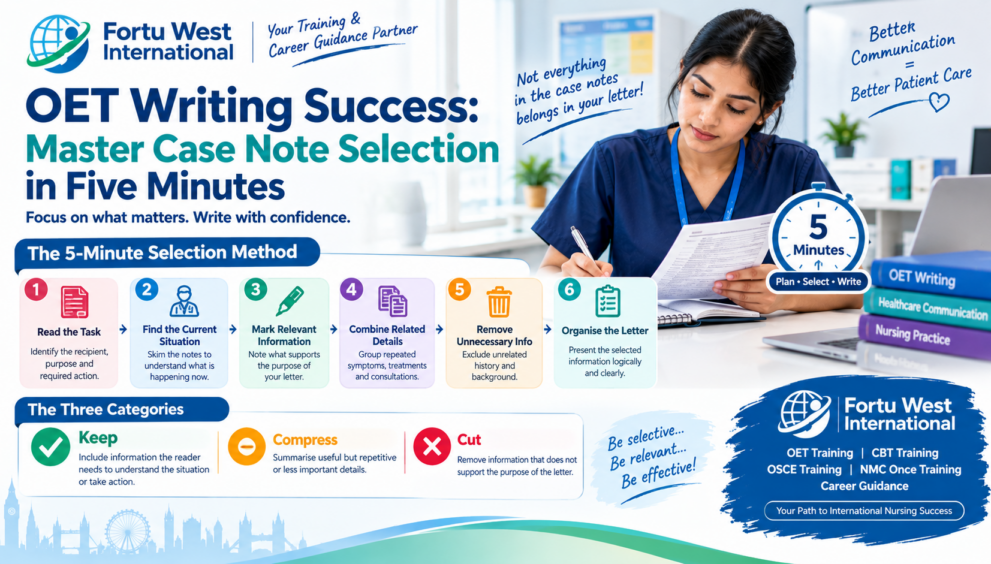
One of the most important skills in OET Writing is knowing what not to write.
Healthcare case notes can contain a large amount of information. They may include previous diagnoses, symptoms, investigations, medications, consultations and personal history. However, a successful OET letter focuses only on information that helps the specific reader understand the patient’s situation and respond appropriately.
Start With the Reader
Before reading the case notes in detail, look at the writing task.
Ask yourself:
Who is receiving this letter?
What is the reason for writing?
What action is expected from the reader?
Your answers create a filter for deciding which case notes are important.
Use the Relevance Test
For every piece of information, ask:
Does this detail explain the current problem, affect management or support the reason for referral?
If yes, it is likely relevant.
For example, when referring a patient with worsening breathlessness, details such as reduced exercise tolerance, abnormal investigation results and limited response to treatment may be important.
An unrelated childhood injury would normally have no place in the same referral.
Three Categories to Remember
1. Essential Information
These are details the recipient needs to understand the patient’s current condition and provide appropriate care.
Examples include current symptoms, significant findings, relevant investigations, treatment response and important risks.
2. Supporting Information
These details may provide useful context but should not dominate the letter.
A previous diagnosis may belong here when it has some connection to the current problem.
3. Unnecessary Information
These details do not contribute to the purpose of the letter. They should be removed rather than included simply because they appear in the case notes.
Turn Several Notes Into One Clear Sentence
OET Writing rewards clear communication rather than repetition.
Instead of describing every consultation separately, combine related information.
For example, several notes about repeated treatment and continuing symptoms can be summarised by explaining that the patient received treatment but experienced limited improvement.
This saves words while preserving the important clinical message.
Do Not Follow the Notes Line by Line
The order of the case notes does not always represent the best order for your letter.
You can reorganise information so that the reader understands the situation quickly.
A practical organisation is:
Paragraph 1: Purpose of the letter and current problem
Paragraph 2: Relevant history and symptoms
Paragraph 3: Investigations and treatment
Paragraph 4: Current condition and requested action
This is a flexible guide, not a fixed formula.
Be Careful With Uncertainty
Clinical notes may use symbols or short forms to indicate uncertainty.
For example:
? infection
should not automatically become:
The patient has an infection.
Instead, communicate the uncertainty accurately, such as:
An infection is suspected.
Accuracy is more important than making the sentence sound definite.
The 5-Minute OET Filter
You can use this quick method during the reading period:
1. Purpose – Why am I writing?
2. Recipient – What does this professional need to know?
3. Current problem – What is happening now?
4. Evidence – Which findings, investigations and treatments support the message?
5. Action – What does the recipient need to do?
Anything that does not support these five areas should be questioned before being included.
Example: Respiratory Referral
Imagine the notes contain:
- Worsening breathlessness for two weeks
- Reduced exercise tolerance
- Abnormal chest X-ray
- Limited improvement after inhaler treatment
- Previous asthma
- Childhood ankle fracture
- Family history of hypertension
For a respiratory referral, the worsening breathlessness, reduced exercise tolerance, abnormal X-ray and treatment response are clearly connected to the purpose.
The asthma history may also be useful because it could influence the specialist’s assessment.
The ankle fracture and unrelated family history would generally not need to be included if they have no connection to the current respiratory problem.
Remember the Main Principle
Do not write everything you know. Write what the reader needs to know.
Strong OET Writing is not about filling the page with medical information. It is about selecting the right details, connecting them logically and communicating them accurately.
With regular practice, you can become faster at identifying relevant information and use the five-minute reading period more effectively.
Prepare for OET with Fortu West International
At Fortu West International, our OET training is designed to help nurses and healthcare professionals develop the language skills and writing techniques needed for the OET. Through structured lessons, practice activities, case-note selection exercises, letter-writing guidance and personalised feedback, learners can improve their ability to communicate clearly and professionally in healthcare settings. Our training focuses on practical OET preparation, helping candidates understand the test requirements, manage their time effectively and approach each task with greater confidence.