


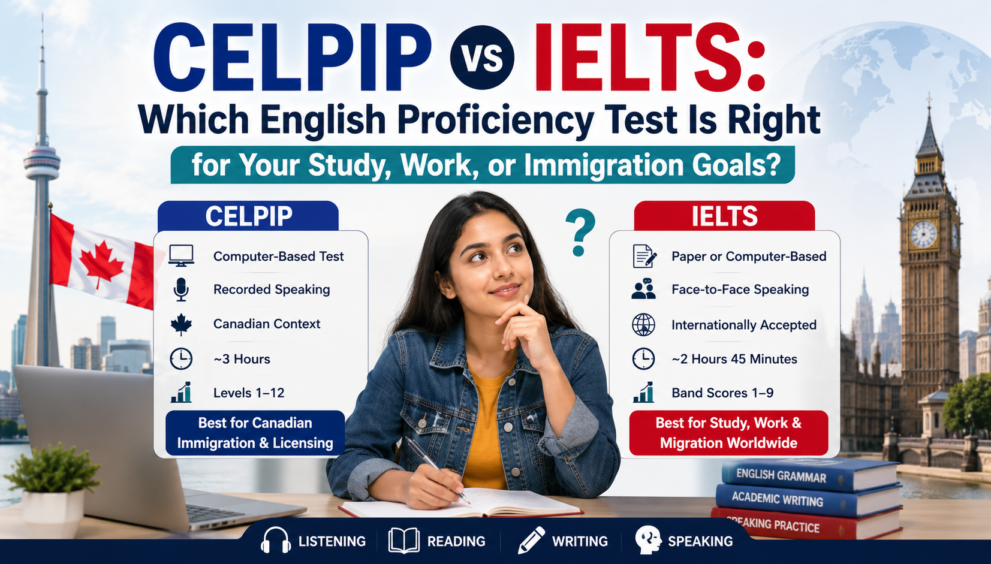
Planning to study abroad, migrate to another country, or build an international career often requires proof of English language proficiency. Two of the world’s most widely recognized English language tests are CELPIP and IELTS. While both assess your ability to communicate effectively in English, they differ in exam format, scoring, acceptance, and testing style.
Understanding the difference between CELPIP and IELTS is essential before registering for an exam. Choosing the right test can simplify your preparation and help you achieve your academic, professional, or immigration goals.
Understanding the CELPIP Exam
The Canadian English Language Proficiency Index Program (CELPIP) is designed primarily for Canadian immigration, citizenship, and professional certification. It evaluates how effectively candidates use English in real-life situations commonly encountered in Canada.
The CELPIP General Test assesses four language skills:
- Listening
- Reading
- Writing
- Speaking
One of CELPIP’s biggest advantages is its fully computer-based format. Even the speaking section is completed using a computer microphone, with responses recorded electronically rather than spoken to an examiner.
Because the tasks reflect everyday Canadian life, CELPIP is an excellent option for candidates planning to live and work in Canada.
Understanding the IELTS Exam
The International English Language Testing System (IELTS) is accepted by universities, employers, immigration authorities, and professional organizations in countries around the world.
IELTS is available in two versions:
- IELTS Academic
- IELTS General Training
Both assess Listening, Reading, Writing, and Speaking, although the Reading and Writing sections differ depending on the purpose of the test.
Unlike CELPIP, IELTS is offered in both computer-delivered and paper-based formats in many test centres.
CELPIP vs IELTS: Key Differences
| Feature | CELPIP | IELTS |
|---|---|---|
| Primary Purpose | Canadian immigration and licensing | International education, employment, and migration |
| Test Format | Computer-based only | Computer-based or paper-based |
| Speaking Test | Recorded responses | Face-to-face interview |
| English Accents | Mainly Canadian | British, Australian, American, Canadian, and others |
| Duration | About 3 hours | About 2 hours 45 minutes |
| Scoring | Levels 1–12 | Band Scores 1–9 |
Although both tests evaluate the same language skills, the overall testing experience differs considerably.
Listening Module
CELPIP uses everyday Canadian conversations, workplace discussions, and public announcements.
IELTS includes recordings featuring speakers from several English-speaking countries, requiring candidates to understand multiple accents.
Candidates who regularly listen to international English media may adapt more easily to IELTS, while those familiar with Canadian English often find CELPIP more comfortable.
Reading Module
CELPIP focuses on practical reading materials such as:
- Emails
- Advertisements
- Notices
- Everyday informational texts
IELTS Academic contains more complex passages taken from books, journals, and articles, while IELTS General Training emphasizes workplace and social situations.
Writing Module
CELPIP writing tasks are practical and include writing emails, responding to surveys, and expressing opinions.
IELTS requires more formal writing.
Academic candidates describe charts or graphs before writing an essay, while General Training candidates write a letter followed by an essay.
Speaking Module
One of the biggest differences between CELPIP and IELTS is the speaking test.
In CELPIP, candidates record their responses using a computer microphone.
In IELTS, candidates participate in a live interview with a certified examiner consisting of:
- Introduction and interview
- Individual speaking task
- Two-way discussion
Candidates who feel nervous during interviews often prefer CELPIP, while others appreciate the natural conversation offered by IELTS.
Scoring System
CELPIP uses Level 1 to Level 12.
IELTS uses Band Scores from 1 to 9.
Both provide separate scores for Listening, Reading, Writing, and Speaking, allowing candidates to identify strengths and areas for improvement.
For Canadian immigration, both score systems can be converted into Canadian Language Benchmark (CLB) levels.
Global Recognition
IELTS is recognized by thousands of universities, employers, and immigration authorities worldwide, making it one of the most accepted English proficiency tests internationally.
CELPIP is mainly accepted for:
- Canadian immigration
- Canadian citizenship
- Selected professional licensing organizations
Candidates planning opportunities outside Canada generally choose IELTS because of its wider international recognition.
CELPIP or IELTS: Which Is Easier?
Many candidates search for “CELPIP or IELTS: Which is easier?”
The truth is that neither exam is universally easier. The better option depends on your strengths, learning style, and future goals.
CELPIP may be the better choice if you:
- Prefer computer-based testing.
- Feel uncomfortable speaking with an examiner.
- Are familiar with Canadian English.
- Prefer practical, real-life communication tasks.
IELTS may be more suitable if you:
- Need a globally recognized qualification.
- Are comfortable with face-to-face interviews.
- Have experience writing formal essays.
- Can understand a wide range of English accents.
Selecting the exam that matches your strengths often leads to better results.
Preparation Tips
Regardless of your choice, consistent preparation is the key to success.
To improve your score:
- Complete regular mock tests.
- Read English newspapers, books, and articles.
- Listen to podcasts featuring different English accents.
- Build your vocabulary daily.
- Practise writing essays and emails.
- Improve speaking fluency through regular conversation practice.
Regular study builds confidence and improves exam performance.
Which Test Should You Choose?
Your decision should always be based on your future plans.
Choose CELPIP if your goal is Canadian immigration, citizenship, or professional registration and you prefer a fully computer-based exam.
Choose IELTS if you plan to study abroad, work internationally, or migrate to countries where IELTS is widely accepted.
Before registering, always verify the English language requirements of your university, employer, or immigration program.
Conclusion
Both CELPIP and IELTS are trusted English proficiency examinations that assess the communication skills needed for higher education, employment, and immigration. Although they evaluate the same four language skills, they differ in format, testing style, and global recognition.
If you’re still wondering “CELPIP or IELTS: Which is easier?”, remember that success depends less on the exam itself and more on choosing the test that aligns with your goals and preparing consistently.
At Fortu West International, we provide expert guidance and preparation support for English language proficiency tests, helping students and professionals confidently take the next step toward their international education, career, or immigration journey.