

By FortuWest International
NMC OSCE GCS Chart: 5 Key Things You Must Know for Accurate Documentation
In the NMC OSCE, you may perform a neurological assessment correctly, but inaccurate documentation of the Glasgow Coma Scale (GCS) can cost valuable marks and even lead to failure at the assessment station. Many candidates struggle not with the assessment itself, but with recording their findings clearly, accurately, and according to NMC standards.
Knowing how to document the NMC OSCE GCS chart is one of the most important skills for international nurses preparing for the OSCE. Examiners assess not only your clinical competence but also your ability to communicate patient observations through professional documentation.
In this guide, you’ll learn how to:
- Document the GCS chart step by step during the NMC OSCE
- Understand the purpose of GCS documentation
- Record findings accurately using the correct documentation format
- Avoid the most common documentation mistakes
- Meet NMC documentation standards with confidence
By the end of this guide, you’ll know how to document a GCS assessment like a UK-registered nurse—accurately, professionally, and with confidence.
What Is the Glasgow Coma Scale (GCS)?
The Glasgow Coma Scale (GCS) is a neurological assessment tool used to evaluate a patient’s level of consciousness. It is widely used across NHS hospitals to identify neurological deterioration, particularly in patients with head injuries, stroke, or other neurological conditions.
For the NMC OSCE, understanding the GCS is only part of the assessment. Candidates must also demonstrate that they can accurately document neurological findings in a clear, structured, and professional manner.
Why Accurate GCS Documentation Matters in the NMC OSCE
Documentation is a legal and professional responsibility for every registered nurse. During the NMC OSCE, examiners evaluate whether your documentation is accurate enough to ensure safe patient care and effective communication among healthcare professionals.
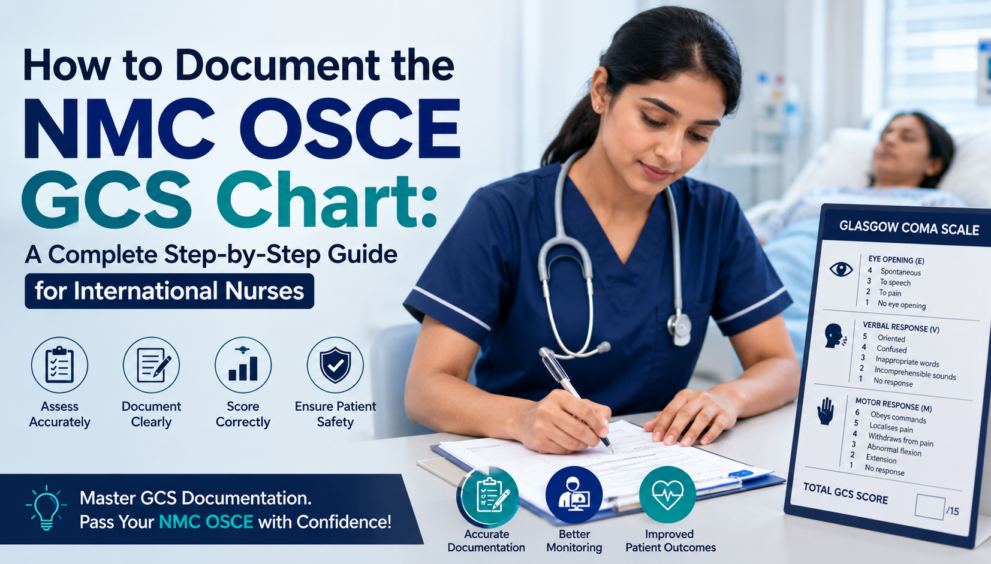
The Glasgow Coma Scale measures three key neurological responses:
- Eye Opening (E)
- Verbal Response (V)
- Motor Response (M)
In addition to neurological observations, candidates are expected to document vital signs, pupil reactions, limb movement, and the correct monitoring frequency based on the patient’s GCS score.
What OSCE Examiners Look For
During the assessment, examiners expect candidates to:
- Record Eye, Verbal, and Motor responses correctly.
- Document vital signs accurately.
- Record pupil size and reaction to light.
- Assess and document movement in all four limbs.
- Calculate the total GCS score correctly.
- Identify abnormal findings.
- State the correct neurological monitoring frequency.
- Complete documentation clearly, professionally, and legibly.
Step-by-Step Guide to Documenting the NMC OSCE GCS Chart
Follow these steps during your OSCE assessment:
Step 1: Assess Eye Opening (E)
Record the patient’s best response.
- E4 – Eyes open spontaneously
- E3 – Eyes open to speech
- E2 – Eyes open to pain
- E1 – No eye opening
Example:
Eyes open to speech (E3)
Step 2: Assess Verbal Response (V)
Evaluate orientation and communication.
- V5 – Oriented
- V4 – Confused
- V3 – Inappropriate words
- V2 – Incomprehensible sounds
- V1 – No response
Example:
Confused conversation (V4)
Step 3: Assess Motor Response (M)
Assess the patient’s ability to follow commands.
- M6 – Obeys commands
- M5 – Localises pain
- M4 – Withdraws from pain
- M3 – Abnormal flexion
- M2 – Extension
- M1 – No response
Example:
Obeys commands (M6)
Step 4: Calculate the Total Score
Add the three components together.
Example:
E3 + V4 + M6 = GCS 13/15
Always record both the individual component scores and the total score.
Step 5: Document Vital Signs
Record the following observations accurately:
- Temperature
- Pulse
- Respiratory Rate
- Blood Pressure
- Oxygen Saturation (SpO₂)
Ensure all observations are plotted correctly on the GCS chart according to the chart’s instructions.
Step 6: Determine the Monitoring Frequency
Monitoring depends on the patient’s neurological score.
If GCS is less than 15:
Monitor and document neurological observations every 30 minutes until the patient reaches a GCS of 15.
If GCS is 15:
- Every 30 minutes for 2 hours
- Every hour for 4 hours
- Every 2 hours thereafter
Always verbalise the monitoring plan during your OSCE.
Common Documentation Mistakes
Avoid these frequent errors:
- Recording only the total GCS score.
- Forgetting to include Eye, Verbal, and Motor components.
- Omitting the assessment time.
- Guessing patient responses.
- Failing to state the monitoring frequency.
- Missing vital sign documentation.
Examiner Expectations
Your documentation should demonstrate:
- Clinical accuracy
- Professional communication
- Safe nursing practice
- Clear clinical reasoning
- Accurate monitoring decisions
Remember, examiners assess whether another nurse could safely continue patient care using your documentation.
Quick Documentation Example
14:00
Eyes open to speech (E3)
Confused conversation (V4)
Obeys commands (M6)
Total GCS: 13/15
Vital signs documented.
Neurological observations to continue every 30 minutes until GCS reaches 15.
Final Tips for OSCE Success
Before your examination:
- Practise documenting complete GCS charts.
- Learn the Eye–Verbal–Motor sequence.
- Simulate timed OSCE stations.
- Practise verbalising your monitoring plan.
- Review common documentation errors.
Consistent practice will improve both your confidence and your OSCE performance.
Prepare with FortuWest International
At FortuWest International, we help international nurses prepare confidently for every stage of the UK registration journey.
Our expert trainers provide structured preparation for:
- NMC OSCE
- NMC CBT
- OET
- Mock OSCE assessments
- Clinical documentation stations
- UK nursing interview preparation
With realistic practice scenarios, personalised feedback, and expert guidance, our programmes help candidates build clinical confidence and meet NMC standards successfully.
Start Your UK Nursing Journey with FortuWest International
Whether you’re preparing for the OET, NMC CBT, or NMC OSCE, FortuWest International provides expert exam preparation, practical clinical training, and personalised career guidance to support your success.
Book your FREE consultation today and take the next step toward becoming a UK Registered Nurse.