

IELTS 2026: Major Changes Every Test Taker Must Know
The IELTS exam is entering an important new phase in 2026.
For millions of students, nurses, professionals and international applicants, IELTS remains an important English-language qualification for higher education, professional registration, employment and international mobility. IELTS is accepted by thousands of organisations and institutions worldwide. (IELTS)
However, candidates preparing for the IELTS 2026 exam need to understand a major change: IELTS is transitioning away from traditional paper-based testing at test centres and moving towards computer delivery.
At the same time, IELTS has introduced Writing on Paper in selected markets for candidates who prefer handwriting their Writing responses.
These changes make 2026 an important year for anyone planning to take IELTS.
And if you are looking for structured IELTS preparation in Kerala or the UK, choosing a training centre that understands both the English skills and the changing test environment can give your preparation a valuable advantage.
Fortuwest International provides training for IELTS along with other language and professional examinations and has a presence serving candidates in India and the UK. (Fortuwest International)
What Are the Major IELTS Changes in 2026?
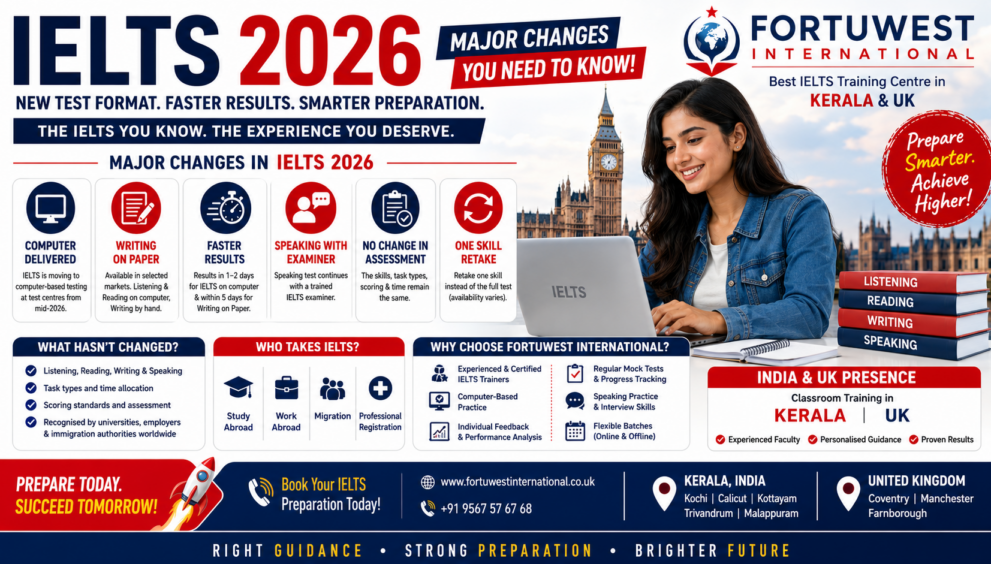
The most important IELTS updates are:
- Traditional paper-based IELTS is being phased out at test centres.
- IELTS is moving to computer-delivered testing.
- Writing on Paper is being introduced in selected markets.
- IELTS Writing tasks, scoring and time allocation remain the same.
- Speaking continues with an examiner.
- Computer-delivered IELTS provides faster results.
- One Skill Retake continues to be available subject to eligibility and test-centre availability.
- IELTS for UKVI will be fully digital.
- Existing paper-based IELTS results remain valid for the applicable validity period.
- Candidates need to become increasingly comfortable with computer-based Reading, Listening and Writing.
IELTS officially announced that from mid-2026, paper-based IELTS will no longer be offered, although implementation timelines can vary by market. Importantly, IELTS says the change is about test delivery and does not change the skills assessed, test construct or interpretation of results. (IELTS)
1. IELTS Is Moving Completely Towards Computer-Based Testing
The biggest IELTS 2026 change is the transition from traditional paper-based testing to computer delivery.
From mid-2026, IELTS test centres will move to computer-delivered testing, with the exact timeline depending on the market. (IELTS)
This means candidates should become familiar with:
- Reading passages on a computer
- Answering Listening questions digitally
- Typing Writing responses
- Navigating between questions
- Reviewing answers on screen
- Managing time in a digital environment
Does this mean IELTS has become a different examination?
No.
The move to computer delivery does not fundamentally change what IELTS assesses.
The four familiar skills remain:
Listening | Reading | Writing | Speaking
For IELTS Academic, the total test time is approximately 2 hours and 45 minutes, with Listening, Reading, Writing and Speaking assessed separately. (IELTS)
2. What Is IELTS Writing on Paper?
One of the most important developments for IELTS 2026 is Writing on Paper.
Some candidates are more comfortable handwriting an essay than typing it. IELTS has therefore introduced a Writing on Paper option in selected markets.
With this format:
| IELTS Section | Delivery |
|---|---|
| Listening | Computer |
| Reading | Computer |
| Writing | Handwritten |
| Speaking | With an examiner |
The Writing questions appear on the computer screen. Candidates then use an official IELTS Writing Answer Sheet and pen to complete their responses by hand. (IELTS)
Does Writing on Paper have a different IELTS score?
No.
The:
- Task types
- Scoring
- Assessment
- Time allocation
remain the same.
The primary difference is simply whether the Writing response is typed or handwritten. IELTS research has found comparable performance between the delivery modes. (IELTS)
3. Writing on Paper Is Available for Academic and General Training
Writing on Paper is available for:
- IELTS Academic
- IELTS General Training
where offered in the relevant market.
The Writing component remains 60 minutes and consists of two parts. (IELTS)
However, there is an important exception.
Is Writing on Paper available for IELTS for UKVI?
No.
IELTS states that the Secure English Language Test (SELT) for UK Visas and Immigration purposes will only be available in a fully digital format. (IELTS)
Therefore, candidates planning to use IELTS for a UK visa should carefully check which IELTS test they require before booking.
4. IELTS Speaking Continues With an Examiner
Another common misconception about IELTS on computer is that Speaking has become an automated or AI-only assessment.
That is not the case.
The IELTS Speaking test continues to be conducted with an examiner. The Speaking component generally takes 11–14 minutes. (IELTS)
Therefore, IELTS Speaking preparation remains essential.
Candidates should work on:
- Fluency
- Pronunciation
- Vocabulary
- Grammar
- Answer development
- Confidence
- Natural conversation
- Responding to follow-up questions
Memorising complete answers is not a reliable substitute for developing genuine speaking ability.
5. IELTS Results Are Faster With Computer Delivery
Faster results are one of the advantages associated with computer-delivered IELTS.
IELTS currently reports that most IELTS on computer results are issued within two days, although result timing can vary. IELTS says globally around 80% of computer-delivered scores were available within two days based on its published test data. (IELTS)
For the Writing on Paper option, IELTS states that results are received within five days. (IELTS)
This can be particularly useful when candidates are working around:
- University deadlines
- Admission conditions
- Professional registration
- Employment applications
- Immigration timelines
Candidates should always check the expected result date associated with their specific test booking.
6. IELTS One Skill Retake in 2026
Another feature that IELTS candidates should understand is One Skill Retake.
Instead of repeating the entire test, eligible candidates may be able to retake one of the four skills:
- Listening
- Reading
- Writing
- Speaking
Availability depends on the test centre, country and applicable requirements. IELTS confirms that One Skill Retake is available in many locations. (IELTS)
One Skill Retake and Writing on Paper
There is an important 2026 update.
If a candidate takes Writing on Paper and later chooses a One Skill Retake for Writing, the retake must also be completed using Writing on Paper. (IELTS)
Candidates should also confirm that their university, professional body or other receiving organisation accepts One Skill Retake before relying on it.
7. IELTS for UKVI Is Fully Digital
For candidates planning to study, work or settle in the UK, understanding the difference between standard IELTS and IELTS for UKVI is particularly important.
IELTS confirms that the SELT for UK Visas & Immigration purposes will be delivered in a fully digital format. (IELTS)
Therefore, UK-bound candidates should not simply book an ordinary IELTS test without first checking their specific visa or institutional requirement.
Before booking IELTS for the UK, check:
✔ Required IELTS test type
✔ Required overall band score
✔ Required score in each component
✔ Whether IELTS for UKVI is required
✔ Whether One Skill Retake is accepted
✔ Whether the institution accepts the selected test
The safest approach is to check the requirements of the relevant university, professional regulator or UK authority before booking.
8. The IELTS Assessment Criteria Have Not Been Replaced
One of the most important messages for IELTS candidates is:
New delivery does not mean a completely new IELTS syllabus.
The transition to computer delivery does not change the fundamental skills assessed by IELTS. (IELTS)
For IELTS Academic, candidates continue to prepare for:
Listening
Approximately 30 minutes.
Reading
60 minutes.
Writing
60 minutes.
Speaking
11–14 minutes.
These timings are reflected in the official IELTS Academic format. (IELTS)
So, rather than searching for a completely new “IELTS 2026 syllabus,” candidates should concentrate on mastering the existing assessment requirements while becoming comfortable with the updated delivery environment.
IELTS Academic vs IELTS General Training
Choosing the correct IELTS test is one of the first decisions candidates need to make.
IELTS Academic
IELTS Academic is generally intended for candidates who want to:
- Study at undergraduate level
- Study at postgraduate level
- Meet certain professional registration requirements
IELTS specifically identifies professional registration, including fields such as medicine and nursing, among potential Academic test uses. (IELTS)
IELTS General Training
IELTS General Training is designed around more practical, everyday and workplace language contexts and is used for certain migration and employment purposes.
Always check the exact requirement of your destination organisation before booking.
How Will IELTS 2026 Affect Students?
The transition to computer-based testing may be easy for some candidates but challenging for others.
Students who are already comfortable with computers may quickly adapt.
Candidates who have spent years preparing exclusively with notebooks and printed IELTS materials may need additional practice.
The biggest adjustment may be:
Writing on a computer + Reading on a screen + Digital Listening + Time management
This is why IELTS preparation in 2026 should combine language development with test-format familiarisation.
How to Prepare for IELTS 2026
1. Practise Computer-Based Reading
Reading on a screen can feel different from reading from a book.
Practise:
- Skimming
- Scanning
- Identifying keywords
- Recognising paraphrases
- Locating information quickly
- Managing 60 minutes effectively
2. Improve Your Typing Skills
If you choose standard IELTS on computer, you will type your Writing responses.
You don’t need to become a professional typist.
However, you should be comfortable enough with the keyboard that typing does not interfere with:
- Developing ideas
- Organising paragraphs
- Checking grammar
- Correcting spelling
- Managing time
3. Practise IELTS Writing Under Real Time Limits
IELTS Writing remains a major component of your preparation.
For Academic Writing, candidates should understand:
Task 1
Describing and interpreting visual information such as charts, graphs, tables, diagrams or processes.
Task 2
Writing an essay in response to a particular argument, opinion, problem or discussion.
A strong Writing preparation programme should focus on:
Task Response + Coherence & Cohesion + Lexical Resource + Grammatical Range & Accuracy
The goal should be to develop these skills rather than memorise generic essays.
4. Strengthen Your IELTS Speaking
Speaking practice should be regular.
Practise answering naturally rather than memorising entire responses.
Focus on:
Part 1
Short questions about familiar topics.
Part 2
Long-turn speaking based on a task card.
Part 3
More detailed discussion and abstract questions.
Your preparation should develop your ability to think, organise and communicate ideas in English.
5. Take Computer-Based Mock Tests
Mock tests are particularly important for IELTS 2026.
A good mock test should help you understand:
- Your current band level
- Your weak sections
- Your time-management problems
- Your common grammar mistakes
- Your vocabulary weaknesses
- Your Listening accuracy
- Your Reading performance
- Your Writing quality
- Your Speaking fluency
The most important part comes after the mock test: analysing your mistakes and improving them.
Fortuwest International – IELTS Training in Kerala & UK
Prepare for IELTS 2026 With a Future-Ready Approach
When IELTS delivery changes, preparation should change too.
Fortuwest International offers coaching in IELTS alongside OET, CBT, OSCE, TOEFL, PTE and other professional and language examinations. Its official website describes its work across language proficiency training, professional examination preparation, overseas education and career guidance, with a presence in India and the UK. (Fortuwest International)
Why Consider Fortuwest International for IELTS Preparation?
Fortuwest can position its IELTS programme around the skills candidates need for the changing 2026 testing environment.
✔ All Four IELTS Skills
Structured preparation for:
Listening | Reading | Writing | Speaking
✔ Computer-Based IELTS Practice
Candidates can become familiar with the digital environment that is increasingly central to IELTS testing.
✔ Writing Guidance
Get focused practice in:
- Task 1
- Task 2
- Essay structure
- Vocabulary
- Grammar
- Coherence
- Task response
✔ Speaking Practice
Regular speaking activities can help candidates improve fluency, pronunciation and confidence.
✔ Mock Tests
Regular practice tests can help candidates identify their strengths and weaknesses.
✔ Personalised Feedback
Effective IELTS preparation is not simply about completing hundreds of questions. Candidates need to understand why an answer is wrong and how to improve.
Fortuwest International: A Leading IELTS Training Choice in Kerala and the UK
For promotional positioning, Fortuwest International can be presented as a leading IELTS training centre serving learners in Kerala and the UK, particularly for students and professionals preparing for international education and career opportunities.
Its wider training portfolio includes IELTS, OET, CBT, OSCE, TOEFL, PTE and other healthcare/language examinations. (Fortuwest International)
The organisation’s UK-and-India presence can also be useful for candidates whose IELTS preparation is part of a larger study-abroad or international career journey.
Rather than preparing only for a test date, candidates can approach IELTS as one stage in their wider international education or professional pathway.
Why Start IELTS 2026 Preparation Early?
Waiting until a few weeks before the test can create unnecessary pressure.
Starting early allows you to:
Identify your current level
Take a diagnostic test and understand where you stand.
Set a realistic target
Your required IELTS score may depend on your university, employer, professional regulator or immigration pathway.
Build vocabulary gradually
Vocabulary improvement takes consistent practice.
Improve grammar
Identify recurring grammar problems and work on them systematically.
Develop Writing skills
Good Writing requires practice, feedback and revision.
Build Speaking confidence
Regular speaking practice is more effective than last-minute memorisation.
Become comfortable with computers
This is especially important as IELTS moves further towards computer delivery.
IELTS 2026 Preparation Plan
A practical preparation roadmap could look like this:
| Stage | Main Objective |
|---|---|
| Week 1 | Diagnostic test + target band identification |
| Weeks 2–3 | Grammar + vocabulary development |
| Weeks 3–5 | Listening and Reading strategies |
| Weeks 4–7 | Writing Task 1 & Task 2 |
| Weeks 5–8 | Speaking practice |
| Weeks 6–9 | Computer-based practice |
| Weeks 8–10 | Full mock tests |
| Final stage | Error correction + exam simulation |
The exact duration should depend on your existing English level, target band and available study time.
Common IELTS 2026 Mistakes to Avoid
Mistake 1: Assuming the syllabus has completely changed
The delivery method is changing, but the fundamental skills IELTS assesses remain the same. (IELTS)
Mistake 2: Ignoring computer practice
If you are taking IELTS on computer, practise in a digital environment before test day.
Mistake 3: Memorising essays
Memorised essays may not appropriately answer the actual question. Develop ideas and learn how to structure your response instead.
Mistake 4: Focusing only on vocabulary
Using complicated vocabulary incorrectly can hurt clarity and accuracy.
Mistake 5: Ignoring Speaking
Speaking is a complete IELTS component and deserves regular practice.
Mistake 6: Booking the wrong test
Academic, General Training and UKVI requirements are not interchangeable in every situation.
Mistake 7: Depending only on mock-test scores
A mock test is useful only when you analyse the errors and improve.
IELTS 2026: Quick Comparison
| Feature | IELTS on Computer | IELTS on Computer – Writing on Paper |
|---|---|---|
| Listening | Computer | Computer |
| Reading | Computer | Computer |
| Writing | Typed | Handwritten |
| Speaking | Examiner | Examiner |
| Writing duration | 60 minutes | 60 minutes |
| Writing tasks | Same | Same |
| Scoring | Same | Same |
| Academic | Yes | Yes, where available |
| General Training | Yes | Yes, where available |
| UKVI Writing on Paper | No | No |
IELTS confirms that Writing on Paper retains the same Writing task types, scoring and time allocation as computer-delivered Writing. (IELTS)
Frequently Asked Questions About IELTS 2026
Is IELTS paper-based discontinued in 2026?
IELTS has announced that from mid-2026, paper-based IELTS will no longer be offered, with exact timelines varying by market. (IELTS)
Is IELTS becoming completely computer-based?
At test centres, IELTS is transitioning to computer delivery. In selected markets, candidates can have the option to complete the Writing component by hand through Writing on Paper. (IELTS)
Has the IELTS syllabus changed in 2026?
The major 2026 change concerns test delivery. IELTS states that the skills assessed, test construct and interpretation of results are not changed by this transition. (IELTS)
Is IELTS Writing on Paper easier?
It should not be considered an easier version of IELTS. The task types, scoring and time allocation remain the same. The main difference is that responses are handwritten rather than typed. (IELTS)
Can I use Writing on Paper for IELTS UKVI?
No. IELTS states that the UKVI SELT is available only in fully digital format. (IELTS)
Is IELTS Speaking still face-to-face?
Speaking continues with an examiner for IELTS on computer. (IELTS)
How quickly will I receive IELTS results?
Most IELTS on computer results are now issued within two days, according to IELTS, while Writing on Paper results are provided within five days. Actual timing can vary. (IELTS)
Is One Skill Retake available in 2026?
One Skill Retake is available in many countries, subject to eligibility and local availability. Candidates should check whether their receiving organisation accepts it. (IELTS)
Final Takeaway: IELTS 2026 Is About Smarter Preparation
The biggest message for candidates is simple:
IELTS is changing how you take the test—not the fundamental English skills you need to succeed.
The transition to computer delivery means that candidates should add digital practice to their existing IELTS preparation.
At the same time, candidates who are more comfortable handwriting may have access to Writing on Paper in selected markets.
For students and professionals preparing for international education, employment or professional opportunities, the best strategy is to start early, understand the correct IELTS test, practise all four skills and become comfortable with the delivery format.
Prepare for IELTS 2026 with Fortuwest International
With IELTS preparation alongside a broader portfolio of language, healthcare examination and overseas education services, Fortuwest International aims to be a leading training choice for candidates in Kerala and the UK. (Fortuwest International)
Learn. Practise. Improve. Achieve your target band.
Fortuwest International – Official Website