

Mastering the Two Inhaled Medication Techniques in the NMC OSCE
The inhaled medication station is one of the most frequently assessed skills in the NMC OSCE. Although it appears straightforward, many candidates lose marks because they miss essential safety checks or demonstrate poor inhaler technique.
This station assesses much more than administering medication. Examiners observe your patient identification, prescription checks, communication, infection prevention, positioning, inhaler technique, documentation, and patient education. Demonstrating these skills confidently shows that you can provide safe nursing care in accordance with NMC standards.
This guide explains the two inhaled medication techniques, the correct procedure, common mistakes, and practical tips to help you perform confidently during your OSCE.
Understanding the Two Inhaled Medication Techniques
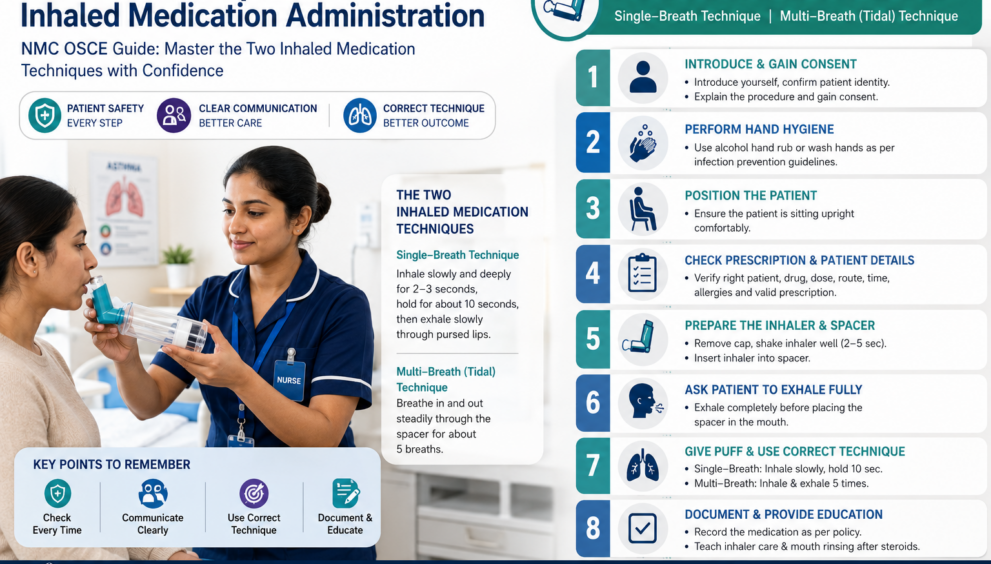
During the NMC OSCE, candidates usually administer medication using a Metered Dose Inhaler (MDI) with a spacer. There are two recognised breathing techniques depending on the patient’s ability.
1. Single-Breath Technique
- Inhale slowly and deeply for 2–3 seconds.
- Hold the breath for approximately 10 seconds.
- Exhale slowly through pursed lips.
This technique is preferred for patients who can coordinate their breathing effectively.
2. Multi-Breath (Tidal Breathing) Technique
If the patient cannot hold their breath, they should breathe in and out normally through the spacer for about five breaths.
Both techniques are accepted in the OSCE. The examiner expects you to select the most appropriate method based on the patient’s condition and explain it clearly.
Why This Station Is Important
The inhaled medication station reflects everyday respiratory nursing care. Correct inhaler technique improves medication delivery and symptom control in conditions such as asthma and COPD.
Before administering medication, always complete essential safety checks:
- Right patient
- Right medication
- Right dose
- Right route
- Right time
- Right method
- Allergy status
- Valid prescription
- Prescriber’s signature
If anything is unclear, stop the procedure and seek clarification. Safe decision-making is an important part of OSCE marking.
Equipment Required
Prepare the following equipment before beginning:
- Metered Dose Inhaler (MDI)
- Spacer device
- Prescription chart
- Alcohol hand rub
- Cleaning wipes (if required)
Always check that the equipment is clean and suitable before use.
Step-by-Step Guide
1. Introduce Yourself
Introduce yourself professionally, confirm the patient’s identity, check allergies, explain the procedure, and obtain consent.
2. Perform Hand Hygiene
Use alcohol hand rub or wash your hands according to infection prevention guidelines.
3. Position the Patient
Help the patient sit upright to improve lung expansion.
Explain common side effects of the medication if appropriate.
4. Check the Prescription
Confirm:
- Patient identity
- Medication
- Dose
- Route
- Time
- Allergy status
- Prescription validity
- Prescriber’s signature
Never administer medication from an incomplete or unclear prescription.
5. Prepare the Inhaler
- Remove the mouthpiece cap.
- Shake the inhaler for 2–5 seconds.
- Insert the inhaler firmly into the spacer.
Explain each step to reassure the patient.
6. Ask the Patient to Exhale
Instruct the patient to breathe out fully before placing the spacer into the mouth.
7. Administer the Medication
Ensure the patient’s lips form a tight seal around the spacer.
Press the inhaler once and guide the patient using either:
- Single-Breath Technique
- Multi-Breath (Tidal) Technique
Choose the method based on the patient’s ability.
8. Complete the Procedure
If another puff is prescribed:
- Wait 30–60 seconds before repeating the dose.
- Shake the inhaler again before the second puff.
After administration:
- Perform hand hygiene.
- Dispose of equipment appropriately.
- Document the medication.
- Educate the patient about inhaler care and mouth rinsing after steroid inhalers.
Common Mistakes to Avoid
Avoid these common OSCE errors:
- Missing hand hygiene
- Forgetting patient identification
- Skipping allergy checks
- Not confirming prescription validity
- Forgetting to shake the inhaler
- Poor mouth seal around the spacer
- Forgetting the waiting time between puffs
- Missing documentation
- Providing no patient education
Remember to verbalise your safety checks throughout the station.
Quick OSCE Checklist
✔ Hand hygiene
✔ Patient identification
✔ Allergy check
✔ Valid prescription
✔ Correct medication
✔ Shake inhaler
✔ Proper spacer technique
✔ Appropriate breathing method
✔ Documentation
✔ Patient education
Prepare with Fortuwest International
At Fortuwest International, we help internationally educated nurses prepare confidently for UK registration through structured NMC OSCE, CBT, and OET training.
Our practical coaching focuses on clinical skills, communication, examiner expectations, and real exam practice. Through guided demonstrations, mock assessments, and expert mentoring, candidates gain the confidence needed to succeed in medication stations and other OSCE skills.
Conclusion
The inhaled medication station assesses much more than inhaler use. Success depends on combining medication safety, effective communication, correct breathing technique, documentation, and patient education.
By understanding both the Single-Breath and Multi-Breath (Tidal Breathing) techniques and practising the complete sequence, you can approach the NMC OSCE with confidence.
With expert guidance from Fortuwest International, you’ll be well prepared to achieve success in your NMC OSCE and begin your nursing career in the UK.
Frequently Asked Questions
What are the two inhaled medication techniques?
The two techniques are the Single-Breath Technique and the Multi-Breath (Tidal Breathing) Technique. The appropriate method depends on the patient’s breathing ability.
Is a spacer always used?
Most OSCE scenarios require a spacer with a metered dose inhaler because it improves medication delivery and reduces coordination difficulties.
How long should I wait between puffs?
Wait 30–60 seconds between puffs of the same medication and shake the inhaler again before the next dose.
What patient education should I provide?
Advise patients to:
- Use the inhaler correctly.
- Keep the spacer clean.
- Never share inhalers.
- Rinse the mouth after steroid inhalers.
What is the most common OSCE mistake?
The most common mistake is rushing the procedure and forgetting essential safety checks such as patient identification, allergy verification, prescription validation, documentation, and patient education.
Continue learning with Fortuwest International’s comprehensive NMC OSCE study guides, CBT preparation, and practical mock assessments to maximise your exam success.