

By Fortu West International
August 30, 2026
3–4 minutes read
NMC OSCE Assessment Charts: What Every Candidate Should Know
Preparing for the NMC OSCE is not only about demonstrating clinical skills. You must also show that you can assess patients, interpret clinical information, document findings accurately, recognise risks and escalate concerns appropriately.
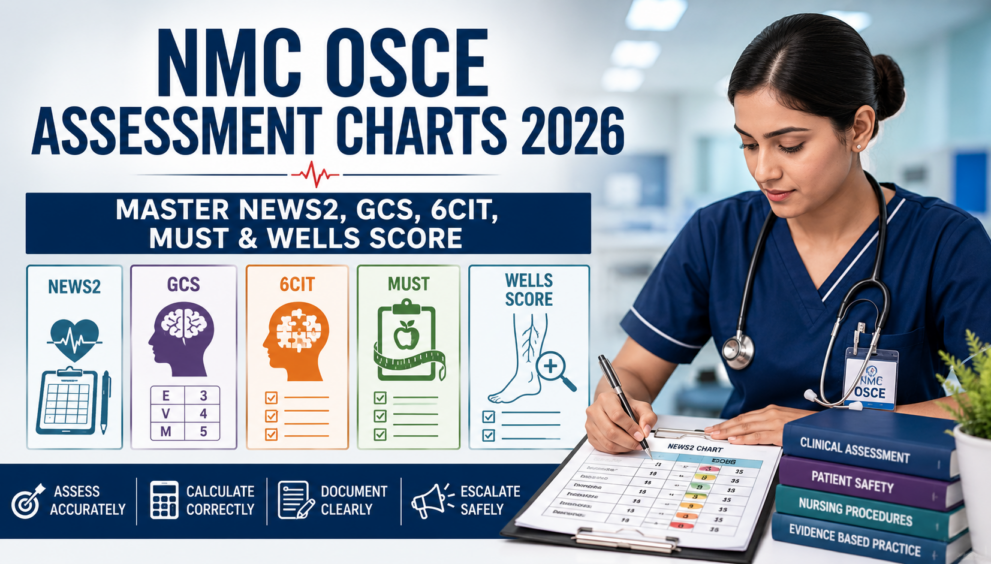
Supporting charts are an important part of assessment stations. Depending on the scenario, you may be required to use tools such as NEWS2, Glasgow Coma Scale (GCS), 6CIT, MUST or the 2-Level Wells Score.
Understanding what each chart is designed to assess—and practising how to use it—can make your OSCE preparation much more effective.
Important: The exact documentation provided in an OSCE station can depend on the scenario and current NMC/OSCE test-centre requirements. Always prepare using the latest official guidance and your training provider’s current materials.
Why Are Assessment Charts Important in the NMC OSCE?
Clinical documentation is not simply paperwork. It demonstrates your ability to apply clinical knowledge safely and systematically.
During an assessment station, you may need to:
- Collect relevant patient information.
- Record observations accurately.
- Complete the appropriate assessment tool.
- Calculate a score correctly.
- Recognise abnormal findings.
- Explain your clinical reasoning.
- Escalate concerns appropriately.
- Document your findings clearly.
A useful approach is to remember four principles:
Clear verbalisation + Accurate assessment + Safe clinical judgement + Clear documentation
1. NEWS2 – National Early Warning Score
What is NEWS2?
The National Early Warning Score 2 (NEWS2) is used to identify patients at risk of clinical deterioration.
NEWS2 combines several physiological observations into an overall score. The score helps healthcare professionals recognise deterioration and determine the urgency of clinical review.
Parameters assessed in NEWS2
The chart includes:
- Respiratory rate
- Oxygen saturation
- Systolic blood pressure
- Pulse rate
- Level of consciousness
- Temperature
- Whether the patient is receiving air or supplemental oxygen
Each observation is assigned a score according to the NEWS2 scoring system, and the individual scores are added together.
What should you demonstrate in the OSCE?
When using a NEWS2 chart:
- Record the observations accurately.
- Place each result in the correct section.
- Calculate the score carefully.
- Check whether the overall score indicates increased risk.
- Recognise concerning findings.
- Explain that appropriate escalation and monitoring would be required.
Common NEWS2 mistakes
Candidates should avoid:
- Forgetting one of the observations.
- Recording information in the wrong section.
- Adding the score incorrectly.
- Failing to recognise deterioration.
- Completing the chart but not communicating significant findings.
OSCE tip: Don’t treat NEWS2 as a mathematical exercise. The important point is what the score means for the patient’s safety and what action should follow.
2. GCS – Glasgow Coma Scale
What is GCS?
The Glasgow Coma Scale (GCS) is used to assess a patient’s level of consciousness.
It is particularly relevant in scenarios involving neurological problems, reduced consciousness or head injury.
The GCS consists of three components:
Eye Opening – E
This assesses the patient’s eye-opening response.
Verbal Response – V
This assesses the patient’s verbal response, including orientation and appropriate communication.
Motor Response – M
This assesses the patient’s motor response to commands or appropriate stimuli.
The three component scores are combined to produce the total GCS score.
How should you document GCS?
Do not simply write the total score.
Where the chart requires it, document the individual:
E + V + M = Total GCS
This makes your assessment clearer and demonstrates that you have assessed each component systematically.
Common GCS mistakes
- Recording only the total score.
- Forgetting one component.
- Incorrectly interpreting verbal responses.
- Failing to recognise a change in consciousness.
- Forgetting to document the assessment.
OSCE tip: If a neurological assessment identifies a concerning change, demonstrate appropriate escalation rather than simply recording the number.
3. 6CIT – Six-Item Cognitive Impairment Test
What is 6CIT?
The Six-Item Cognitive Impairment Test (6CIT) is a brief cognitive screening tool.
It can help identify possible cognitive impairment by assessing areas such as orientation, memory and attention.
Importantly, 6CIT is a screening tool and should not be treated as a standalone diagnosis of dementia.
In an OSCE scenario
You may be asked to assess a patient who has:
- Confusion
- Memory difficulties
- Changes in cognitive function
- Possible cognitive impairment
Your role is to communicate appropriately, complete the assessment systematically and document the patient’s responses accurately.
6CIT documentation tips
- Follow the scoring instructions provided.
- Record responses accurately.
- Calculate the score carefully.
- Complete the documentation clearly.
- Communicate concerns appropriately.
OSCE tip: Focus on the patient’s dignity and communication throughout the assessment. A cognitive assessment should be conducted respectfully and without making the patient feel judged.
4. MUST – Malnutrition Universal Screening Tool
What is MUST?
The Malnutrition Universal Screening Tool (MUST) is used to identify adults who are malnourished or at risk of malnutrition.
It considers factors such as:
- BMI
- Unplanned weight loss
- Acute disease effect
The five-step MUST process
Step 1 – BMI Score
Use the patient’s height and weight to determine BMI and identify the corresponding score according to the MUST chart.
Step 2 – Weight Loss Score
Consider the patient’s unplanned weight loss over the relevant period and determine the appropriate score.
Step 3 – Acute Disease Effect
Determine whether the patient is acutely ill and is expected to have little or no nutritional intake for more than five days, where applicable to the MUST criteria.
Step 4 – Calculate the Overall Score
Add the relevant scores to determine the patient’s overall MUST score.
Step 5 – Management Plan
Use the resulting risk category to identify the appropriate management and follow-up according to the chart and local policy.
Common MUST mistakes
Candidates sometimes:
- Calculate BMI incorrectly.
- Forget the weight-loss component.
- Miss the acute disease effect.
- Add scores incorrectly.
- Fail to identify the correct risk category.
- Forget to consider the management plan.
OSCE tip: Work through MUST in order. Avoid jumping between sections because this increases the chance of missing information.
5. 2-Level Wells Score for DVT
What is the Wells Score?
The 2-Level Wells Score for DVT is a clinical prediction tool used to assess the likelihood of deep vein thrombosis.
It helps classify a patient’s presentation as:
- DVT likely
- DVT unlikely
The Wells score does not by itself confirm a diagnosis. Further assessment and investigations may be required according to the appropriate clinical pathway.
Using the chart in an OSCE
You should:
- Read the scenario carefully.
- Assess each criterion provided by the chart.
- Award the appropriate points.
- Add the points accurately.
- Interpret the final category.
- Communicate and escalate concerns appropriately.
Common Wells Score mistakes
Avoid:
- Adding points incorrectly.
- Awarding points without evidence from the scenario.
- Making assumptions about the patient.
- Forgetting the final interpretation.
- Failing to communicate significant concerns.
OSCE tip: Only award points supported by the information given. Don’t assume that a criterion is present simply because the scenario sounds suspicious.
Quick Comparison of the Five Assessment Charts
| Chart | Main Purpose | What You Should Focus On |
|---|---|---|
| NEWS2 | Identifying clinical deterioration | Observations, scoring and escalation |
| GCS | Assessing consciousness | Eye, verbal and motor responses |
| 6CIT | Cognitive screening | Patient responses, scoring and documentation |
| MUST | Identifying nutritional risk | BMI, weight loss, acute disease and management |
| 2-Level Wells Score | Assessing DVT likelihood | Criteria, scoring and interpretation |
Common Documentation Mistakes in the NMC OSCE
Regardless of which chart you are given, avoid these common errors:
1. Incomplete documentation
Check that every required section has been completed.
2. Incorrect calculations
Take a moment to double-check your total before moving on.
3. Poor legibility
Your documentation should be clear and easy to understand.
4. Ignoring abnormal findings
Recording an abnormal result is not enough. You should demonstrate that you recognise its significance.
5. Failure to escalate
If your assessment identifies a significant concern, explain what action you would take according to the appropriate clinical policy or pathway.
6. Making assumptions
Use the information provided in the scenario and the assessment findings. Do not invent information that has not been given.
Frequently Asked Questions
Which chart is commonly associated with a subdural haematoma scenario?
A GCS chart may be relevant because neurological assessment and level of consciousness are important when assessing a patient with a subdural haematoma. The exact documentation provided depends on the OSCE scenario.
Which chart may be used in a malnutrition scenario?
A MUST chart is specifically designed to assess nutritional risk. Depending on the scenario, other assessments such as NEWS2 may also be relevant.
Will I get an actor or mannequin during an assessment station?
OSCE stations can use different forms of simulation depending on the station and test-centre setup. Candidates should be prepared to interact with a simulated patient and/or use clinical equipment or mannequins where required.
How long is an assessment station?
The time available depends on the current NMC OSCE station structure and the specific test centre. Always check the latest official NMC guidance and your current OSCE provider information rather than relying on an older timing.
How to Prepare for NMC OSCE Assessment Charts
The best way to become comfortable with these charts is through repeated practice.
Try this simple routine:
Read → Assess → Calculate → Interpret → Document → Escalate
Before finishing a station, ask yourself:
- Have I completed every required section?
- Have I calculated the score correctly?
- Do I understand what the result means?
- Have I recognised any abnormal findings?
- Have I documented clearly?
- Have I communicated or escalated concerns appropriately?
This approach can help you stay organised even when you are under examination pressure.
Final Thoughts
Assessment charts are an important part of demonstrating safe nursing practice in the NMC OSCE. NEWS2, GCS, 6CIT, MUST and the 2-Level Wells Score each have a different purpose, but they all require the same fundamental approach: assess carefully, document accurately, interpret findings safely and communicate concerns appropriately.
Don’t focus only on memorising scores. Understand why the assessment is being performed and what the result means for the patient.
With regular practice, these charts can become much easier to use, helping you approach assessment stations with greater confidence and a structured clinical mindset.
Prepare smart. Practise consistently. Perform with confidence.
Prepare for Your NMC OSCE with Fortu West International
Looking for structured support for your NMC OSCE preparation? Fortu West International can help you strengthen your clinical knowledge, assessment skills, documentation and OSCE confidence through focused preparation and practice.