

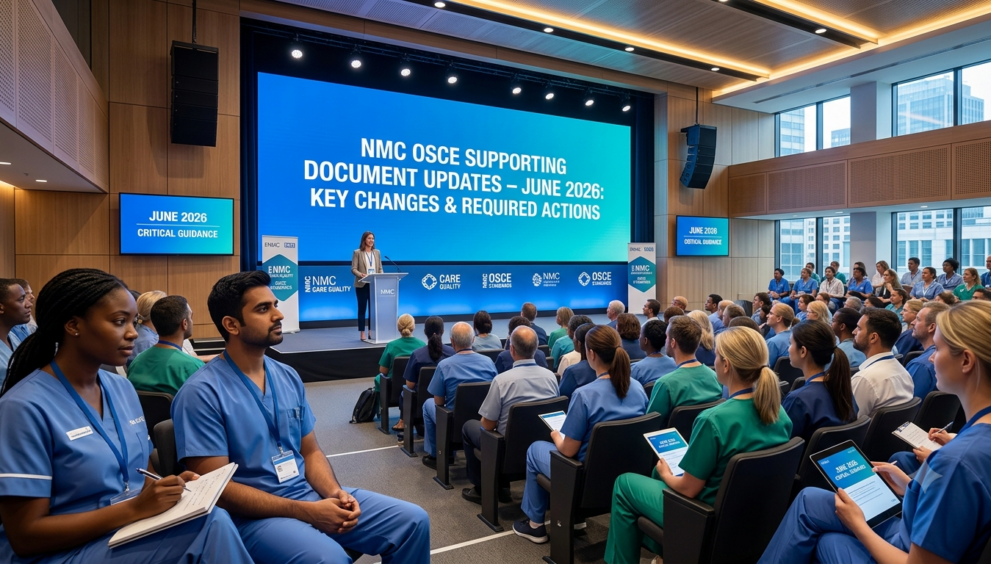
Navigating the Nursing and Midwifery Council (NMC) OSCE requires absolute precision, and staying on top of the latest resource changes is essential for exam-day success. The recent June 2026 updates introduced crucial formatting revisions to several key supporting documents used across the assessment stations.
While the underlying clinical principles remain identical, the presentation of these charts has been altered to streamline your workflow and reduce calculation errors under exam pressure.
At Fortuwest International, we have fully integrated these June 2026 updates into our curriculum. Here is a complete breakdown of exactly what has changed and how to apply it during your examination.
1. Nutritional Assessment Station Update
The most significant operational change occurs in the Malnutrition Universal Screening Tool (MUST) documentation, specifically within Step 2: Weight Loss Score.
The Core Criteria (Unchanged)
The scoring thresholds themselves have not altered:
- Score 0: Weight loss less than 5%
- Score 1: Weight loss between 5% and 10%
- Score 2: Weight loss greater than 10%
What Has Formally Changed?
The layout has been flipped to align with how clinical data is naturally processed.
| Feature | Previous Chart Layout | New June 2026 Chart Layout |
| Primary Reference Point | Organized by the patient’s current weight. | Organized by the patient’s weight before weight loss. |
| Method of Use | Candidates had to locate the current weight and cross-reference a calculated range to find the score. | Candidates identify the baseline weight prior to illness, then directly read across to find the exact weight-loss thresholds. |
| Metrics Provided | Primarily metric-focused. | Displays baseline weight in both kilograms (kg) and stones/pounds (st lb) alongside direct score ranges. |
OSCE Clinical Tip: Always subtract the patient’s current weight from their baseline weight first. Once you have the exact volume of weight lost, locate their baseline weight on the new chart to instantly pull the correct MUST score without manual percentage math.
2. Anti-Embolism Stockings Guidance Update
The updated documentation provides strict structural rules for measuring and selecting the correct stocking size based on the patient’s anatomy. The update clarifies the exact landmarks candidates must measure based on a core anatomical threshold.
Threshold 1: Upper Thigh Circumference is Less Than 91.4 cm
If the patient’s thigh circumference falls below this limit, you must take three distinct measurements:
- Upper thigh circumference
- Calf circumference at its widest point
- Distance from the buttock fold to the heel
- Correct Selection: Thigh Length or Thigh Length with Belt.
Threshold 2: Upper Thigh Circumference is 91.4 cm or More
If the patient’s thigh circumference meets or exceeds this limit, the measurement sequence shifts:
- Upper thigh circumference
- Calf circumference at its widest point
- Distance from behind the knee to the heel
- Correct Selection: Knee Length.
3. DVT Scenario: 2-Level DVT Wells Score Update
When assessing a patient for suspected Deep Vein Thrombosis (DVT) in the Assessment station, candidates utilize the evidence-based Wells Score chart.
- The Update: The clinical risk criteria and individual point allocations remain exactly the same. However, the NMC has officially added a dedicated “Total Score” column directly onto the chart.
- Why it matters: Previously, candidates had to mentally aggregate the points or note them separate from the main matrix columns. The new layout provides a dedicated box to record the sum, drastically reducing documentation omissions and accelerating your clinical decision-making pathway.
Action Plan for OSCE Success
To ensure these documentation changes work to your advantage on test day, practice the following habits:
- Identify the Baselines First: Before writing anything down, meticulously scan the scenario text for baseline metrics (e.g., weight prior to admission).
- Verbalize Your Actions: Assessors cannot grade what they do not hear. Clearly state your rationale, such as: “Because the upper thigh circumference is greater than 91.4 cm, I am measuring from behind the knee to the heel to select a knee-length stocking.”
- Legible Documentation: Record the final MUST and Wells scores clearly within the newly designated areas. A correct clinical calculation can still lose marks if it is recorded illegibly.
Excel on Test Day with Fortuwest International
Rote memorization of old templates can severely compromise your performance under exam conditions. At Fortuwest International, our mock exam bays are outfitted with the exact June 2026 updated documentation.
Our expert mentors provide hands-on feedback, helping you master these layout adjustments alongside our 100% OSCE pass rate guarantee.
Lorem ipsum dolor sit amet, consectetur adipiscing elit. Ut elit tellus, luctus nec ullamcorper mattis, pulvinar dapibus leo.