

By Fortu West International
July 30, 2026 • 3 minutes read
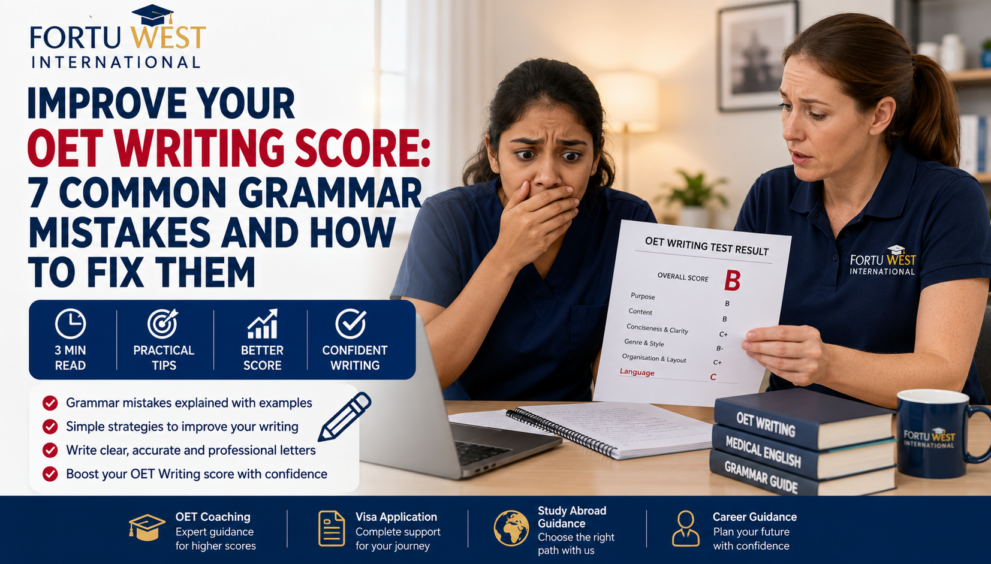
Preparing for the OET Writing sub-test isn’t just about learning referral letter formats or using medical terminology. One of the biggest reasons candidates lose marks is poor grammar.
The good news? You don’t need complex vocabulary or advanced sentence structures to achieve a high score. OET examiners look for writing that is clear, accurate, concise, and appropriate for healthcare professionals.
Here are seven common grammar mistakes that can lower your OET Writing score—and simple ways to avoid them.
1. Subject–Verb Agreement
Your verb must match the subject of the sentence.
❌ Incorrect:
The patient’s blood results indicates infection.
✅ Correct:
The patient’s blood results indicate infection.
Tip: Identify the true subject before choosing the verb, especially in longer sentences.
2. Inconsistent Tense Usage
Use the correct tense to show when events happened.
- Past: Completed treatment or medical history
- Present: Current condition
- Future: Care plans or recommendations
❌ Incorrect:
The patient presented with dizziness and is admitted for observation.
✅ Correct:
The patient presented with dizziness and was admitted for observation.
Maintaining consistent tense makes your letter easier to understand.
3. Incorrect Use of Articles
Articles (a, an, and the) may seem small, but they make your writing sound natural.
❌ Incorrect:
Patient complained of headache.
✅ Correct:
The patient complained of a headache.
Remember:
- Use a/an when mentioning something for the first time.
- Use the when referring to a specific person or condition already mentioned.
4. Incorrect Medical Prepositions
Medical English contains many fixed expressions that should be learned as complete phrases.
Examples include:
- diagnosed with diabetes
- allergic to penicillin
- admitted to hospital
- treated with antibiotics
- referred for physiotherapy
❌ Incorrect:
The patient was diagnosed by diabetes.
✅ Correct:
The patient was diagnosed with diabetes.
5. Unclear Pronouns
Pronouns should never confuse the reader.
❌ Unclear:
The patient discussed the treatment with her daughter because she was worried.
Who was worried?
✅ Better:
The patient discussed the treatment with her daughter because the patient was concerned about possible side effects.
When several people are mentioned, repeating a noun is often clearer than using a pronoun.
6. Overusing Passive Voice
Passive voice is common in healthcare writing, but too much of it makes your letter difficult to read.
Less Effective:
Blood tests were performed, medication was administered, and follow-up arrangements were made.
Better:
The medical team performed blood tests, administered medication, and arranged follow-up care.
Use passive voice only when it improves clarity.
7. Punctuation Errors
Good punctuation improves readability.
❌ Incorrect:
The patient was discharged yesterday, she returned today.
✅ Correct:
The patient was discharged yesterday. However, she returned today.
Breaking long sentences into shorter ones also helps healthcare professionals understand your message quickly.
Quick Proofreading Checklist
Before submitting your OET Writing task, ask yourself:
✔ Is the subject matched with the correct verb?
✔ Have I used consistent tenses?
✔ Are articles used correctly?
✔ Are medical prepositions accurate?
✔ Are pronouns clear?
✔ Is punctuation correct?
✔ Have I checked spelling?
Even two minutes of proofreading can help eliminate avoidable mistakes.
Final Thoughts
Strong grammar doesn’t mean writing complicated sentences. In the OET Writing sub-test, clear and professional communication is what earns higher marks.
By avoiding these seven common grammar mistakes, you’ll produce referral, discharge, and transfer letters that are easier for healthcare professionals to read—and more likely to achieve a higher OET Writing score.
Regular practice, careful proofreading, and understanding the OET assessment criteria will help you write with greater confidence and accuracy.
Prepare for OET Success with Fortu West International
At Fortu West International, we help healthcare professionals achieve their study and career goals through expert guidance and personalised support.
Our Services
- OET Preparation Guidance
- Study Abroad Counselling
- UK Student Visa Assistance
- University Admissions Support
- Career Guidance for Healthcare Professionals
Whether you’re preparing for the OET exam or planning to study or work overseas, our experienced team is ready to support your journey.
Book your FREE consultation with Fortu West International today and take the next step towards your international healthcare career.