


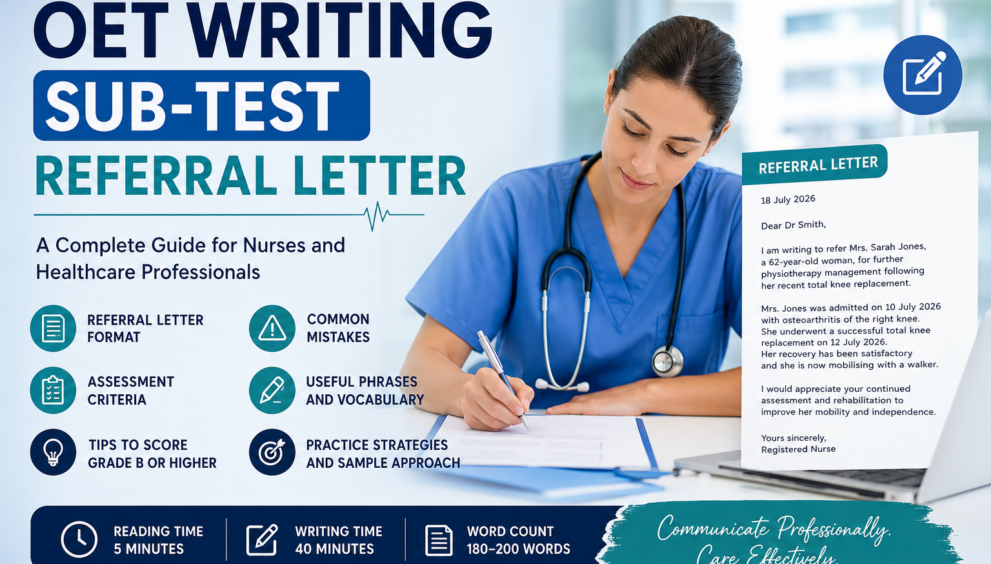
OET Writing Sub-Test: Master the Referral Letter and Achieve Your Dream Score
The Occupational English Test (OET) is one of the most trusted English language proficiency exams for healthcare professionals planning to work in countries such as the UK, Australia, New Zealand, Ireland, Singapore, and Dubai. Among all the sections, the OET Writing Sub-Test is often considered the most challenging because it requires candidates to produce a professional healthcare document within a limited time.
For nurses, the writing task is almost always a referral letter, making it essential to understand its format, language, and purpose.
This comprehensive guide explains everything you need to know about the OET referral letter, helping you prepare effectively and improve your chances of achieving a high score.
What is the OET Writing Sub-Test?
The OET Writing Sub-Test evaluates your ability to communicate effectively in a professional healthcare setting.
You will be provided with:
- A case notes sheet
- A writing task
- A target healthcare professional
- Patient information
Your task is to transform the case notes into a well-organized professional letter.
Duration
- Reading Time: 5 minutes
- Writing Time: 40 minutes
Word Count
Generally 180–200 words, although slightly above or below is acceptable if the information is relevant.
What is a Referral Letter?
A referral letter is a formal medical document written when a patient needs to be transferred to another healthcare professional for further assessment, treatment, rehabilitation, or specialized care.
The purpose is to ensure continuity of care by communicating relevant patient information clearly and concisely.
Structure of an OET Referral Letter
1. Address
Include:
- Recipient’s Name
- Hospital/Clinic
- Address
2. Date
Write the date using an accepted format.
Example:
18 July 2026
3. Salutation
Examples:
- Dear Dr Smith,
- Dear Physiotherapist,
- Dear Community Nurse,
4. Opening Paragraph
State immediately:
- Who the patient is
- Why you are writing
- Purpose of referral
Example:
I am writing to refer Mrs. Sarah Jones, a 62-year-old woman, for further physiotherapy management following her recent total knee replacement.
5. Body Paragraphs
Include only relevant information:
Medical History
- Diagnosis
- Previous illnesses
- Allergies
- Current medications
Recent Admission
- Symptoms
- Treatment provided
- Progress made
Current Condition
- Present health status
- Functional abilities
- Ongoing concerns
6. Closing Paragraph
Mention:
- Requested follow-up
- Future management
- Appreciation
Example:
I would appreciate your continued assessment and rehabilitation to improve her mobility and independence.
7. Closing
Yours sincerely,
Registered Nurse
Assessment Criteria
The OET Writing Sub-Test is evaluated based on six criteria.
Purpose
The reason for writing should be immediately clear.
Content
Include all relevant information while excluding unnecessary details.
Conciseness and Clarity
Present information logically and avoid repetition.
Genre and Style
Maintain a professional, polite, and formal tone throughout the letter.
Organisation and Layout
Use appropriate paragraphing and ensure a logical flow of information.
Language
Demonstrate accurate grammar, spelling, punctuation, and appropriate medical terminology.
Common Mistakes Candidates Make
Many candidates lose marks because they:
- Copy case notes directly.
- Include irrelevant information.
- Forget the purpose of the letter.
- Use informal language.
- Write overly long sentences.
- Exceed the recommended word count unnecessarily.
- Organize information poorly.
- Miss important patient details.
Avoiding these common errors can significantly improve your score.
Tips to Score Grade B or Higher
Read the Task Carefully
Always identify:
- Why you are writing
- Who the reader is
- What information the reader actually needs
Select Relevant Case Notes
Not every piece of information belongs in your letter.
Choose only details that support the referral.
Prioritize Information
Start with the most important clinical information.
Less important details should appear later.
Use Formal Healthcare Language
Examples:
- “I am writing to refer…”
- “Following discharge…”
- “Further assessment is recommended…”
- “Ongoing management is required.”
Link Ideas Smoothly
Use connecting phrases such as:
- Furthermore
- In addition
- Consequently
- Since then
- Therefore
Proofread
Reserve the final few minutes to check:
- Grammar
- Spelling
- Patient details
- Dates
- Medication names
- Word count
Practice is the Key
Consistent practice is the best way to improve your OET Writing score.
Try writing referral letters based on different clinical scenarios, including:
- Diabetes
- Stroke
- COPD
- Fractures
- Asthma
- Mental health
- Post-operative care
- Palliative care
The more case notes you practice, the more confident you will become in selecting relevant information and writing clear, professional referral letters.
Why Professional OET Writing Training Matters
Many candidates struggle not because of poor English, but because they find it difficult to identify relevant information and organize it effectively within the time limit.
Structured coaching can help you:
- Understand OET assessment criteria
- Improve referral letter organization
- Receive personalized feedback
- Learn examiner expectations
- Build confidence through regular mock tests
Professional guidance can significantly enhance your performance and prepare you for real exam conditions.
Final Thoughts
The OET Writing Sub-Test is more than a language assessment—it measures your ability to communicate safely and professionally in a healthcare environment. A well-written referral letter demonstrates clinical judgment, effective communication, and patient-centered care.
By mastering the referral letter structure, selecting only relevant case notes, maintaining a formal tone, and practicing consistently, you can greatly improve your chances of achieving your target OET score and advancing your international healthcare career.
Welcome to Fortuwest International
At Fortuwest International, we empower healthcare professionals to achieve international success through expert-led training, career-focused education, and global employment support. Whether you’re a nurse aiming to work in the UK, Ireland, Australia, or New Zealand, we provide the skills, guidance, and qualifications you need to succeed in today’s competitive healthcare landscape.
Why Professional Training Is Essential
Proficiency in English—especially in medical communication—is a core requirement for nurses seeking registration abroad. The Occupational English Test (OET) is accepted by healthcare regulatory bodies worldwide and plays a vital role in proving your readiness for an international career. At Fortuwest International, our training doesn’t just prepare you for the test—it prepares you for your future.
OET Training for Nurses – 30 Days Online (1 Hour per Day)
Our intensive 30-day OET training program is specifically designed for nurses and other healthcare professionals preparing for the OET. With just one hour of focused training per day, this course fits easily into your schedule—whether you’re working, studying, or balancing both.
Course Details:
- Duration: 30 Days
- Class Time: 1 Hour per Day
- Format: 100% Online
- Total Hours: 30 Hours
- Trainers: Certified professionals with expertise in healthcare English
- Scheduling: Flexible morning and evening batches
- Training Fee: £200
Modules:
- OET Writing – Individual sessions
- OET Speaking – One-on-one practice
- OET Reading – Group-based training
- OET Listening – Real-time practice sessions
This program is ideal for nurses looking to pass the OET and begin their registration journey with the NMC UK, AHPRA Australia, or equivalent bodies.
Contact Us to Enroll
Join hundreds of nurses who trust Fortuwest International for their career development and training needs. Get in touch today: Phone (UK):+44 7378 467245Phone (India):+91 79944 44788Email:wecare@fortuwestinternational.co.uk
Frequently Asked Questions (FAQs)
Q1. How many words should an OET referral letter contain?
The recommended length is 180–200 words, focusing on relevant information.
Q2. How much time is given for the OET Writing Sub-Test?
Candidates receive 5 minutes to read the case notes and 40 minutes to write the letter.
Q3. What type of letter do nurses usually write in OET?
Nurses are most commonly required to write a referral letter, although discharge or transfer letters may occasionally appear.
Q4. Is grammar very important in OET Writing?
Yes. Grammar, vocabulary, organization, clarity, and appropriate professional language all contribute to your final score.
Q5. Can I achieve a Grade B with regular practice?
Yes. Regular practice, constructive feedback, and familiarity with OET assessment criteria can significantly improve your chances of achieving Grade B or higher.
SEO Keywords
Primary Keyword: OET Writing Sub-Test Referral Letter
Secondary Keywords:
- OET writing tips
- OET referral letter format
- OET writing for nurses
- OET letter writing guide
- OET Grade B preparation
- OET writing assessment criteria
- OET referral letter sample
- OET exam preparation
- OET writing practice
- OET for healthcare professionals