

Every relocation guide tells you the visa steps, the licensing exams, the paperwork. What they rarely capture is the lived experience — the 20-applications-a-day grind, the relocation package that almost tempted someone into the wrong job, the moment a nurse realizes their nursing school never taught them to use a defibrillator on a real patient. Below are real, published accounts from internationally educated nurses who’ve made the move, alongside what their experiences reveal about the process.
A note on sourcing: rather than inventing quotes, this roundup draws on nurses’ own published accounts and community threads, credited below. Follow the links for the full stories.
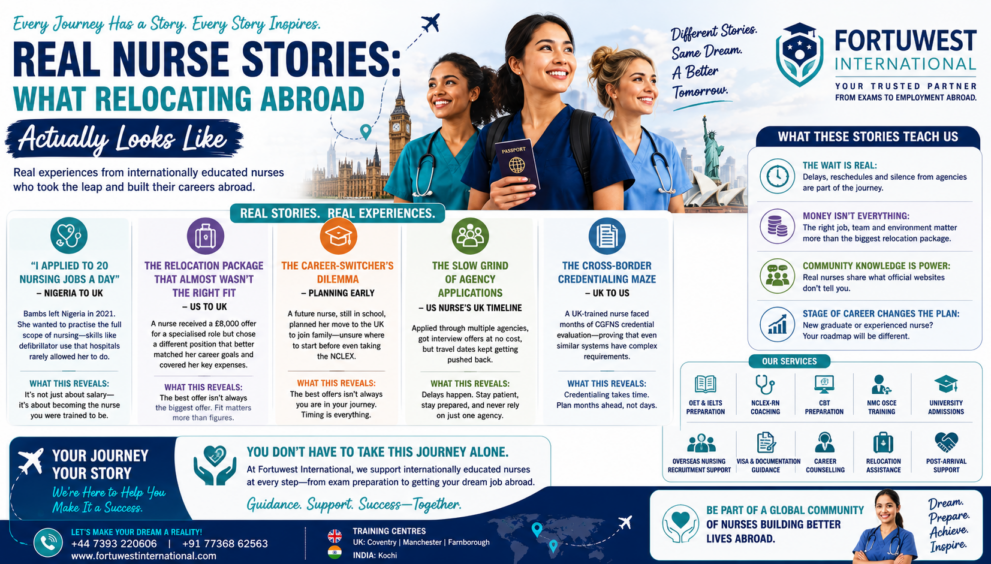
“I Applied to 20 Nursing Jobs a Day” — Nigeria to the UK
One of the more candid accounts comes from a Nigerian nurse identified as Bambs, who shared her relocation story with the Nigerian outlet Zikoko. She left Nigeria toward the end of the COVID-19 pandemic in 2021, drawn to nursing since childhood but increasingly aware of the gap between what her textbooks taught and what Nigerian hospitals could actually provide — she points to something as basic as defibrillator use on a cardiac arrest patient as a skill her training covered in theory but her hospitals rarely allowed her to practise in reality.
What this reveals: For many nurses, the decision to relocate isn’t only about salary — it’s about wanting to practise the full scope of what they were actually trained to do. If your home country’s clinical infrastructure can’t support your training, that mismatch alone is worth naming honestly when you’re deciding where to go next.
The Relocation Package That Almost Wasn’t the Right Fit — US to UK
A nurse blogging at Moving to England shared her own move from the US to work for the NHS. She described receiving several job offers, each with its own relocation package, including one initial offer of roughly £8,000 for a Psychiatric Intensive Care Unit role in a coastal part of England. She ultimately turned it down — not because the money wasn’t generous, but because the clinical setting wasn’t the right match for her.She instead accepted a different position that covered her flight and first month’s accommodation, and combined with being exempt from the Immigration Health Surcharge under the Health and Care Worker visa, found the overall package more than adequate.
What this reveals: The biggest relocation package on paper isn’t automatically the right choice. Matching your clinical specialty and working environment to the job — not just chasing the largest signing bonus — tends to predict how long nurses actually stay and how well they settle in.
The Career-Switcher’s Dilemma — Planning a Move Before You’ve Even Graduated
Not every relocation story starts after years of experience. On the nursing community forum allnurses.com, a career-switcher in her mid-30s, transitioning out of an education career and set to graduate from nursing school in December, described trying to plan a move to the UK’s Berkshire area to join family already living there— all while still finishing her degree and without yet having sat the NCLEX. Much of the advice she found online assumed an experienced nurse already holding a license, leaving her unsure where to even begin.
What this reveals: Relocation planning looks completely different depending on where you are in your career — a new graduate weighing a move needs guidance on sequencing (finish licensing first, then apply, versus applying while still in school) that’s very different from what an experienced RN with ten years on the floor needs.
The Slow Grind of Agency Applications — A US Nurse’s UK Timeline
A thread on allnurses.com from a US-trained ICU nurse planning a move to the UK captures the less glamorous middle stretch of relocation: <cite index=”19-1″>the process of applying through multiple agencies, receiving several interview offers at no cost to the candidate, and then having a travel date pushed back repeatedly — from July, to August, to October</cite>, largely due to pandemic-era disruptions.
What this reveals: Delays are common enough that they should be built into your expectations from day one. Applying to more than one agency in parallel, as this nurse did, appears to meaningfully shorten the wait compared to relying on a single point of contact.
The Cross-Border Credentialing Maze — UK to US
On the forum British Expats, a UK-trained nurse described struggling alongside her spouse to navigate the CGFNS credentialing process after relocating back to the United States — a reminder that even nurses moving between two English-speaking, broadly similar healthcare systems still face a credential-by-credential evaluation that can stall a return home or a fresh start abroad.
What this reveals: “The UK and US aren’t that different” is a common assumption that doesn’t hold up at the credentialing level. Budget real time — often months — for CGFNS or equivalent evaluation, regardless of how similar the two systems seem on paper.
The Threads Running Through Every Story
Read enough of these accounts side by side and a few patterns repeat, regardless of which two countries are involved:
- The paperwork is rarely the hard part emotionally — the waiting is. Nearly every account above involves a delay, a pushed-back date, or a slower-than-expected agency response.
- Money isn’t the only variable that matters. The nurse who turned down a larger relocation package for a better clinical fit is a pattern worth paying attention to.
- Community knowledge fills the gaps official guidance leaves behind. Every story here was shared on a forum or blog precisely because official visa and licensing pages don’t address the human, sequencing, and “which agency do I trust” questions nurses actually have.
- Career stage changes the entire plan. A new graduate and a ten-year veteran need different relocation roadmaps, even when they’re aiming for the same country.
If you’re an internationally educated nurse further along in your own relocation story — successful, in progress, or even one that didn’t work out the way you planned — accounts like these are what help the next nurse behind you plan with open eyes instead of guesswork.