



Share this
In this article
Earlier this July, the U.S. Department of Homeland Security (DHS) updated an important rule related to international students’ ability to stay in the US. Starting on September 15, 2026, international students with an F-class visa (non-immigrant academic students) will receive a visa for a fixed period of time, which will vary based on the length of their study program, instead of a ‘duration of status’ visa, which was more flexible. There were also updates around how students may move between study levels and areas of study.
Further changes will affect students holding a J (exchange visitor student) visa. However, as F visas are the most common option for international students, we’ve focused on them below. Read on to learn more.
Note: This article is provided as information, and rules are subject to change with policy updates. The post was last updated on July 24, 2026. Refer to official sources like the DHS website for full updates.

How are the new US student visa durations being set?
After Sept. 15, F-class visa length will be based on the length of each student’s program. To assess program length, DHS will use the student’s Form I-20 (Certificate of Eligibility for Nonimmigrant Student Status), which lists the program duration.
Students with an F visa who were admitted to the US before Sept. 15, 2026 may stay in the US until the program end date listed on their Form I-20 or the end of their post-completion Optional Practical Training (OPT) or STEM OPT extension. All of these students must leave on or before November 14, 2030 (which is four years, plus 60 additional days for departure, after Sept. 15, 2026).
Looking to understand how the rules apply to a specific student situation? Refer to the DHS’ guidelines around how the transition period will work for different students.
How long will US student visas be after September 15?
Once the new rule is effective, F visas will last up to four years, plus two additional 30-day periods: one for pre-study arrival, and one for departure. Each student’s total visa length will be determined by how long their study program is.
Some types of students with F visas will have shorter visa durations:
- Students in English language training programs may stay in the US for up to 24 months, plus an additional 30 days to prepare for departure.
- Students at public high schools (including charter schools) are limited to an aggregate stay that is no longer than 12 months. This includes annual vacation time and school breaks.
Note: Prior to this rule change, F visa-holding international students had up to 60 days after their program end date (and any authorized period of practical training) to leave the US. During that time, they could alternately extend their stay. Students could transfer to another school, pursue a higher level of study, or apply for a different visa, like a P visa for athletes or an H1-B temporary worker visa. Students may still extend their stay, or travel; we’ll explain how in the next question. They’ll just have a shorter period of time to shift between statuses.

What if a student hasn’t finished their program or training after four years, or wants to start a new one?
If international students want to stay longer to complete their program, start a new one, or complete Optional Practical Training (OPT), they must apply for a visa extension (also called an extension of stay or EOS) with the U.S. Citizenship and Immigration Services (USCIS), including completing and filing the Form I-539.
In some cases, students must request the EOS from their designated school official (DSO) first. So, it’s a good idea for students who are considering an extension to check in with their campus international student office early on in the process. Students may begin to apply for an EOS when there are 180 days or fewer remaining in their currently authorized admission period.
For more information about extensions, refer to USCIS’ extension of stay resource page.
International students holding an unexpired F visa who want to travel may apply for admission with the U.S. Customs and Border Protection at a port of entry (like an airport). They’ll receive a new Form I-94 with a new period of admission.
How do these updated rules affect students’ dependents?
F-2 dependents are also subject to the fixed admission period to the US, and cannot stay longer in the country than the F-1 visa holder. If the primary student plans to extend their stay, F-2 dependents must also apply for an EOS.

Which rules are changing related to maintaining a student visa?
After international students receive their visa, they must follow a series of rules to maintain (or keep) their visa valid. Updates to some of these rules were introduced alongside the duration of status visa ruling.
Some maintenance-of-status rules apply to all F visa holders. For example, students can’t change to a program of study at a lower educational level, like a bachelor’s degree, after completing a program at a higher level like a master’s degree. They also can’t change to a program at the same level, like doing another bachelor’s degree after already completing one in the US.
In some cases, how the updated rules work varies by educational level. Let’s look at the revised rules below.
Changing study/educational level:
- Students in programs below the graduate level: Can’t change their study level during their first academic year (unless SEVP authorizes a special exception).
- Graduate-level students: Can’t change their study level during their program.
Changing the area of study/academic major:
- Students in programs below the graduate level: May change their major after completing their first academic year.
- Graduate-level students: Can’t change their major at any point during their program.
Transferring between academic institutions:
- Students in programs below the graduate level: Must complete their first academic year at the school which issued their Form I-20 (unless SEVP authorizes a special exception).
- Graduate-level students: Can’t transfer between institutions at any point during their program (unless SEVP authorizes a special exception).

We hope that this guide has helped to explain some of the key changes to US student visas. Looking for more answers? The DHS has also published a list of frequently asked questions related to the ruling.
Ready to start your study journey to the US? Find programs that fit your academic goals and budget on the ApplyBoard platform today.
43
SHARES
Share on WhatsappShare on FacebookShare on Linkedin
Taryn Graham
Taryn Graham leverages over a decade of communications expertise from the public and private sectors in her work with ApplyBoard’s Strategic Content and Thought Leadership team, spanning ApplyBoard Insights and the main blog. She also manages the biannual Student and Recruitment Partner Pulse Surveys.
Recent Articles
Find more advice and updates for every step of the student journeyUnderstanding Recent Updates to US Student Visa Duration and Requirements
- Blog
- July 24, 2026
- by Taryn Graham
Share this
In this article:
- How are the new US student visa durations being set?
- How long will US student visas be after September 15?
- What if a student hasn’t finished their program or training after four years, or wants to start a new one?
- How do these updated rules affect students’ dependents?
- Which rules are changing related to maintaining a student visa?
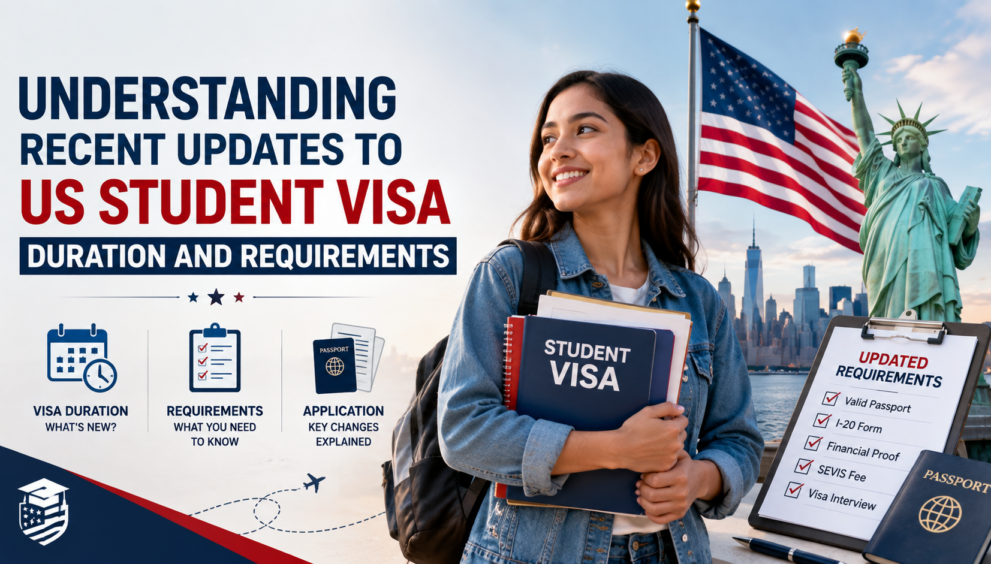
Earlier this July, the U.S. Department of Homeland Security (DHS) updated an important rule related to international students’ ability to stay in the US. Starting on September 15, 2026, international students with an F-class visa (non-immigrant academic students) will receive a visa for a fixed period of time, which will vary based on the length of their study program, instead of a ‘duration of status’ visa, which was more flexible. There were also updates around how students may move between study levels and areas of study.
Further changes will affect students holding a J (exchange visitor student) visa. However, as F visas are the most common option for international students, we’ve focused on them below. Read on to learn more.
Note: This article is provided as information, and rules are subject to change with policy updates. The post was last updated on July 24, 2026. Refer to official sources like the DHS website for full updates.
How are the new US student visa durations being set?
After Sept. 15, F-class visa length will be based on the length of each student’s program. To assess program length, DHS will use the student’s Form I-20 (Certificate of Eligibility for Nonimmigrant Student Status), which lists the program duration.
Students with an F visa who were admitted to the US before Sept. 15, 2026 may stay in the US until the program end date listed on their Form I-20 or the end of their post-completion Optional Practical Training (OPT) or STEM OPT extension. All of these students must leave on or before November 14, 2030 (which is four years, plus 60 additional days for departure, after Sept. 15, 2026).
Looking to understand how the rules apply to a specific student situation? Refer to the DHS’ guidelines around how the transition period will work for different students.
How long will US student visas be after September 15?
Once the new rule is effective, F visas will last up to four years, plus two additional 30-day periods: one for pre-study arrival, and one for departure. Each student’s total visa length will be determined by how long their study program is.
Some types of students with F visas will have shorter visa durations:
- Students in English language training programs may stay in the US for up to 24 months, plus an additional 30 days to prepare for departure.
- Students at public high schools (including charter schools) are limited to an aggregate stay that is no longer than 12 months. This includes annual vacation time and school breaks.
Note: Prior to this rule change, F visa-holding international students had up to 60 days after their program end date (and any authorized period of practical training) to leave the US. During that time, they could alternately extend their stay. Students could transfer to another school, pursue a higher level of study, or apply for a different visa, like a P visa for athletes or an H1-B temporary worker visa. Students may still extend their stay, or travel; we’ll explain how in the next question. They’ll just have a shorter period of time to shift between statuses.
What if a student hasn’t finished their program or training after four years, or wants to start a new one?
If international students want to stay longer to complete their program, start a new one, or complete Optional Practical Training (OPT), they must apply for a visa extension (also called an extension of stay or EOS) with the U.S. Citizenship and Immigration Services (USCIS), including completing and filing the Form I-539.
In some cases, students must request the EOS from their designated school official (DSO) first. So, it’s a good idea for students who are considering an extension to check in with their campus international student office early on in the process. Students may begin to apply for an EOS when there are 180 days or fewer remaining in their currently authorized admission period.
For more information about extensions, refer to USCIS’ extension of stay resource page.
International students holding an unexpired F visa who want to travel may apply for admission with the U.S. Customs and Border Protection at a port of entry (like an airport). They’ll receive a new Form I-94 with a new period of admission.
How do these updated rules affect students’ dependents?
F-2 dependents are also subject to the fixed admission period to the US, and cannot stay longer in the country than the F-1 visa holder. If the primary student plans to extend their stay, F-2 dependents must also apply for an EOS.
Which rules are changing related to maintaining a student visa?
After international students receive their visa, they must follow a series of rules to maintain (or keep) their visa valid. Updates to some of these rules were introduced alongside the duration of status visa ruling.
Some maintenance-of-status rules apply to all F visa holders. For example, students can’t change to a program of study at a lower educational level, like a bachelor’s degree, after completing a program at a higher level like a master’s degree. They also can’t change to a program at the same level, like doing another bachelor’s degree after already completing one in the US.
In some cases, how the updated rules work varies by educational level. Let’s look at the revised rules below.
Changing study/educational level:
- Students in programs below the graduate level: Can’t change their study level during their first academic year (unless SEVP authorizes a special exception).
- Graduate-level students: Can’t change their study level during their program.
Changing the area of study/academic major:
- Students in programs below the graduate level: May change their major after completing their first academic year.
- Graduate-level students: Can’t change their major at any point during their program.
Transferring between academic institutions:
- Students in programs below the graduate level: Must complete their first academic year at the school which issued their Form I-20 (unless SEVP authorizes a special exception).
- Graduate-level students: Can’t transfer between institutions at any point during their program (unless SEVP authorizes a special exception).
We hope that this guide has helped to explain some of the key changes to US student visas. Looking for more answers? The DHS has also published a list of frequently asked questions related to the ruling.
Ready to Study Abroad?
Planning to study in the United States? Stay updated with the latest student visa regulations and prepare your application with confidence.
Fortuwest International provides expert guidance on study abroad admissions, university selection, student visa preparation, documentation, and pre-departure support. Whether you’re applying for your first F-1 visa or need assistance with visa extensions and university applications, our experienced team is here to help you achieve your international education goals.
Contact Fortuwest International today and take the next step toward your dream of studying abroad.