

The NMC OSCE scenario is a crucial part of your nursing assessment in the UK. The Objective Structured Clinical Examination (OSCE) assesses more than clinical skills. It also evaluates your communication, decision-making, professionalism, patient-centred care, and ability to apply nursing knowledge safely.
Every OSCE station is designed to assess specific competencies and may present you with a clinical situation, patient information, instructions, or a professional scenario. One simple step that candidates sometimes overlook is reading the scenario and instructions carefully before starting.
Taking a few moments to understand exactly what is required can help you stay focused, organised, and confident throughout the station.
The NMC OSCE Scenario: Your Blueprint for Success
The information provided at an OSCE station gives you important clues about what you need to do. Depending on the station, this may include:
- Patient details and relevant background
- The patient’s presenting condition or reason for admission
- Medical or social history
- Current symptoms or concerns
- The specific task you are expected to complete
- Instructions about communication, assessment, planning, implementation, or evaluation
The NMC advises candidates to read the station instructions and scenarios carefully and make sure they understand what is expected before proceeding.
Missing an important detail can affect the way you approach the entire station. Therefore, reading is not simply preparation time—it is an important part of your OSCE strategy.
Why Should You Read the Scenario Carefully?
1. Understand Exactly What the Station Requires
OSCE stations can have very different objectives. You may be asked to assess a patient, plan care, implement an intervention, evaluate care, demonstrate a clinical skill, or respond to a professional situation.
Reading the instructions carefully helps you identify the main task before you begin.
For example, if the station asks you to assess a patient’s condition, you should focus on assessment rather than immediately moving into interventions that have not been requested.
2. Identify Important Patient Information
The scenario may contain information that should influence your approach.
Pay attention to:
- Patient identity
- Age
- Presenting problem
- Relevant medical history
- Current symptoms
- Risk factors
- Specific concerns mentioned in the scenario
- Any limitations or special instructions
Use the information provided rather than making unnecessary assumptions about the patient.
3. Connect the Scenario to Patient-Centred Care
The OSCE is designed to assess skills that are relevant to safe and effective nursing practice. Understanding the patient situation allows you to demonstrate appropriate communication and patient-centred care.
Before beginning, ask yourself:
“Who is my patient, what is happening, and what exactly am I being asked to do?”
This simple approach can help you establish the correct direction for the station.
Scenario Reading Is Important Across Different OSCE Stations
The NMC nursing OSCE currently consists of 10 stations. Four are linked to the nursing care process—Assessment, Planning, Implementation and Evaluation (APIE). Four stations assess clinical skills through linked skill stations, while two silent stations assess professional values and behaviours and evidence-based practice.
Because the purpose of each station can differ, you should not approach every scenario in exactly the same way.
For a care-process station, identify which stage you are being assessed on.
For a clinical skills station, understand the specific procedure and instructions.
For a professional values station, identify the professional issue and consider how the NMC Code applies.
For an evidence-based practice station, carefully identify what the question or scenario is asking you to evaluate.
Important NMC OSCE Updates for 2026
The NMC regularly reviews and refreshes OSCE content to ensure that the Test of Competence reflects current clinical practice. New stations can therefore be introduced, while existing stations may be retired or updated.
For adult nursing, new stations introduced as part of the 2026 replenishment included:
- Suspected deep vein thrombosis APIE
- Anti-embolism stockings
- Pre-operative check
- Deteriorating patient professional values
- Patient private details professional values
- New evidence-based practice topics
The NMC also announced new stations for children’s nursing, mental health nursing and midwifery during 2026.
These updates highlight an important point: candidates should prepare for the skills and competencies being assessed rather than relying only on memorised scenarios.
The NMC states that candidates may encounter a different clinical scenario or skill from another candidate, even though the number of OSCE stations remains the same.
A Simple Method for Reading Your Scenario
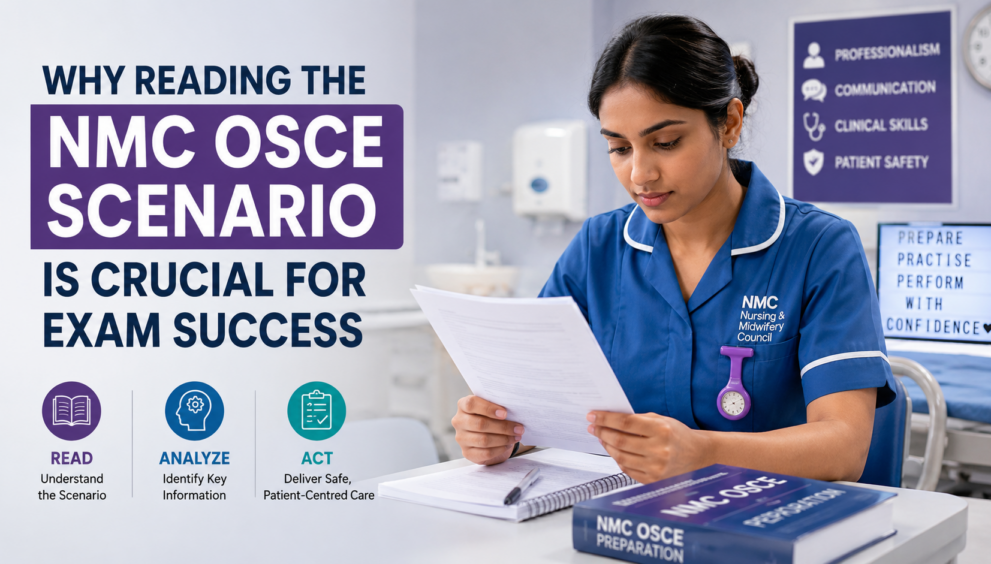
When you receive the station information, use a quick three-step approach:
1. Identify the patient
Who is the patient and what relevant information has been provided?
2. Identify the problem
What is happening, and what clinical or professional issue needs your attention?
3. Identify the task
What exactly does the examiner want you to demonstrate?
Once these three points are clear, begin the station according to the instructions and the relevant marking criteria.
Avoid Rushing Through the Reading Time
One common mistake is becoming so focused on performing the clinical skill that the candidate does not properly process the information provided.
Remember that the scenario is there to guide your performance.
Read it carefully. If you are unsure about an instruction, use the available reading time to review it. The NMC’s candidate guidance specifically advises candidates to read station instructions and scenarios carefully and notes that they can look at them again if they are unsure.
Prepare With Understanding, Not Memorisation
Good OSCE preparation involves more than memorising checklists. You need to understand why you are performing an assessment, procedure, communication technique, or professional action.
Practise reading different scenarios and identifying:
- The patient’s needs
- The clinical priority
- The purpose of the station
- Relevant safety considerations
- Appropriate communication
- The professional standards involved
This approach can make it easier to adapt when you encounter an unfamiliar scenario on exam day.
Final Thoughts
Reading the NMC OSCE scenario carefully may seem like a small step, but it can have a significant impact on your performance. The scenario tells you about the patient, establishes the context, and explains what you are expected to demonstrate.
With the NMC continuing to refresh OSCE content in 2026, candidates should focus on understanding the underlying nursing principles rather than depending entirely on memorised scenarios.
At Fortu West International, we encourage nurses preparing for the NMC OSCE to combine clinical knowledge, practical preparation, communication skills, and a clear understanding of the station instructions.
Read the scenario. Understand the task. Think patient-centred. Then perform with confidence.