

Fortuwest International Blog | OET Exam Overview
By Fortuwest International
If you often run out of time in OET Reading Part A, the problem may not be your English level—it is your reading technique. Strong candidates do not read every word from beginning to end. Instead, they use skimming techniques to understand the structure of each text quickly and then scan for the exact details they need.
For international nurses preparing for UK registration, this skill is essential. OET Reading Part A gives you just 15 minutes to locate, compare, and match information across four short texts. Learning how to skim efficiently is what turns language ability into high marks.
Skimming vs. Scanning: Building a Mental Map
Skimming is reading a text quickly to understand its main idea, structure, and purpose without analyzing every line. It gives you the overall picture, helping you build a mental map of the four texts.
Scanning, on the other hand, is searching for specific details like dosages, symptoms, or contraindications. By skimming first, you will instantly know which text to scan when a question asks about specific data like emergency signs or treatment guidelines.
The 2-Minute Approach Before Answering Questions
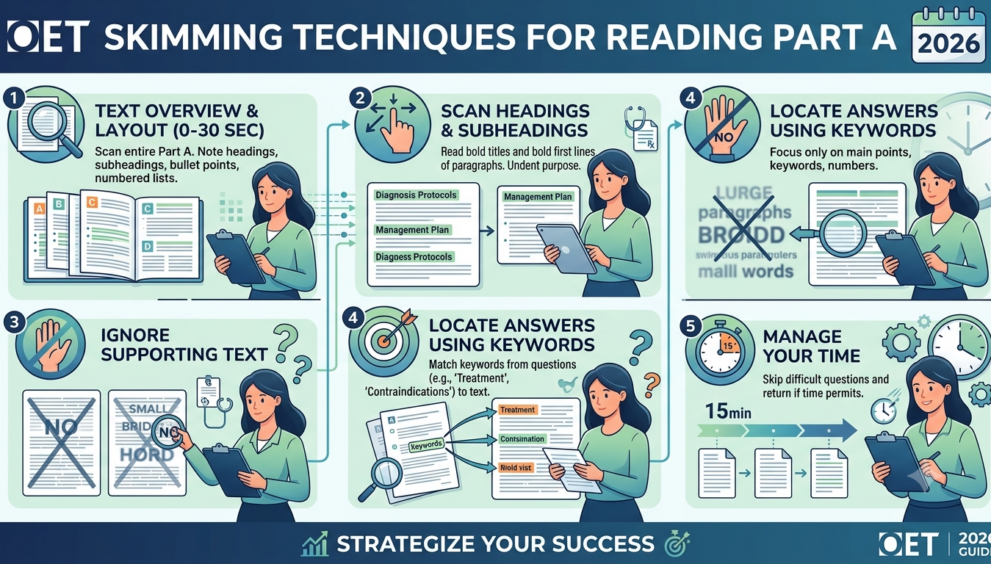
One of the most effective OET Reading Part A tips is to spend the first one to two minutes getting a fast overview of all four texts. Do not try to memorise details. Instead, look for these structural landmarks:
- Titles and Main Headings: These reveal the overarching topic instantly.
- Subheadings: These divide the text into sections like symptoms, treatment, or referral criteria.
- Bullet Points & Tables: These hold high-value information like side effects, steps, or numerical data in a compact form.
- Opening Lines: The first sentence of a paragraph usually contains its core concept.
Think of this as building a map before a journey so you do not waste time wandering blindly when answering questions.
Cracking Paraphrasing in OET
OET questions and texts rarely use the exact same words. To score well, you must train yourself to think in ideas rather than exact word matches.
| Question Wording | Typical Text Synonyms |
|---|---|
| Warning signs requiring urgent attention | “Seek immediate medical help if…” |
| People who should not use this medicine | Contraindications, not recommended for… |
| Worsening condition | Deterioration, decline |
| Stop treatment | Discontinue, withhold |
Balancing Speed and Accuracy
Fast reading is useful, but accuracy wins the marks. The best method is to move quickly when locating information, then slow down when confirming it.
Once you find the correct section, read closely around it to make sure the context matches completely. Check if a recommendation applies specifically to adults or children, or if an action is meant for pre-operative or post-operative care.
Common Pitfalls to Avoid
- Reading every single word out of habit.
- Ignoring headings, tables, and layouts.
- Searching only for exact word matches.
- Spending more than 1 minute on a difficult question.
How Fortuwest International Helps You Succeed
Mastering skimming requires timed, targeted practice. At Fortuwest International, our OET preparation programmes combine language building with proven test strategies. We provide realistic mock exams, guided feedback, and practice materials modeled directly after current 2026 OET standards. We train you to process clinical information rapidly, a skill that will serve you well not just in the exam, but in your future career within the NHS.
Why Wait? Just Fortuwest It!
Free Consultation – Chat now with a Fortuwest International expert.
FAQ: OET Skimming Techniques
Q: What is the main difference between skimming and scanning?
A: Skimming identifies the layout, purpose, and main ideas of the texts. Scanning targets specific pieces of data like a metric, a drug name, or a timeframe once you know where to look.
Q: Can I pass Reading Part A if I don’t understand every word?
A: Yes. You do not need perfect vocabulary comprehension. Focus on context, headings, and overall meaning to locate answers rather than panicking over unfamiliar medical terms.
Q: How can I practice this outside of official exam papers?
A: Practice reading real-world healthcare resources like NHS patient leaflets, clinical guidelines, and hospital discharge summaries. Force yourself to identify the layout and core message within 30 seconds.
Lorem ipsum dolor sit amet, consectetur adipiscing elit. Ut elit tellus, luctus nec ullamcorper mattis, pulvinar dapibus leo.