

Catheter Urine Specimen Collection in the NMC OSCE
If you are preparing for the NMC OSCE, understanding how to collect a catheter urine specimen accurately and aseptically is an essential clinical skill. This station assesses much more than the technical procedure. Examiners evaluate your communication, patient consent, infection prevention, specimen handling, documentation, and overall professionalism.
Many candidates lose marks because they overlook small but important details such as performing hand hygiene, maintaining patient privacy, using the correct collection technique, or explaining what happens after the sample is collected.
This guide provides a simple step-by-step approach, highlights common mistakes, and shares practical tips to help you meet NMC OSCE standards. Whether you are an internationally educated nurse or preparing for your first OSCE attempt, these principles will improve both your confidence and performance.
Why This Skill Is Important
Catheter urine specimens are commonly collected for microscopy, culture, and sensitivity (MC&S) testing to identify urinary tract infections and guide treatment.
In the OSCE, examiners expect you to demonstrate not only the correct procedure but also the clinical reasoning behind every action.
An aseptic approach is essential because contaminated samples may produce inaccurate laboratory results, delay diagnosis, increase unnecessary antibiotic use, and compromise patient safety. Correct specimen collection, immediate labelling, and prompt transport to the laboratory are all key parts of safe nursing practice and reflect the standards of the NMC Code.
Equipment Required
Before beginning the procedure, confirm that all equipment is available, clean, and within its expiry date.
You will need:
- Personal protective equipment (PPE)
- Sterile specimen container with lid
- Alcohol wipes
- Syringe (and needle if required)
- Sharps bin (if a needle is used)
- Microbiology specimen bag
- Patient identification label
- Clinical waste disposal facilities
Even if every item is not physically available during the OSCE, verbalising what you would use demonstrates safe practice.
Step-by-Step Procedure
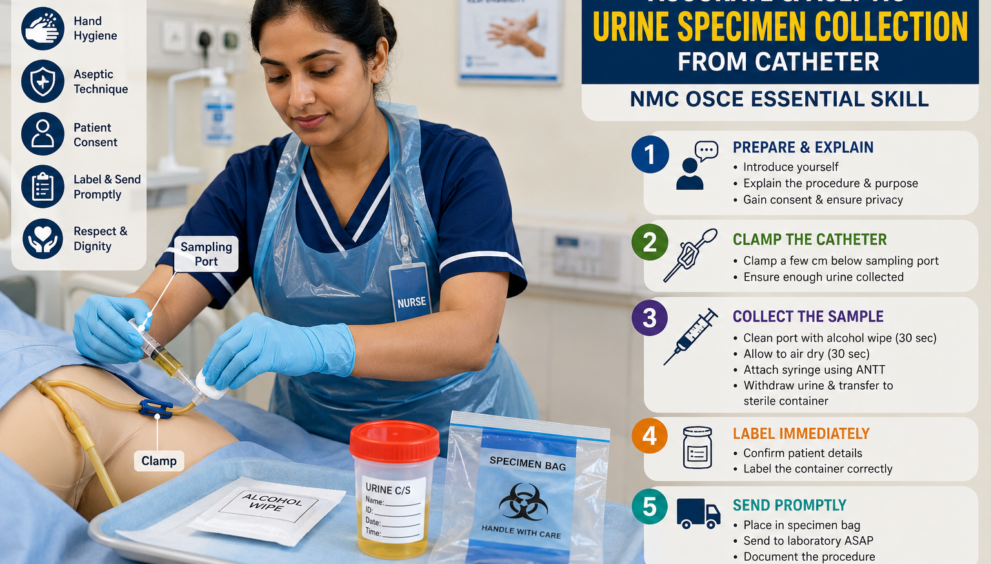
1. Prepare and Introduce Yourself
- Perform hand hygiene.
- Introduce yourself and confirm the patient’s identity.
- Explain the procedure and its purpose.
- Gain informed consent.
- Ensure privacy and patient comfort.
Good communication is an important part of the assessment and demonstrates patient-centred care.
2. Clamp the Catheter
Clamp the catheter a few centimetres below the sampling port and wait until sufficient urine has collected before obtaining the specimen.
Explaining your actions clearly shows both technical knowledge and clinical understanding.
Learn with Fortuwest International
3. Collect the Urine Sample
- Perform hand hygiene again.
- Wear gloves and an apron.
- Clean the sampling port with an alcohol wipe for 30 seconds.
- Allow it to air dry for another 30 seconds.
- Using ANTT (Aseptic Non-Touch Technique), attach the syringe to the sampling port and withdraw the required urine sample.
OSCE Tips
- If only a syringe is provided, insert it at 90°.
- If using a needle and syringe, insert at 45°.
- Dispose of any used needle immediately into a sharps bin.
Transfer the urine into a sterile specimen container without touching the inside of the container or lid. Secure the lid, place the specimen inside a microbiology bag, and clean the sampling port again before unclamping the catheter.
4. Label Immediately
Always label the specimen immediately after collection.
Confirm the patient’s identity according to local policy before attaching the label.
Correct labelling prevents specimen errors and is an essential patient safety requirement.
5. Send the Specimen Promptly
Send the specimen to the laboratory as soon as possible.
If transport is delayed, follow local policy regarding storage.
Finally, document:
- The procedure performed
- Time of collection
- Patient response
- Specimen labelling
- Laboratory dispatch
In the OSCE, verbalising your documentation is usually sufficient.
Demonstrating Aseptic Technique
Remember these key principles throughout the station:
- Perform hand hygiene at appropriate moments.
- Use a sterile specimen container.
- Avoid touching sterile surfaces.
- Close the container immediately after collection.
- Label the specimen correctly.
- Transport it promptly.
The examiner is looking for a calm, organised, and safe approach rather than unnecessary complexity.
Common Mistakes to Avoid
Many candidates lose marks by:
- Forgetting to obtain consent
- Missing hand hygiene
- Failing to clamp or unclamp the catheter
- Touching the inside of the specimen container
- Delaying specimen labelling
- Forgetting laboratory transport
- Ignoring patient privacy and comfort
Remember that communication and professionalism are assessed alongside your technical skills.
Quick Exam Checklist
Before finishing the station, make sure you have completed each of the following:
- Hand hygiene
- Patient identification
- Explanation and consent
- Privacy maintained
- Catheter clamped
- Equipment checked
- Sample collected aseptically
- Specimen labelled
- Laboratory transport mentioned
- Documentation completed
- Patient left comfortable
Practising this checklist regularly will help you perform confidently under exam conditions.
Prepare with Fortuwest International
At Fortuwest International, we support internationally educated nurses preparing for UK registration through structured CBT, OSCE, and OET preparation programmes.
Our experienced educators help candidates understand examiner expectations, improve communication skills, and master practical clinical procedures with confidence. Through guided practice, mock assessments, and expert feedback, we help you build the knowledge and confidence needed to succeed in the NMC OSCE and begin your NHS career.
Conclusion
Accurate and aseptic catheter urine specimen collection is an essential NMC OSCE skill. Success depends on combining sound clinical knowledge with effective communication, infection prevention, patient safety, and professional practice.
By following a structured approach and practising regularly, you can confidently demonstrate the standards expected of a registered nurse in the UK.
Fortuwest International is committed to supporting your journey with expert CBT, OSCE, and OET preparation designed to help you achieve your professional goals.
Frequently Asked Questions
Why is a Catheter Specimen of Urine (CSU) collected?
A CSU is collected to:
- Diagnose urinary tract infections (UTIs)
- Monitor renal function
- Detect blood or protein in urine
- Support appropriate treatment decisions
How should the catheter be clamped?
Clamp the catheter a few centimetres below the sampling port using the built-in clamp or a non-traumatic clamp until enough urine has collected.
Should gloves be worn?
Yes. Non-sterile gloves should always be worn to reduce the risk of contamination and maintain infection prevention standards.
Should I mention laboratory transport during the OSCE?
Yes. Always state that the specimen will be labelled immediately and sent promptly to the laboratory.
How can I improve my OSCE confidence?
Practise the complete procedure aloud, including your communication with the patient. Regular mock practice and structured training with Fortuwest International will help improve both confidence and performance.
Continue your OSCE preparation by exploring our guides on NG Tube Insertion, Catheter Care, Wound Assessment, and other essential NMC OSCE skills.
Start Your UK Nursing Journey with Fortuwest International today.