

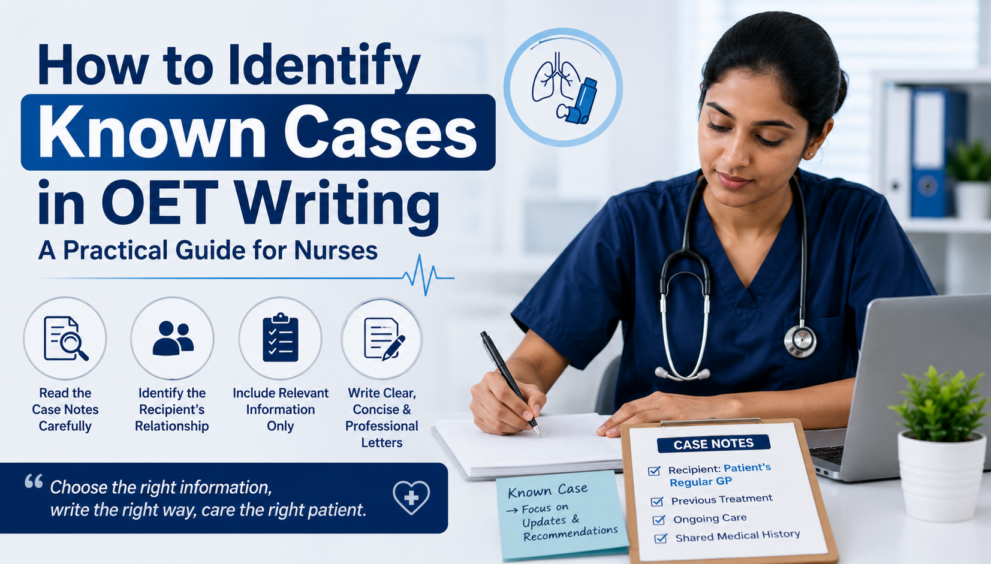
Understanding whether a patient is a known case or an unknown case is one of the easiest ways to improve your OET Writing score. Many candidates lose marks because they include unnecessary information or omit important details simply because they fail to identify the recipient’s relationship with the patient.
In this guide, you’ll learn how to recognise known cases, structure your referral letter correctly, and avoid common mistakes in the OET Writing sub-test.
What Is a Known Case in OET Writing?
A known case means the healthcare professional receiving your letter already knows the patient. This usually happens when the recipient is the patient’s:
- General Practitioner (GP)
- Regular Consultant
- Community Nurse
- Family Doctor
- Long-term Healthcare Provider
Because the recipient is already familiar with the patient’s medical history, your letter should focus mainly on new developments, current treatment, and the reason for writing.
How to Recognise a Known Case
Always read the case notes carefully.
A known case is usually indicated by phrases such as:
- Patient’s regular GP
- Family physician
- Treating consultant
- Follow-up with previous doctor
- Continue ongoing care
- Return to your care
If you see these expressions, you do not need to explain the patient’s complete medical history.
Signs of an Unknown Case
An unknown case occurs when the healthcare professional has never treated the patient before.
Examples include referrals to:
- Specialist clinics
- New consultants
- Rehabilitation centres
- Community health services
- Residential care facilities
In these situations, include enough background information to help the recipient understand the patient’s condition.
How to Structure a Letter for a Known Case
Introduction
Briefly explain why you are writing.
Example:
I am writing to update you regarding your patient, Mr John Smith, who is being discharged following treatment for pneumonia.
Medical Updates
Only include information the recipient needs to know, such as:
- Recent diagnosis
- Hospital treatment
- Current medications
- Changes in condition
- Investigation results
- Follow-up requirements
Avoid repeating information already known to the recipient.
Recommendations
Clearly state what you expect the recipient to do.
For example:
- Continue medication.
- Monitor blood pressure.
- Arrange follow-up appointments.
- Review wound healing.
- Provide ongoing diabetic education.
Common Mistakes to Avoid
Many OET candidates lose marks by:
- Rewriting the patient’s entire medical history.
- Including unnecessary case-note details.
- Forgetting the purpose of the referral.
- Omitting important recent changes.
- Using informal language.
- Writing an introduction that is too long.
Remember, OET examiners assess whether you can select the most relevant information, not every detail in the case notes.
Tips to Score Higher in OET Writing
Before you begin writing:
✔ Identify the recipient.
✔ Decide whether the case is known or unknown.
✔ Highlight only relevant information.
✔ Organise your ideas before writing.
✔ Keep paragraphs short and logical.
✔ Use formal professional language.
✔ Focus on the purpose of the letter.
These simple habits can significantly improve your Organisation and Content scores.
Why This Matters in the OET Exam
The OET Writing sub-test measures your ability to communicate effectively with other healthcare professionals.
A well-written referral letter should be:
- Relevant
- Accurate
- Concise
- Well organised
- Easy to follow
Understanding whether the recipient already knows the patient helps you decide what information to include and what information to leave out, making your writing more professional and clinically appropriate.
Prepare with Fortuwest International
At Fortuwest International, we help nurses achieve success in OET, CBT, and NMC OSCE through structured coaching, expert feedback, and exam-focused practice.
Our experienced trainers teach candidates how to analyse case notes, identify known and unknown cases, organise referral letters, and meet all OET assessment criteria with confidence.
Whether you are preparing for your first OET attempt or aiming for a higher writing score, our practical training can help you communicate clearly and professionally.
Conclusion
Recognising a known case is one of the most important skills in OET Writing. It helps you choose the correct information, avoid unnecessary repetition, and write concise, effective referral letters.
With regular practice and the right guidance, you can improve your writing skills and achieve your target OET score.
Fortuwest International is committed to helping internationally educated nurses succeed in OET and begin their healthcare careers with confidence.
Frequently Asked Questions
What is a known case in OET Writing?
A known case is one in which the recipient already has a professional relationship with the patient, such as the patient’s regular GP or consultant.
How do I identify a known case?
Look for clues such as “regular GP,” “family doctor,” “follow-up,” or “return to your care” in the case notes.
Should I include the patient’s full medical history?
No. Only include new or relevant information that the recipient needs for ongoing care.
Why is identifying a known case important?
It helps you write a concise, relevant referral letter and avoids unnecessary repetition, which improves your OET Writing score.
How can I improve my OET Writing skills?
Practise analysing case notes, identifying the purpose of the letter, selecting relevant information, and writing clear, well-structured referral letters. Expert coaching from Fortuwest International can also help you build confidence and improve your exam performance.
Explore more OET Writing tips, referral letter samples, mock tests, and exam preparation resources with Fortuwest International.