

If you’re preparing for the NMC CBT, one topic that frequently appears in exam questions is the difference between Alzheimer’s disease and dementia. Many candidates mistakenly use these terms interchangeably, but understanding the distinction can help you answer questions correctly and provide safer, person-centred care in the NHS.
This quick guide explains the key differences, common symptoms, nursing responsibilities, and practical revision tips to help you succeed in your NMC CBT.
Dementia vs Alzheimer’s: What’s the Difference?
The easiest way to remember this topic is:
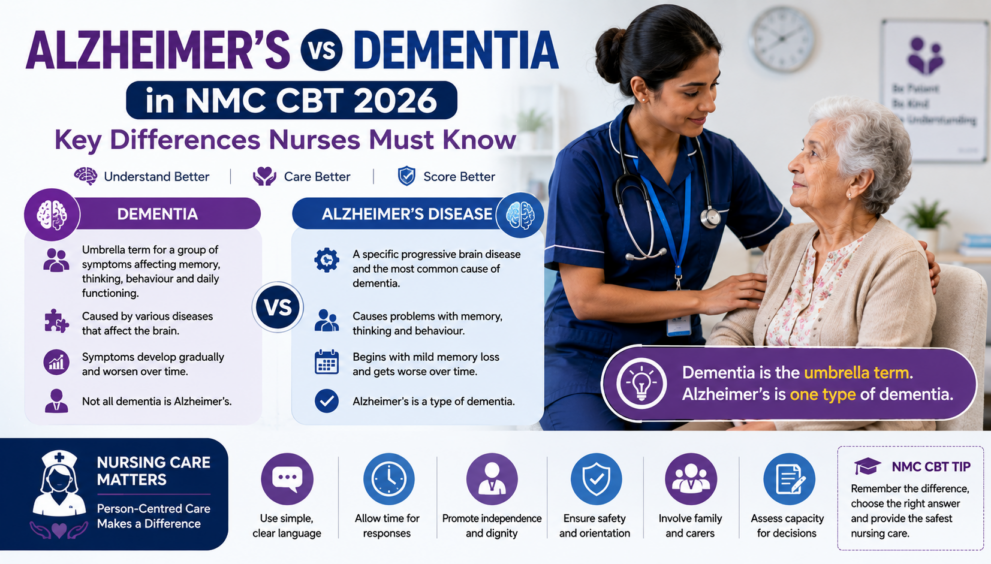
Dementia is an umbrella term, while Alzheimer’s disease is the most common type of dementia.
Dementia is not a single disease. It describes a group of symptoms that affect memory, thinking, reasoning, communication, and the ability to perform everyday activities.
Alzheimer’s disease is a progressive brain disorder that gradually damages memory and cognitive function, eventually leading to dementia.
Quick Memory Tip
- Dementia = Syndrome (umbrella term)
- Alzheimer’s = Specific disease
- All Alzheimer’s is dementia, but not all dementia is Alzheimer’s.
Common Symptoms
Dementia
People living with dementia may experience:
- Memory loss
- Confusion
- Difficulty communicating
- Poor judgement
- Personality changes
- Problems performing daily activities
Alzheimer’s Disease
Early signs often include:
- Forgetting recent conversations
- Repeating questions
- Difficulty finding words
- Confusion about time and place
- Poor decision-making
As Alzheimer’s progresses, individuals may require assistance with eating, dressing, personal hygiene, mobility, and communication.
Why This Topic Matters in the NMC CBT
The NMC CBT often tests whether candidates understand:
- The difference between Alzheimer’s and dementia.
- Early symptoms of cognitive decline.
- Safe, person-centred nursing care.
- Communication techniques.
- Mental capacity principles.
A common CBT mistake is selecting answers that suggest Alzheimer’s and dementia are the same condition.
Always remember:
Dementia describes the symptoms. Alzheimer’s is one disease that causes those symptoms.
Person-Centred Nursing Care
International nurses working in the NHS frequently care for people living with dementia.
Good nursing practice includes:
- Speaking calmly using simple language.
- Allowing extra time for responses.
- Promoting independence whenever possible.
- Maintaining dignity and privacy.
- Involving family members appropriately.
- Providing a safe, familiar environment.
Person-centred care remains essential throughout every stage of the condition.
Don’t Confuse Dementia with Delirium
The CBT may also compare dementia with delirium.
| Dementia | Delirium |
|---|---|
| Develops gradually | Appears suddenly |
| Usually progressive | Often reversible |
| Long-term condition | Short-term condition |
| Memory gradually declines | Rapid confusion and altered consciousness |
If symptoms appear suddenly after illness, infection, surgery, or medication changes, think delirium, not dementia.
Nursing Tips for CBT Success
When answering CBT questions:
- Read the question carefully.
- Decide whether it asks about the syndrome or the disease.
- Remember that capacity is assessed for each decision individually.
- Choose answers that prioritise patient safety and dignity.
- Focus on person-centred communication.
These principles reflect both the NMC Code and everyday NHS practice.
Quick Revision Checklist
✔ Dementia is a syndrome, not a disease.
✔ Alzheimer’s disease is the most common cause of dementia.
✔ Alzheimer’s develops gradually.
✔ Delirium develops suddenly.
✔ Dementia does not automatically mean a patient lacks mental capacity.
✔ Person-centred communication is always the safest nursing approach.
How Fortuwest International Can Help
Preparing for the NMC CBT can be challenging, but expert guidance makes the journey easier.
Fortuwest International supports international nurses with:
- NMC CBT preparation
- OSCE coaching
- OET guidance
- UK nursing career counselling
- NMC registration support
- Documentation assistance
- Visa and relocation guidance
Our experienced team helps you understand complex nursing topics through simple explanations, exam-focused learning, and practical guidance designed for success in both the CBT and NHS practice.
Conclusion
Understanding the difference between Alzheimer’s disease and dementia is essential for every international nurse preparing for the NMC CBT.
Remember the golden rule:
Dementia is the umbrella term. Alzheimer’s is one type of dementia.
Mastering this concept will help you answer exam questions with confidence while improving your ability to provide safe, compassionate, and person-centred care in the NHS.
With expert preparation and personalised support from Fortuwest International, you’ll be one step closer to achieving your dream of becoming a registered nurse in the UK.
Frequently Asked Questions
1. Is Alzheimer’s the same as dementia?
No. Dementia is a syndrome, while Alzheimer’s disease is the most common cause of dementia.
2. What is the easiest way to remember the difference?
Remember: All Alzheimer’s is dementia, but not all dementia is Alzheimer’s.
3. What are the early symptoms of Alzheimer’s?
Memory loss, repeating questions, confusion, difficulty finding words, and poor judgement.
4. Can someone with dementia still have mental capacity?
Yes. Mental capacity is decision-specific and should never be assumed to be absent solely because a person has dementia.
5. How can Fortuwest International help?
Fortuwest International offers comprehensive support for NMC CBT, OSCE, OET, UK registration, visa guidance, and career counselling to help international nurses build successful NHS careers.