


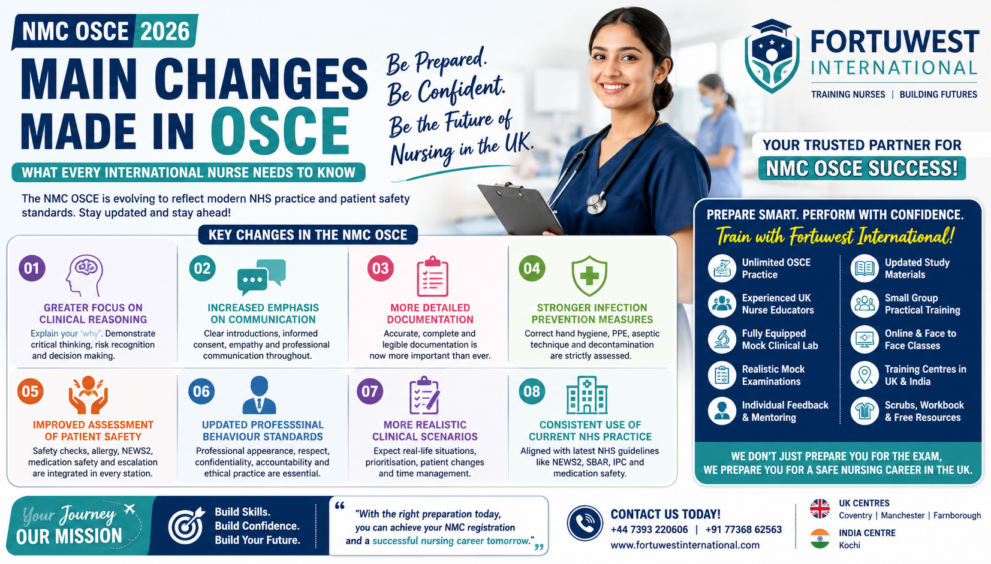
Main Changes Made in the NMC OSCE: A Complete Guide for International Nurses
The Nursing and Midwifery Council (NMC) Objective Structured Clinical Examination (OSCE) is a vital step for internationally educated nurses seeking registration in the UK. To ensure that the examination reflects current NHS practice and patient safety standards, the OSCE is reviewed and updated periodically.
If you are planning to take the NMC OSCE, understanding these changes is essential. This guide explains the key updates and how you can prepare effectively.
Why Does the NMC Update the OSCE?
Healthcare is constantly evolving. The NMC reviews the OSCE to ensure candidates demonstrate:
- Safe and evidence-based nursing practice
- Effective communication skills
- Accurate clinical documentation
- Patient-centred care
- Compliance with the latest NHS and NMC standards
These updates ensure newly registered nurses are ready to provide high-quality care across UK healthcare settings.
Key Changes in the NMC OSCE
1. Greater Focus on Clinical Reasoning
Candidates are expected not only to perform procedures correctly but also to explain why they are making specific clinical decisions.
Examiners assess your ability to:
- Recognise patient deterioration
- Prioritise care
- Identify risks
- Escalate concerns appropriately
Critical thinking has become as important as technical skills.
2. Increased Emphasis on Communication
Communication is now assessed throughout every station.
Candidates should:
- Introduce themselves professionally
- Confirm patient identity
- Gain informed consent
- Explain procedures clearly
- Demonstrate empathy
- Maintain patient dignity
Good communication can significantly improve overall performance.
3. More Detailed Documentation Expectations
Documentation continues to play a major role.
Candidates should:
- Record findings accurately
- Document assessments completely
- Use appropriate nursing terminology
- Avoid omissions
- Complete forms neatly and correctly
Many candidates lose marks because of incomplete documentation rather than poor clinical skills.
4. Stronger Infection Prevention Measures
Infection prevention remains one of the highest priorities.
Candidates are expected to demonstrate:
- Correct hand hygiene
- Appropriate use of PPE
- Safe aseptic technique
- Proper waste disposal
- Equipment decontamination
- Cross-infection prevention
Missing infection control steps can lead to significant mark deductions.
5. Improved Assessment of Patient Safety
Patient safety is integrated throughout every station.
Examiners look for:
- Correct patient identification
- Allergy checks
- Medication safety
- Risk assessment
- Escalation using recognised communication methods
- Safe clinical judgement
Patient safety is considered before speed.
6. Updated Professional Behaviour Standards
Professionalism is continuously assessed.
Candidates should demonstrate:
- Respect
- Confidentiality
- Professional appearance
- Accountability
- Ethical decision-making
- Respect for patient privacy
Professional conduct reflects the expectations of registered nurses working within the NHS.
7. More Realistic Clinical Scenarios
OSCE stations increasingly reflect real NHS practice.
Candidates may encounter:
- Multiple patient concerns
- Unexpected changes in patient condition
- Time management challenges
- Prioritisation decisions
- Communication with multidisciplinary teams
Preparation should therefore focus on understanding clinical situations rather than memorising scripts.
8. Consistent Use of Current NHS Practice
The OSCE aligns closely with current NHS clinical standards.
Candidates should stay familiar with:
- NEWS2 observations
- SBAR communication
- Medication safety principles
- Infection prevention guidance
- Patient-centred care approaches
Understanding current NHS practice improves confidence during the examination.
Common Mistakes Candidates Still Make
Even after the recent updates, many candidates lose marks because they:
- Rush through assessments
- Forget patient identification
- Miss hand hygiene opportunities
- Skip documentation details
- Fail to verbalise clinical reasoning
- Forget to gain consent
- Miss safety checks
Avoiding these common errors can make a significant difference.
How to Prepare for the Updated OSCE
A successful preparation strategy includes:
- Daily practical sessions
- Regular mock OSCE examinations
- Practising documentation
- Developing communication skills
- Reviewing NHS guidelines
- Receiving structured feedback from experienced trainers
- Repeating stations until confident
Consistent practice builds confidence and reduces exam anxiety.
Prepare with Fortuwest International
Keeping up with OSCE updates can be challenging without expert guidance. Fortuwest International provides structured preparation designed around the latest examination expectations.
Our training includes:
- Unlimited OSCE practice sessions
- Experienced UK nurse educators
- Complete coverage of all OSCE stations
- Fully equipped mock clinical laboratory
- Realistic mock examinations
- Individual feedback and mentoring
- Updated study materials
- Small-group practical training
- Online and face-to-face learning options
- Training centres in the UK and India
Our focus is to help every candidate build confidence, improve clinical competence, and perform safely under examination conditions.
Final Thoughts
The NMC OSCE continues to evolve to reflect modern NHS nursing practice. While the core examination structure remains familiar, there is now a stronger emphasis on clinical reasoning, patient safety, communication, documentation, professionalism, and evidence-based care.
Success in the updated OSCE depends on understanding these expectations and practising consistently in a realistic clinical environment. With the right preparation, international nurses can approach the examination with confidence and take the next step toward a rewarding nursing career in the United Kingdom.