


By Fortuwest International
July 30, 2026 • 3 minutes read
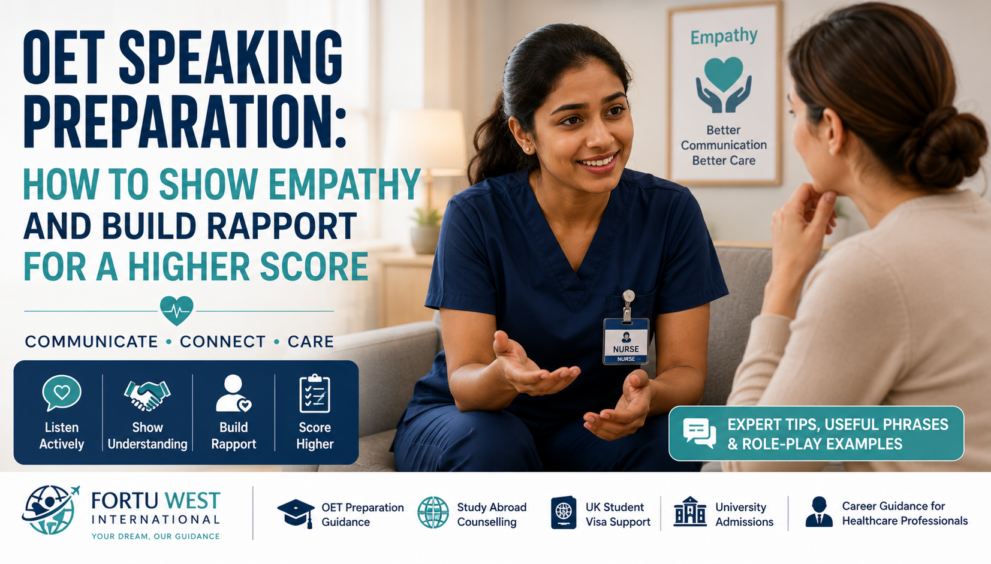
Empathy is one of the most important communication skills assessed in the OET Speaking sub-test. While accurate medical information is essential, examiners also want to see that you can recognise a patient’s emotions and respond professionally.
Many candidates lose marks because they focus only on giving advice or asking questions. In reality, acknowledging a patient’s feelings before offering information helps you build rapport and score better in the Relationship Building criterion.
In this guide, you’ll learn how to use empathy naturally during your OET Speaking role-play.
What Is Empathy in OET Speaking?
Empathy means recognising how a patient feels and responding with understanding while remaining professional.
It is different from sympathy.
❌ Sympathy:
“I feel so sorry for you.”
✅ Empathy:
“I understand that this situation must be worrying for you.”
The second response acknowledges the patient’s feelings without becoming emotionally involved, making it more appropriate in a healthcare consultation.
Why Does Empathy Matter?
Patients may feel:
- Worried
- Anxious
- Frustrated
- Embarrassed
- Confused
- Afraid
If you ignore these emotions and immediately give medical advice, the conversation may sound cold or robotic.
Patient:
“I’m really worried about my surgery.”
Less Effective:
“The operation usually takes about an hour.”
Better:
“I understand why you’re feeling worried. Let me explain what will happen during the procedure so you know what to expect.”
Always acknowledge the emotion before providing information.
The Two-Step Formula for Showing Empathy
A simple structure can make your responses sound natural.
Step 1: Acknowledge the Patient’s Feelings
Useful phrases include:
- I understand your concern.
- I can see why you’re worried.
- That sounds difficult.
- It’s understandable that you’re feeling anxious.
- I appreciate how frustrating this must be.
Step 2: Offer Reassurance or Support
Follow your empathetic statement with reassurance.
Examples:
- Let’s go through everything together.
- I’ll explain each step.
- We’ll work through this together.
- There are treatment options available.
- I’ll answer all your questions.
Example
Patient:
“I’m worried about my test results.”
Response:
“I understand why you’re feeling anxious. Let’s go through the results together so I can explain what they mean.”
Common Situations Where You Should Use Empathy
Show empathy whenever a patient expresses emotion.
Concern
Patient:
“I’m worried these tablets aren’t working.”
Response:
“I understand your concern. Let’s review your treatment together.”
Fear
Patient:
“I’m frightened about the operation.”
Response:
“I understand this feels frightening. I’ll explain each step so you know exactly what to expect.”
Embarrassment
Patient:
“This problem is embarrassing.”
Response:
“I understand this may feel uncomfortable to discuss. Please don’t worry—we help patients with this regularly.”
Frustration
Patient:
“Nothing seems to be improving.”
Response:
“I can appreciate how frustrating that must be. Let’s discuss the next steps together.”
Match Your Empathy to the Situation
Not every situation requires the same level of emotion.
Mild Empathy
Use for routine concerns.
Example:
“I understand your concern. Let me explain how this treatment works.”
Moderate Empathy
Use when patients are clearly worried or disappointed.
Example:
“I can appreciate how frustrating this must be. Let’s review your progress together.”
High Empathy
Use for serious diagnoses or emotional situations.
Example:
“I’m very sorry to hear that. I understand how difficult this must be. We’ll support you throughout your treatment.”
Tips to Score Higher in OET Speaking
- Listen carefully for emotional cues.
- Respond to feelings before giving advice.
- Use a variety of empathetic expressions.
- Keep your tone calm and professional.
- Avoid sounding scripted or repetitive.
- Reassure the patient whenever appropriate.
Natural empathy creates a more patient-centred conversation and improves your communication score.
Final Thoughts
The OET Speaking test is not only about medical knowledge—it also assesses how effectively you communicate with patients.
Remember this simple formula:
Empathy → Reassurance → Information
When patients feel heard and understood, your role-play becomes more natural, professional, and effective.
With regular practice and the right communication techniques, you can build confidence, strengthen rapport, and improve your OET Speaking score.
Prepare for OET Success with Fortuwest International
Whether you’re preparing for the OET exam or planning an international healthcare career, Fortuwest International is here to support you every step of the way.
Our Services
- OET Speaking & Writing Preparation
- Study Abroad Counselling
- UK Student Visa Assistance
- University Admissions Support
- Career Guidance for Healthcare Professionals
Book your FREE consultation with Fortuwest International today and take the next step towards achieving your OET goals and international healthcare career.