

This is the first installment of our monthly Visa Bulletin series. Each month we’ll break down what moved, what didn’t, and what it actually means if you’re an internationally educated nurse waiting on a priority date. Bookmark this one — we’ll link back to it as the baseline for comparison in future editions.
Where Nurses Sit in the Visa Bulletin
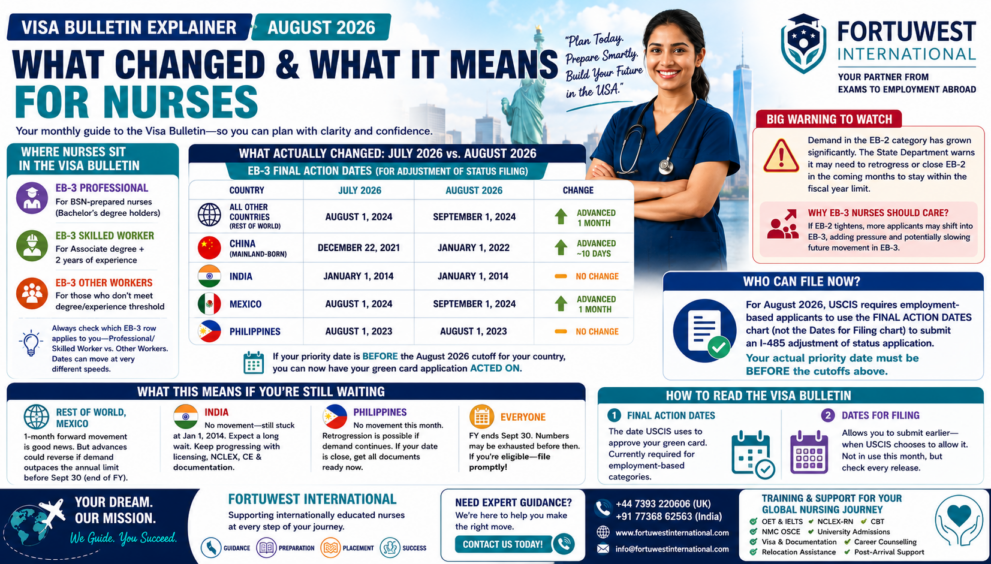
Most internationally educated nurses fall under EB-3, the employment-based third preference category, which the State Department’s own bulletin defines as covering skilled workers, professionals, and other workers. If you hold a BSN, you’re typically classified as an EB-3 “Professional.” If you hold an associate degree plus at least two years of experience, you may fall under the “Skilled Worker” line, also read from the EB-3 row. A smaller number of nurses without the experience or degree threshold fall under EB-3 Other Workers, which has its own, generally slower-moving cutoff date.
This matters because it’s easy to glance at “EB-3” moving forward and assume you’re covered — always check whether your case is Professional/Skilled Worker or Other Workers, since the two can move at very different speeds.
What Actually Changed From July to August 2026
Comparing the Final Action Dates chart nurses need for filing an adjustment of status application, here’s the month-over-month movement:
| Country | July 2026 EB-3 Final Action Date | August 2026 EB-3 Final Action Date | Change |
|---|---|---|---|
| All other countries (Rest of World) | August 1, 2024 | September 1, 2024 | Advanced 1 month |
| China (mainland-born) | December 22, 2021 | January 1, 2022 | Advanced ~10 days |
| India | January 1, 2014 | January 1, 2014 | No change |
| Mexico | August 1, 2024 | September 1, 2024 | Advanced 1 month |
| Philippines | August 1, 2023 | August 1, 2023 | No change |
In plain terms: if you’re an EB-3 nurse from most countries — including much of Sub-Saharan Africa, the Caribbean, and Southeast Asia outside the Philippines — your final action date moved forward a full month. If your priority date falls before September 1, 2024, you’re now eligible to have your green card application finally acted on. If you’re from India, the date has been frozen at January 1, 2014 for a long stretch, meaning nurses with priority dates after that point are still waiting with no forward movement this month. The Philippines also saw no movement, holding at August 1, 2023.
The Bigger Warning Buried in the Narrative Section
Numbers moving forward isn’t the whole story this month. The bulletin’s narrative section carries a warning worth flagging for anyone in the pipeline: demand in the EB-2 category (the tier just above EB-3, typically covering advanced-degree holders) has grown enough that the State Department is warning it may need to retrogress or fully close that category in the coming months to stay within its annual limit for the fiscal year. That warning applies broadly, not to one specific country.
Why should EB-3 nurses care about an EB-2 warning? Because when EB-2 categories tighten or close, some applicants who would otherwise file under EB-2 (nurses with a BSN pursuing further credentials, for instance, or those who qualify under both categories) shift demand toward EB-3, which can add pressure to EB-3 wait times down the line. It’s a category to watch even if it’s not the one your case sits in.
Which Applicants Are Currently Eligible to File
For August 2026, USCIS requires employment-based applicants to use the Final Action Dates chart (not the more generous Dates for Filing chart) to determine eligibility to submit an I-485 adjustment of status application. That means your actual priority date — not just an earlier “you can start paperwork” date — needs to fall before the cutoffs above.
What This Means If You’re Still Waiting
- Rest of World, Mexico: the one-month forward movement is good news, but keep watching — the bulletin’s own narrative notes that further advances could reverse if demand outpaces the annual limit before the fiscal year closes at the end of September.
- India: the extended freeze at January 1, 2014 means nurses with more recent priority dates should plan on a long runway. This is the reality behind the persistent EB-3 backlog for India that’s been building for years — patience and parallel planning (state licensure, NCLEX, credential evaluation) matter more than watching the bulletin for a breakthrough that isn’t imminent.
- Philippines: no movement this month, and the bulletin has separately flagged the possibility of retrogression here too if demand keeps climbing. If your priority date is close to the current cutoff, consider getting your paperwork fully ready now rather than waiting for confirmation that the date has passed.
- Everyone: the fiscal year ends September 30, and the bulletin explicitly notes that numbers could be exhausted before then. If you’re newly eligible this month, don’t sit on it — file as promptly as your documentation allows.
Reading the Bulletin Yourself Going Forward
Two charts matter, and it’s worth knowing which one applies to you:
- Final Action Dates — the date USCIS actually uses to approve your green card. This is the chart employment-based applicants must currently use.
- Dates for Filing — a more forward-looking chart that sometimes lets you submit paperwork earlier, when USCIS opts to allow it. It’s not currently in use for employment-based categories this month, but that can change, so it’s worth checking each release.
We’ll publish this same format every month — a comparison table against the prior month, the narrative warnings translated into plain language, and what it means specifically for nurses by country. If there’s a specific country or visa category you want us to track more closely in future editions, let us know.