

In OET Speaking, it is not enough to simply use polite or memorised expressions. Candidates are expected to communicate in a way that is clear, professional and patient-centred.
Many candidates preparing for the exam focus heavily on remembering phrases such as “I understand how you feel” or “Please don’t worry.” While these expressions can sometimes be useful, repeating them in every situation can make communication sound rehearsed or robotic.
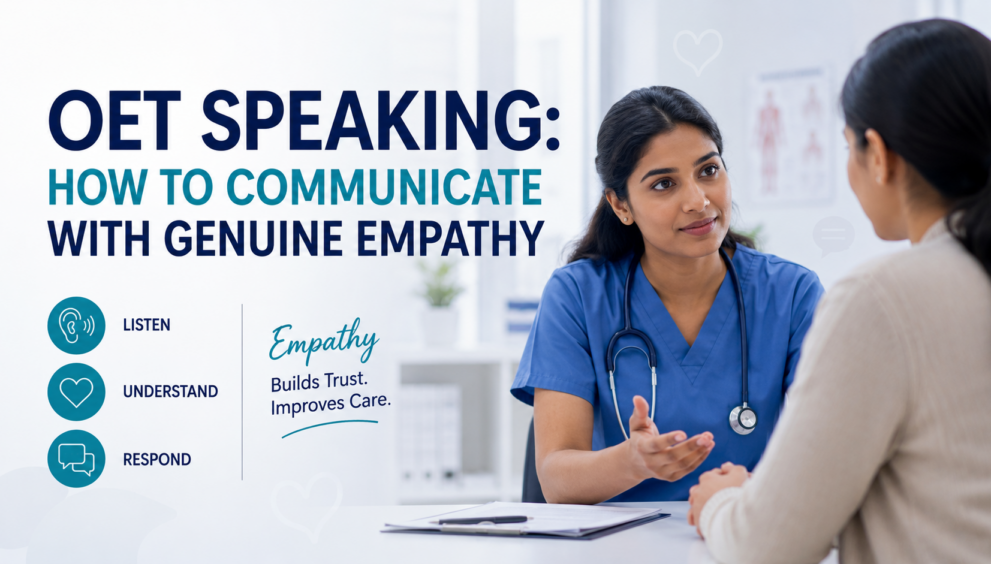
The key to effective empathy is simple: listen to the patient, understand their concern and respond appropriately.
Empathy Is More Than a Prepared Phrase
Imagine a patient says:
“I’m really worried about this lump. My mother had cancer, so I’m scared it could be something serious.”
A memorised response might be:
“I understand how you feel. Please don’t worry.”
Although this sounds polite, it does not fully respond to the patient’s actual concern.
A more natural response could be:
“I can understand why you’re feeling worried, especially given your mother’s experience. Let’s talk about what you’ve noticed and discuss what we can do next.”
The difference is important. The second response shows that you have listened to why the patient is worried.
Use the Listen → Recognise → Respond Approach
A simple way to demonstrate empathy during an OET role play is:
Listen → Recognise → Respond
Listen
Pay attention to the patient’s words and emotional state.
For example:
- “I’m frightened about the surgery.” → Fear
- “I’ve been waiting for weeks for an appointment.” → Frustration
- “I don’t know if I can manage this treatment.” → Anxiety or uncertainty
Recognise
Acknowledge what the patient is experiencing.
You might say:
- “I can understand why you’re concerned.”
- “It sounds like this has been difficult for you.”
- “I’m sorry that you’ve had such a frustrating experience.”
Respond
After acknowledging the concern, provide what the patient needs next—whether that is information, clarification, reassurance or practical support.
For example:
“I can understand why you’re concerned about the possible side effects. Let me explain what you should look out for and what you can do if you experience any problems.”
This creates a natural connection between empathy and information-giving.
Let the Patient Shape the Conversation
One of the biggest mistakes candidates make is treating the role-play card like a script.
Instead of simply moving from one point to the next, respond to what the patient actually says.
For example:
Patient: “I’m worried that I’ll become dependent on this medication.”
Candidate: “I understand why that might concern you. Let me explain how this medication works and address your concerns about dependence.”
The patient’s concern now guides the conversation. This makes your communication sound more natural, flexible and patient-centred.
A useful structure to remember is:
Acknowledge → Address → Explain → Check
For example:
“I can understand why you’re worried. Let me explain what is happening and what we can do next. Does that make sense?”
Keep Your Language Simple and Natural
You do not need complicated vocabulary to sound empathetic.
A simple sentence such as:
“I can see that this has been difficult for you.”
can be much more effective than an overly formal or complicated response.
Also, remember that empathy is not only about the words you choose. Your tone, pace and willingness to listen are equally important. Allow the patient to finish speaking, pause briefly when appropriate and respond to their specific concern.
Final Thoughts
Effective empathy in OET Speaking is not about memorising the perfect phrase.
Instead of asking:
“Which empathy phrase should I use?”
Ask yourself:
“What is this patient feeling, and what do they need from me right now?”
Listen carefully. Recognise the patient’s concern. Respond appropriately. Then provide the information, reassurance or support they need.
When you focus on the patient rather than following a fixed script, your communication becomes more natural, professional and patient-centred.
Prepare for OET with Fortu West International
At Fortu West International, we help healthcare professionals develop the communication skills needed to approach the OET with greater confidence. Focus on understanding the patient, responding naturally and building meaningful communication—because successful OET Speaking is not about sounding rehearsed. It is about communicating effectively.
Take the next step in your OET journey with Fortu West International.