


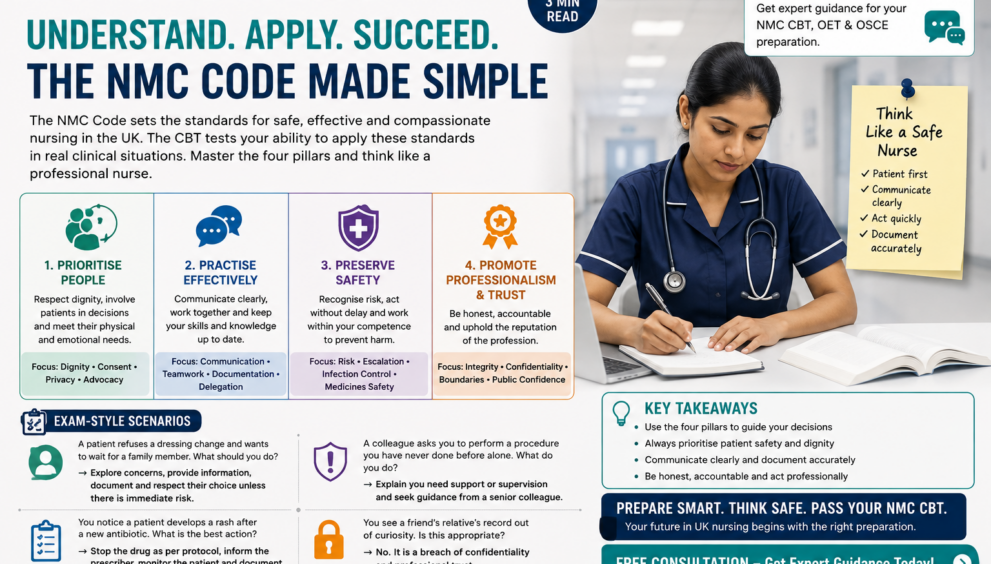
Preparing for the NMC CBT is not only about learning clinical procedures and nursing knowledge. You also need to understand how a professional nurse should think, communicate, and act in different situations.
One of the best ways to strengthen your professional judgement is to understand the four pillars of the NMC Code. These principles can help you analyse scenario-based questions and choose answers that reflect safe, patient-centred nursing practice.
The four pillars are:
- Prioritise people
- Practise effectively
- Preserve safety
- Promote professionalism and trust
Let us explore how these principles can help you approach the NMC CBT with greater confidence.
1. Put the Patient First
The principle of prioritising people is about treating every patient with dignity, compassion, and respect. In CBT questions, this may involve consent, privacy, confidentiality, equality, communication needs, and patient choice.
For example, if a patient refuses a non-emergency procedure, the nurse should not simply ignore the patient’s wishes. The appropriate response is to explore their concerns, provide relevant information, assess any risks, and respect their decision where appropriate.
When answering these questions, ask yourself:
“Does this answer respect the patient’s rights, dignity, and individual needs?”
The safest and most patient-centred option is often the strongest answer.
2. Communicate and Work Effectively
The second pillar, practise effectively, focuses on communication, teamwork, documentation, delegation, and maintaining professional competence.
In the CBT, you may face scenarios involving patient handovers, changes in condition, delegation to another healthcare professional, or recording important information.
A good nurse communicates clearly and records information accurately and promptly. For example, if a patient develops an unexpected reaction after receiving medication, the nurse should take appropriate action, inform the relevant healthcare professional, and document the event clearly.
Delegation also requires professional judgement. Before delegating a task, you should consider whether the person has the appropriate knowledge, skills, and competence to complete it safely.
3. Recognise Risk and Act Without Delay
Preserving safety is one of the most important principles for scenario-based CBT questions. It includes recognising deterioration, managing risk, preventing harm, reporting incidents, safeguarding vulnerable people, and working within your level of competence.
If a patient is showing clear signs of deterioration, delaying action is unlikely to be the correct choice. The nurse should assess the situation and escalate concerns according to the appropriate procedure.
The same principle applies when you are unsure about a task. You should never attempt a procedure independently if you do not have the required competence. Seeking guidance or supervision demonstrates safe and professional practice.
A useful CBT question to ask yourself is:
“What action will protect the patient from harm right now?”
When there is an immediate safety concern, prompt action and escalation should always be considered.
4. Be Honest, Accountable, and Professional
The final pillar is promote professionalism and trust. Nurses are expected to behave honestly, maintain confidentiality, respect professional boundaries, and take responsibility for their actions.
This principle may appear in CBT questions involving patient records, social media, errors, inappropriate behaviour, or confidentiality.
For example, accessing a patient’s medical record without a legitimate reason is a breach of professional standards. Similarly, hiding an error is not the correct response. Patient safety must come first, followed by appropriate reporting, honest documentation, and action according to policy.
Professional trust is built through everyday behaviour. Being respectful, accountable, and honest are all essential qualities of safe nursing practice.
A Simple Way to Approach NMC CBT Scenarios
When you are unsure about a professional practice question, try using this simple method:
Step 1: Identify the main issue.
Is the question about patient dignity, communication, safety, or professional behaviour?
Step 2: Think about the four pillars.
Which principle of the NMC Code is most relevant?
Step 3: Choose the safest patient-centred action.
Avoid answers that ignore concerns, delay necessary action, or hide important information.
Step 4: Remember communication and accountability.
Clear communication, appropriate escalation, and accurate documentation are often important parts of the correct answer.
Final Thoughts
You do not need to memorise the entire NMC Code word for word to use it effectively in the CBT. What matters most is understanding how its principles apply to real nursing situations.
A simple way to remember the four pillars is:
- Prioritise people – Respect and put the patient first.
- Practise effectively – Communicate, collaborate, and document clearly.
- Preserve safety – Recognise risks and act promptly.
- Promote professionalism and trust – Be honest, accountable, and respectful.
By applying these principles to practice questions, you can develop the professional judgement needed for the NMC CBT.
Fortu West International supports nurses preparing for the NMC CBT through focused guidance, exam preparation strategies, and practice-based learning. With the right approach, professional practice questions can become easier to understand and answer with confidence.
Frequently Asked Questions
Do I need to memorise the entire NMC Code for the CBT?
No. It is more important to understand the four pillars and apply them correctly to clinical and professional scenarios.
What types of CBT questions relate to the NMC Code?
Questions involving consent, dignity, confidentiality, communication, delegation, documentation, patient safety, escalation, and professional boundaries can all be linked to the NMC Code.
How can I improve my professional judgement for the CBT?
Practise scenario-based questions and ask yourself which option best protects the patient, promotes safety, and demonstrates professional accountability.
Understand the Code. Think like a safe nurse. Prepare with confidence with Fortu West International.