

IELTS continues to be one of the most widely recognised English-language tests for international education, professional registration and migration. But 2026 has brought important changes to the way IELTS is delivered.
For anyone planning to take IELTS this year, understanding these updates can help avoid confusion and make preparation more effective.
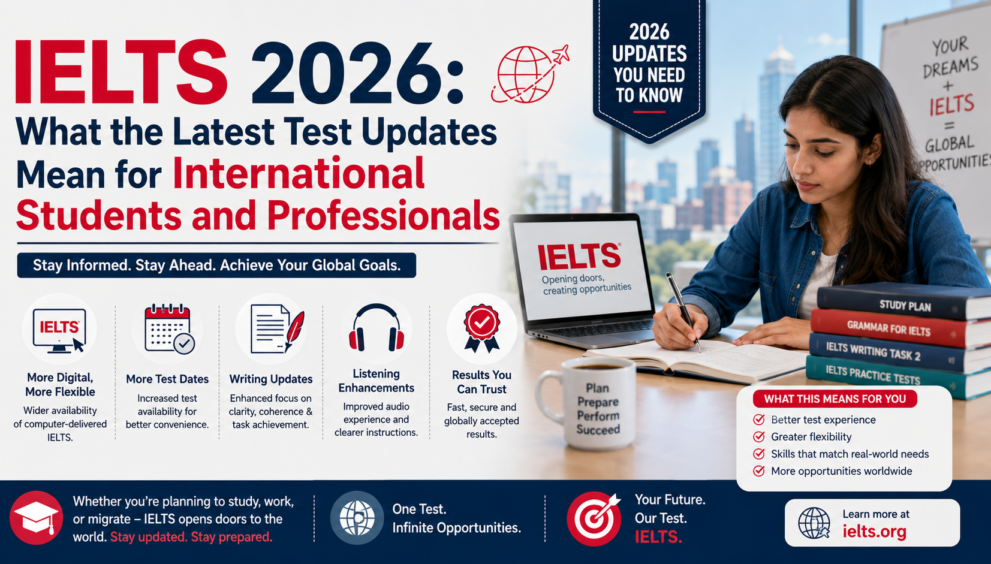
IELTS Is Moving to Computer-Based Delivery
One of the biggest developments in 2026 is the transition away from the traditional paper-based IELTS test.
IELTS announced that from mid-2026, paper-based testing will no longer be offered, with exact implementation timelines varying by market. IELTS will therefore increasingly be delivered on computer.
This does not mean that the skills being tested have changed. IELTS still assesses four core areas:
- Listening
- Reading
- Writing
- Speaking
The test construct and scoring remain unchanged.
What Is Writing on Paper?
For candidates who prefer handwriting, IELTS has introduced a new option called Writing on Paper in selected markets.
Under this format, candidates complete Listening and Reading on computer, while the Writing tasks appear on screen and the answers are written by hand on an official answer sheet. The Writing task types, time allocation and scoring remain the same.
However, this option is not available for IELTS for UKVI.
How Should Candidates Prepare?
The change in delivery makes computer familiarity increasingly important.
Candidates should practise:
- Reading questions on screen
- Typing accurately and efficiently
- Navigating between questions
- Managing time without relying on paper
- Checking spelling while typing
- Writing structured answers under timed conditions
Speaking continues to be assessed through a speaking interview, while Listening, Reading and Writing form the main computer-based components.
What About IELTS Scores?
The scoring system remains based on the familiar IELTS nine-band scale. Overall scores are calculated from the four component scores and rounded according to IELTS scoring rules.
Therefore, candidates should not assume that the move to computer delivery means the band requirements have changed.
Final Thoughts
IELTS in 2026 is evolving primarily in how the test is delivered, rather than what it assesses.
The smartest approach is to prepare for the actual test format available in your location, practise using realistic computer-based materials and stay informed about local test-centre arrangements.
For students, nurses, healthcare professionals and other international candidates, being comfortable with the updated delivery format can be an important part of successful IELTS preparation.
About Fortu West International
Fortu West International provides focused training and guidance for international healthcare professionals preparing for IELTS and NMC OSCE requirements. Our training is designed to help candidates strengthen their English communication, understand UK healthcare expectations, develop practical clinical skills and build confidence through structured practice and expert guidance. Whether you are preparing for IELTS to meet your English-language requirement or working towards the NMC OSCE, Fortu West International supports you with a practical, learner-focused approach that connects your existing clinical experience with the standards expected in the UK. Our goal is to help international nurses prepare effectively, perform confidently and take the next step towards their UK healthcare career.