


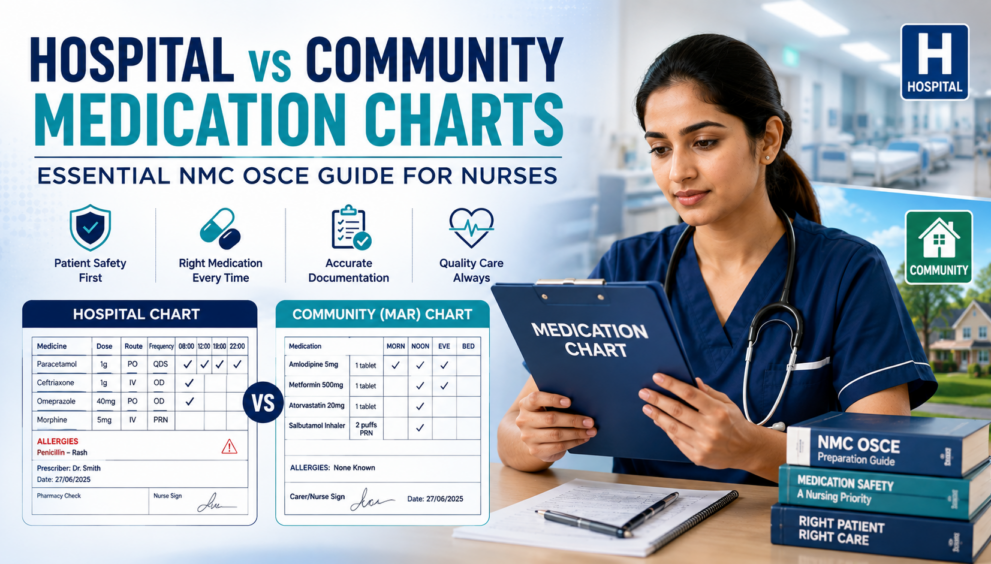
For nurses preparing for the NMC OSCE, understanding how to read and use medication or prescription charts is an essential part of safe medication administration. In the OSCE, candidates may encounter charts from either a hospital or community setting, and knowing the differences can help you approach the medication administration station with greater confidence.
Although the format may vary, the fundamental principle remains the same: patient safety, accurate medication administration and clear documentation come first.
What Is a Prescription Chart?
A prescription chart, also known as a medication or drug chart, contains important information about a patient’s prescribed medicines. It may include the patient’s details, allergies, medication name, dose, route, frequency, administration times and documentation requirements.
During the NMC OSCE, you may need to interpret a prescription chart before administering medication and demonstrate that you can identify whether a medicine is due, safely administer it and document the outcome correctly.
Understanding Hospital Prescription Charts
Hospital prescription charts are generally more detailed because patients may receive several types of medication and treatments during an admission.
They can contain sections for:
- Regular medicines
- PRN or “when required” medicines
- Antimicrobials
- Stat doses
- Other treatments such as IV therapy, depending on the chart
Before administering medication, carefully check the patient’s identity, allergies, prescribed medicine, dose, route, time and any other relevant information.
Pay particular attention to start and stop dates, prescriber details and previous administration records. After administering medication, ensure the appropriate documentation is completed accurately.
OSCE Tip
Never rush to administer a medicine simply because it appears on the chart. Check whether it is actually due and whether there are any factors that require clarification before administration.
Understanding Community Medication Charts
Community medication charts are commonly used in settings such as patients’ homes, residential care facilities and community healthcare services.
A MAR (Medication Administration Record) chart is commonly used to record medicines administered to a patient. Compared with many hospital charts, community MAR charts may have a simpler layout, with medicines listed alongside administration times such as morning, afternoon, evening or bedtime.
Community charts can include regular and PRN medicines, as well as start and stop dates for treatments such as short courses of medication.
The same safety principles apply: confirm the patient’s details, medicine, dose, timing and route before administration, and document the medication correctly afterwards.
Omission Codes: What Should You Remember?
During an OSCE medication station, you may encounter a situation where a prescribed medicine cannot be administered.
The chart may provide specific omission codes for circumstances such as:
- Medicine unavailable
- Patient temporarily away
- Patient self-administering
- Unable to administer
- Incorrect or unclear prescription
- Patient refusal
- Nil by mouth where appropriate
- Other specified reasons
Do not guess an omission code. Always follow the chart and scenario instructions provided in your OSCE station.
If medication is not administered, ensure the appropriate code and required documentation are completed according to the chart.
Hospital vs Community Charts: Key Differences
The easiest way to remember the distinction is to focus on the setting and complexity.
| Feature | Hospital Chart | Community/MAR Chart |
|---|---|---|
| Setting | Hospital wards and inpatient settings | Homes, care homes and community settings |
| Format | Usually detailed | Often simpler |
| Medicines | Regular, PRN, stat and other treatments | Commonly regular and PRN medicines |
| Users | Nurses, prescribers and pharmacists | Nurses, carers and other authorised professionals |
| Documentation | Detailed administration records | Administration signatures/codes and records |
Regardless of the setting, accurate documentation is essential.
The Golden Rule for NMC OSCE Medication Stations
When preparing for the medication administration station, focus on a consistent safety process:
Check → Assess → Administer → Document → Evaluate
Use the medication administration rights required by your training and station instructions. Confirm patient identity and allergies, check the prescription carefully, communicate appropriately with the patient and document your actions accurately.
If something is unclear, never guess. Stop and seek appropriate clarification.
Prepare Confidently for Your NMC OSCE
Understanding hospital and community medication charts is not only useful for the NMC OSCE. It reflects an important aspect of real nursing practice, where safe medication administration and accurate documentation directly support patient care.
Candidates should practise reading different chart formats, identifying due medications, recognising situations requiring clarification and documenting administration correctly.
Best OSCE Training Institute in UK | Fortuwest International can support nurses preparing for their NMC OSCE with structured training and guidance designed to improve confidence across clinical stations. Practising scenarios before the examination can help candidates become more familiar with medication charts, clinical communication and safe documentation.
Remember: the goal is not simply to complete the station—it is to demonstrate safe, professional and patient-centred nursing practice.