

How to Apply for January 2027 Intake in the UK
Are you planning to study in the UK in January 2027? The January intake is a great alternative for international students who need extra time to prepare their university application, English-language qualification, finances and visa documents.
However, one important point must be understood before you begin: not every UK university or course offers a January intake. You should first confirm that your preferred course has a January 2027 start date and is open to international applicants.
This step-by-step guide explains how international students can prepare for the UK January 2027 intake, from choosing a course to receiving an offer, obtaining a CAS and applying for a Student visa.
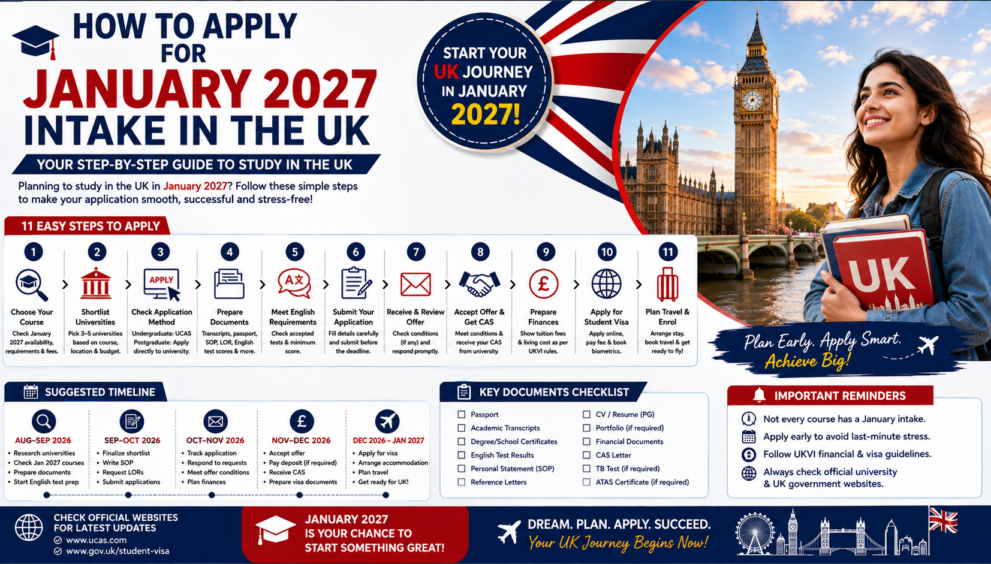
Step 1: Choose Your Course and Check January 2027 Availability
Your first step should be choosing the right course, not simply the most famous university.
Check:
- Whether the exact course starts in January 2027.
- Whether international students are eligible.
- Academic entry requirements.
- English-language requirements.
- Tuition fees.
- Course duration.
- Application deadline.
- Scholarship or discount opportunities.
For undergraduate applicants, UCAS already displays 2027-entry courses, and some undergraduate programmes specifically show January 2027 start dates. UCAS also advises students to check individual course and university requirements carefully.
Top tip: Always verify January entry directly on the university’s official course page before submitting an application.
Step 2: Shortlist 3–5 UK Universities
Instead of applying randomly, create a balanced university shortlist.
Consider:
- Dream choices – Universities where admission may be more competitive.
- Target choices – Universities that closely match your academic profile.
- Safer choices – Courses where you comfortably meet the published requirements.
When comparing universities, look at:
- Course content and modules.
- Entry requirements.
- Tuition fees.
- City and living costs.
- Scholarships.
- Placement opportunities.
- Graduate and career support.
UCAS recommends choosing a course that matches your interests, skills and academic background rather than selecting a university based only on its reputation.
Step 3: Check the Application Method
The application process can differ depending on your course and level of study.
For Undergraduate Courses
Many undergraduate applications are made through UCAS. For the 2027 application cycle, UCAS applications opened on 12 May 2026, and completed undergraduate applications can be submitted from 1 September 2026. UCAS lists 13 January 2027 at 18:00 UK time as the equal-consideration deadline for most undergraduate courses, although your January-start course may have its own application arrangements or deadline.
For Postgraduate Courses
Many postgraduate applications are made directly through the university’s own application portal. Application deadlines can vary significantly between universities and courses.
The best approach is simple: check the exact application instructions on your chosen course page.
For an overview of the UCAS application process, use UCAS: How to Apply.
Step 4: Prepare Your Documents
Preparing documents early can make the application process much smoother.
Depending on the university and course, you may need:
- Passport.
- Academic transcripts.
- Degree certificate or school certificates.
- English-language test results, if required.
- Personal statement or supporting statement.
- Academic or professional references.
- CV or résumé for selected postgraduate courses.
- Portfolio for creative programmes.
- Professional registration or work-experience documents for selected courses.
UCAS states that international applicants may be asked for qualifications, transcripts, references and evidence of English-language ability, depending on the course and university. For the 2027 cycle, UCAS is also introducing a document-upload service for supporting information such as qualification certificates, transcripts, English-language certificates and passport documents.
Step 5: Meet the English-Language Requirement
UK universities may require evidence that you can study in English.
The accepted qualification and score can vary by:
- University.
- Course.
- Level of study.
- Your previous education.
- Your nationality or educational background.
Some universities may accept qualifications such as IELTS, PTE Academic or other approved English-language evidence, while some may have alternative assessment options. Never assume that one university’s English requirement will automatically apply to another.
UCAS confirms that English-language requirements can vary between universities and even between courses at the same institution.
Step 6: Submit Your University Application
Before submitting, carefully check:
- Your name matches your official documents.
- Your academic history is accurate.
- Your personal statement is tailored and relevant.
- Your reference is included if required.
- Your English-language evidence is ready or you understand the conditions of your application.
- You have selected the correct intake: January 2027.
For UCAS applications, all required sections must be completed before the application can be submitted, and applicants can save their progress and return later.
Do not wait until the final deadline. Applying early can give you more time to respond to requests from the university and prepare your next steps.
Step 7: Receive and Review Your Offer
After submitting your application, you may receive one of several outcomes.
Conditional Offer
You have been offered a place, but you still need to meet certain conditions. For example:
- Achieving a required academic grade.
- Providing final transcripts.
- Meeting an English-language requirement.
- Providing additional documents.
Unconditional Offer
You have met the university’s admission conditions and have been offered a place, subject to completing the university’s required enrolment and immigration processes.
Some universities may also require an acceptance deposit to confirm your place. UCAS notes that the next stages can include accepting an offer and, depending on the provider, paying a tuition-fee deposit before progressing towards CAS issuance.
Step 8: Accept Your Offer and Prepare for CAS
Once you meet the required conditions and complete the university’s required procedures, the university can begin the process for issuing your Confirmation of Acceptance for Studies (CAS).
A CAS is essential for a UK Student visa application. According to the UK government, you must have an unconditional offer from a licensed student sponsor, and your education provider issues the CAS reference needed for the visa application.
Remember: you must apply for your Student visa within six months of receiving your CAS.
For the official visa overview, see GOV.UK Student Visa Guide.
Step 9: Prepare Your Finances for the UK Student Visa
International students may need to show that they have sufficient money for their course fees and living costs.
According to the current GOV.UK Student visa guidance, students may need to show:
- The required course fees for the relevant period, as stated on the CAS.
- £1,529 per month for up to 9 months if studying in London.
- £1,171 per month for up to 9 months if studying outside London.
The required funds generally need to be held for 28 consecutive days, with the financial evidence ending within 31 days before the visa application. Rules and exemptions can depend on your circumstances and nationality, so always check the latest official guidance before applying.
For the latest financial requirements, see GOV.UK Student Visa Financial Requirements.
Step 10: Apply for Your UK Student Visa
Once you receive your CAS and have prepared the required documents, you can apply online for a UK Student visa.
The current GOV.UK guidance states that applicants applying from outside the UK can normally apply up to six months before their course starts. Applicants will need to prove their identity either through the relevant digital process or, where required, by attending a visa application centre for biometrics.
Documents may include:
- A valid passport or travel document.
- Your CAS reference.
- Financial evidence, where required.
- TB test results, where required.
- ATAS certificate, if required for your course and nationality.
- Additional documents depending on your individual circumstances.
The UK government lists the CAS and valid travel documentation as core documents and identifies financial evidence, TB certificates, ATAS certificates and other evidence as potentially required depending on the applicant.
Apply through GOV.UK Student Visa Application.
Step 11: Check Whether You Need a TB Test
Students applying from certain countries may need to complete a tuberculosis test at a Home Office-approved clinic as part of their UK visa process.
Do not book a test at just any clinic—check the official list and requirements first.
Suggested Timeline for January 2027 Intake
August–September 2026
- Research universities.
- Check January 2027 course availability.
- Compare entry requirements.
- Prepare your passport and academic documents.
- Begin English-language preparation if needed.
September–October 2026
- Finalise your shortlist.
- Prepare your personal statement.
- Request references.
- Submit applications according to the university’s deadlines.
October–November 2026
- Track your application.
- Respond quickly to university requests.
- Complete any outstanding admission conditions.
- Prepare your financial plan.
November–December 2026
- Accept your offer.
- Complete any required deposit or university procedures.
- Prepare for CAS issuance.
- Organise financial evidence according to the latest visa rules.
After Receiving Your CAS
- Check that all CAS details are correct.
- Prepare your visa documents.
- Apply for your UK Student visa within the permitted timeframe.
- Arrange accommodation and travel after completing the necessary immigration steps.
Common Mistakes to Avoid When Applying for January 2027 Intake
1. Assuming Every Course Has a January Intake
January entry is course-specific. Always confirm your exact programme.
2. Applying Too Late
Some courses can fill early or have their own deadlines.
3. Using the Same Personal Statement for Every Course
Your application should clearly explain why you are suitable for the subject and programme.
4. Ignoring Financial Planning
University fees are only one part of your budget. Consider accommodation, daily living costs, visa costs and other expenses.
5. Applying for a Visa Without Understanding the Financial Rules
Check the latest GOV.UK requirements before preparing your financial evidence, as immigration requirements can change.
6. Booking Non-Refundable Travel Too Early
Follow official visa and university guidance before making final travel commitments.
January 2027 Intake UK Application Checklist
- Choose your preferred subject and course.
- Confirm that the course offers January 2027 entry.
- Shortlist 3–5 suitable universities.
- Check academic entry requirements.
- Check English-language requirements.
- Prepare academic transcripts and certificates.
- Prepare your passport.
- Write your personal statement or supporting statement.
- Arrange references if required.
- Submit your university application.
- Track your application and respond to requests.
- Meet the conditions of your offer.
- Accept your place and complete required university procedures.
- Receive your CAS.
- Prepare the required financial evidence.
- Check whether you need a TB test or ATAS certificate.
- Apply online for your UK Student visa.
- Arrange accommodation.
- Prepare for travel and university enrolment.
Final Thoughts
Applying for the January 2027 intake in the UK is straightforward when you follow the process in the right order:
Choose your course → Check January availability → Prepare documents → Apply → Receive an offer → Meet conditions → Receive CAS → Prepare finances → Apply for your Student visa → Travel and enrol.
The most important step is to start early and verify every requirement directly with your chosen university and through official UK government guidance. University deadlines, course availability, tuition fees and immigration requirements can change, so students should always check the latest information before making an application.
Disclaimer: This guide is based on information available in August 2026. UK university admissions procedures and immigration rules may change. Always confirm current course details with the university and check the latest requirements through official UK government sources before applying.