


Introduction
Planning to study at a UK university in 2027? For many undergraduate courses, UCAS (Universities and Colleges Admissions Service) is the main application platform used to apply to universities and colleges in the UK.
Whether you are an international student or a UK-based applicant, understanding the UCAS process early can make your application much easier. From selecting your courses and entering your qualifications to arranging a reference and submitting your application before the deadline, every stage requires careful preparation.
For the 2027 entry cycle, UCAS applications opened on 12 May 2026, while completed applications can be submitted from 1 September 2026.
This complete guide explains the UCAS application process step by step.
What Is UCAS?
UCAS is the central admissions service used for applications to many undergraduate courses at UK universities and colleges.
Through the UCAS application, students can search for courses, select their university choices, provide personal and educational information, submit a personal statement, add a reference and track application decisions.
For the 2027 cycle, the UCAS application fee allows applicants to add up to five choices for standard university applications.
Important: Some courses and institutions may have different application arrangements. Always check the individual course page before applying.
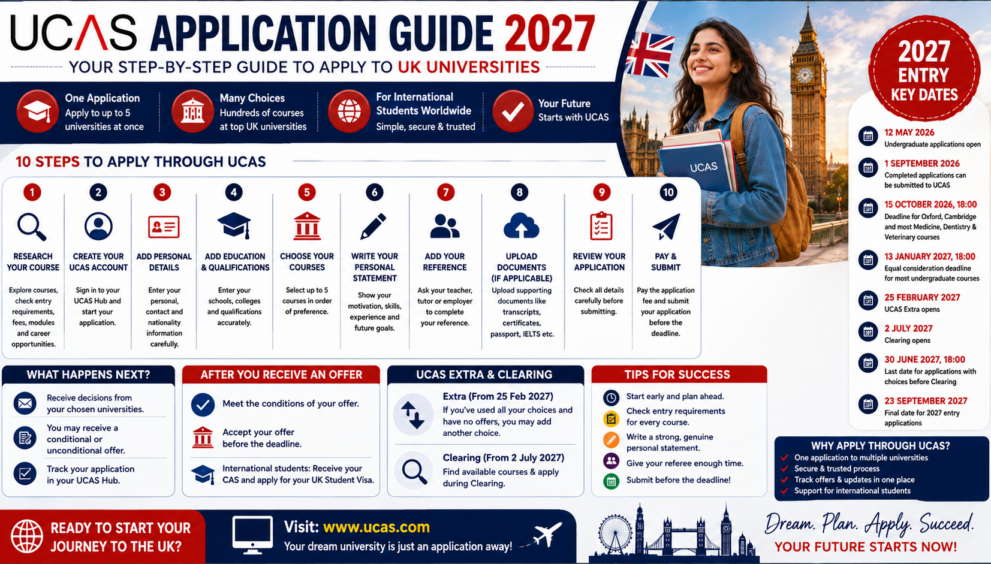
UCAS 2027 Key Dates
Here are some of the most important dates for students applying for 2027 entry:
| Date | UCAS 2027 milestone |
|---|---|
| 28 April 2026 | UCAS search tool displays 2027 courses |
| 12 May 2026 | Undergraduate applications open |
| 1 September 2026 | Completed applications can be submitted to UCAS |
| 15 October 2026, 18:00 UK time | Deadline for Oxford, Cambridge, and most medicine, dentistry and veterinary courses |
| 13 January 2027, 18:00 UK time | Equal-consideration deadline for most undergraduate courses |
| 25 February 2027 | UCAS Extra opens for eligible applicants |
| 30 June 2027, 18:00 UK time | Last date for applications with choices before later applications move into Clearing |
| 2 July 2027 | Clearing opens for eligible applicants |
| 23 September 2027 | Final date for 2027-entry applications |
| 18 October 2027 | Last date to add a 2027-entry Clearing choice |
These dates are published by UCAS for the 2027 application cycle. Always check the deadline for your exact course, as some programmes have different requirements.
Step 1: Research Your Course Before Applying
Before opening your application, research the course carefully.
Check:
- Course content and modules.
- Entry requirements.
- Required subjects and grades.
- English-language requirements.
- Tuition fees.
- University location.
- Accommodation options.
- Placement or internship opportunities.
- Course start date.
Do not choose a university based only on its ranking or popularity. The course should match your academic background, interests and future career plans.
For international students, universities set their own entry requirements, and English-language requirements can also vary between universities and courses.
Step 2: Create Your UCAS Hub Account
To begin your application, create an account through the official UCAS website and access your UCAS Hub.
You can start working on your 2027 application before September, but completed undergraduate applications cannot be submitted until 1 September 2026.
Your UCAS account allows you to build your application gradually rather than completing everything in one sitting.
Step 3: Add Your Personal Information
The application will ask for important personal details, including information such as your:
- Full name.
- Date of birth.
- Contact details.
- Nationality.
- Passport or immigration information where relevant.
- Address.
Make sure your information is accurate and consistent with your official documents.
For the 2027 cycle, international applicants also have the option to upload certain supporting documents, including a copy of an in-date passport photo page or relevant immigration-status documentation.
Step 4: Add Your Education and Qualifications
You will need to enter details of your education and qualifications.
This can include:
- Schools or colleges attended.
- Qualifications already completed.
- Qualifications currently being studied.
- Examination results.
- English-language qualifications.
UCAS advises applicants to use the actual qualification name and grade shown on their certificate, rather than entering a UK equivalent or comparison. Inaccurate or missing qualification information can affect an application.
For 2027 entry, applicants can optionally upload supporting documents such as official qualification certificates, translated certificates, academic transcripts and English-language certificates. However, uploading documents does not replace the requirement to complete the relevant sections of the UCAS application.
Step 5: Choose Your University and Course Options
You can normally add up to five choices to your UCAS application.
Your choices should be based on:
- Your academic profile.
- Course requirements.
- Career goals.
- Budget.
- Preferred location.
- University environment.
A balanced application may include ambitious choices as well as universities where you are confident that you meet the published entry requirements.
You do not have to rush this stage. Compare courses carefully and confirm that you are applying for the correct course, location and year of entry.
Step 6: Understand the UCAS Personal Statement
The personal statement is an important part of the application because it allows universities to understand more about:
- Why you want to study the subject.
- Your academic interests.
- Relevant skills and knowledge.
- Work experience or volunteering.
- Relevant extracurricular activities.
- Your future goals.
For the 2027 cycle, follow the current UCAS application format and guidance when completing this section. Focus on demonstrating your motivation, preparation and suitability for your chosen subject.
A strong statement should be specific and supported with relevant examples. Avoid simply listing activities without explaining what you learned from them or how they relate to your course.
Step 7: Arrange Your UCAS Reference
Your application requires a reference before it can be submitted.
A referee may be:
- A teacher.
- A tutor.
- An employer.
- A trainer, depending on your circumstances.
The reference section is completed by the referee, not by the applicant. UCAS confirms that the reference must be added before the application can be sent.
If you are applying through your school or college, start the application early because your institution may have an internal deadline that is earlier than the official UCAS deadline.
Step 8: Upload Supporting Documents for 2027 Entry
One important development for the 2027 UCAS cycle is the introduction of a document-upload service for applicants.
Depending on the relevant section of your application, supporting documents can include:
- Official qualification certificates.
- Official translated certificates.
- Academic transcripts.
- English-language certificates.
- Passport documentation for international applicants.
- Relevant visa or immigration-status documentation.
Document uploads are optional and are intended to support the admissions process. They do not replace the requirement to complete the application itself.
Step 9: Check Your Application Carefully
Before submitting, review everything carefully.
Check:
- Spelling of your name.
- Date of birth.
- Contact information.
- Qualification details.
- University and course choices.
- Personal statement responses.
- Reference status.
- Uploaded documents, if you choose to provide them.
Small errors can create unnecessary delays or confusion.
Step 10: Pay and Submit Your UCAS Application
For 2027 entry, completed undergraduate applications can be submitted from 1 September 2026.
Before submission, all required sections must be completed, your reference must be in place, and the application fee must be paid.
If you are applying through a school or adviser, you may need to send the application to them first for checking and approval.
What Happens After You Submit Your UCAS Application?
After your application is submitted, universities will review it and send their decisions through UCAS.
Possible outcomes may include:
Conditional Offer
You have been offered a place but still need to meet specific conditions, such as achieving required grades or providing outstanding evidence.
Unconditional Offer
You have met the academic and other conditions required for admission.
Unsuccessful Application
The university has decided not to offer you a place.
You should regularly check your UCAS account and email so that you do not miss important updates or deadlines.
What If You Do Not Receive an Offer?
UCAS provides additional options for eligible applicants.
UCAS Extra
For 2027 entry, Extra opens on 25 February 2027. It may allow eligible applicants who have used all their choices and are not holding an offer to add another choice.
Clearing
For eligible applicants, Clearing opens on 2 July 2027, and vacancies are displayed through the UCAS search tool.
UCAS Guide for International Students
International applicants may need to complete additional steps after receiving and accepting an offer.
The process can include:
- Receiving and accepting an offer.
- Paying a tuition-fee deposit if required by the university.
- Receiving a Confirmation of Acceptance for Studies (CAS).
- Preparing for the UK Student visa application.
- Providing financial evidence and other required immigration documents.
- Receiving the necessary immigration permission before travelling.
- Arriving and enrolling at the university.
UCAS notes that international students may need a CAS number, valid passport or travel document and, depending on their circumstances, evidence relating to English language, finances, TB testing or ATAS.
English-Language Requirements
The required level of English can vary between universities and even between courses at the same university.
Depending on the institution, applicants may be asked to provide recognised evidence of English proficiency. UCAS lists accepted test and qualification pathways, while some universities may also accept previous education as evidence in certain circumstances.
Always check the entry requirements for your exact course.
UCAS Application Checklist for 2027 Entry
- Research courses and universities.
- Check entry requirements.
- Confirm English-language requirements.
- Create your UCAS Hub account.
- Add your personal details.
- Enter your education and qualifications accurately.
- Select your university and course choices.
- Complete your personal statement section.
- Arrange your UCAS reference.
- Upload supporting documents if appropriate.
- Check the application carefully.
- Pay the application fee.
- Submit before the deadline for your chosen course.
- Track university decisions.
- Respond to offers by the relevant deadline.
- Prepare for CAS and the Student visa process if studying in the UK as an international student.
Final Tips for a Successful UCAS Application
Start early. The 2027 application cycle is already open for preparation, and completed applications can be submitted from 1 September 2026.
Do not miss the key deadline. For most undergraduate courses, the equal-consideration deadline is 13 January 2027 at 18:00 UK time. Applications for Oxford, Cambridge and most medicine, dentistry and veterinary medicine/science courses have an earlier deadline of 15 October 2026 at 18:00 UK time.
Check every course individually. Entry requirements, English-language requirements and deadlines can differ.
Use accurate information. Qualification titles and grades should match your official records.
Give your referee enough time. Your application cannot be sent without the required reference.
Conclusion
The UCAS application process may seem lengthy, but it becomes manageable when you approach it step by step.
For 2027 entry, your journey can be summarised as:
Research → Create UCAS account → Add personal details → Enter qualifications → Choose courses → Complete your personal statement → Arrange your reference → Upload supporting documents if needed → Check → Pay → Submit → Track your offers.
The best strategy is to begin early, check the requirements for every university and course, and submit well before the relevant deadline.
For official, up-to-date guidance, use the UCAS 2027 key dates and application timeline and the UCAS guide for international students.
Disclaimer: This guide is based on UCAS information available as of August 2026. Application requirements, fees, deadlines and processes may change. Always verify the latest information directly through UCAS and your chosen university before submitting your application.