

Published by Fortu West International
If you’ve ever finished OET Listening Part A thinking, “I heard the answer, but I still couldn’t write it down,” you’re not alone.
Many candidates assume that success in Part A depends solely on having excellent listening skills. While listening ability certainly matters, one of the biggest reasons candidates lose marks is much simpler: they don’t know what to listen for.
Listening Part A moves quickly. The consultation is played only once, the information is detailed, and there is little time to recover if you lose track of the conversation. Trying to listen to every single word often leaves candidates overwhelmed and increases the likelihood of missing important details.
This is where keyword identification becomes a powerful strategy. By recognising the right clue words before the recording begins, predicting the type of information you’re listening for, and identifying paraphrases in the audio, you can follow the conversation more confidently and improve your accuracy.
Understanding OET Listening Part A
Listening Part A consists of two healthcare consultations in which you complete notes while listening. Unlike other parts of the Listening sub-test, Part A focuses on gathering specific pieces of information from conversations between healthcare professionals and patients.
The questions follow the same order as the recording, making it easier to track the consultation as it progresses. Before the audio begins, you’ll have time to read the notes, headings, and questions. This preparation time is one of the most valuable opportunities in the entire test.
Rather than simply reading the page, use this time strategically. Your goal isn’t to predict the exact answer—it’s to predict the type of information you’re likely to hear.
Why Keywords Matter
Imagine trying to listen to every word in a five-minute conversation. It’s almost impossible. Instead, your brain needs a filter. Keywords act as that filter.
They direct your attention toward the information that matters while allowing you to ignore details that aren’t relevant to the question. For example, if the question contains the words:
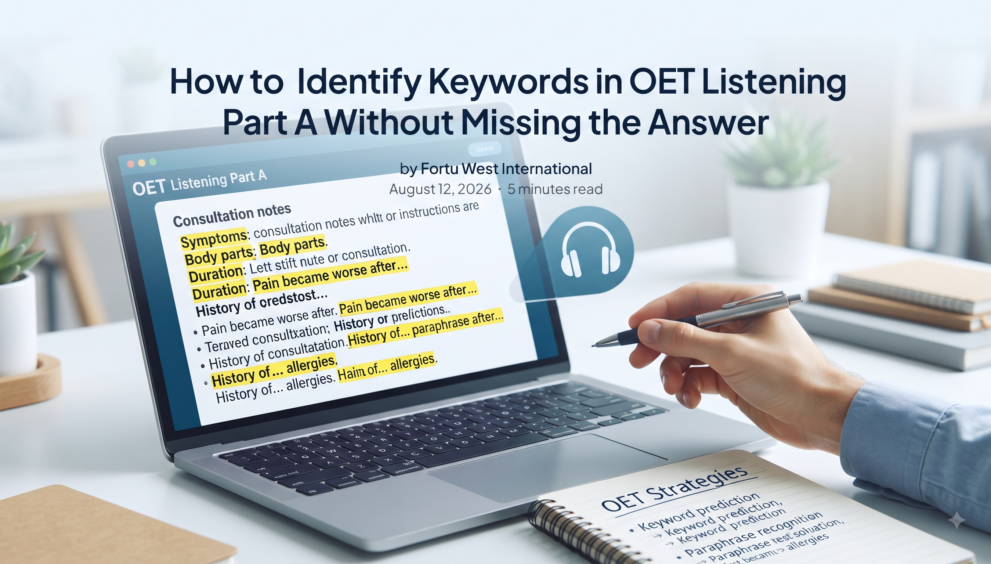
“Pain became worse after ________.”
Your brain immediately starts expecting information about an activity, event, or movement. Instead of listening to everything equally, you’re listening with purpose.
Step-by-Step Guide to Keyword Mastery
Step 1: Identify the Clue Words
Before the recording starts, underline the important words in each question. These clue words usually include:
- Symptoms
- Body parts
- Treatments
- Investigations
- Time expressions
- Measurements
- Negative words
- Action verbs
Example:
“History of ______ allergies.”
The clue word isn’t the blank; it’s allergies. Now you know the patient is likely to mention substances such as penicillin, pollen, seafood, or latex.
Step 2: Predict the Answer Type
Once you’ve identified the clue words, ask yourself: What kind of answer fits this gap? (e.g., Medication, Duration, Frequency, Body part, Investigation, Number, Reason, Healthcare professional).
- “Currently taking ______.” strongly suggests a medication name.
- “Pain score: ______ /10.” tells you to expect a number.
Step 3: Learn to Recognise Paraphrases
One of the biggest misconceptions about Part A is believing you’ll hear exactly what’s written on the question paper. In reality, the recording often expresses the same idea using different words or phrases.
| Question Wording | Audio Phrasing | Correct Answer |
| Symptoms began ________. | “The pain first started about three days ago.” | three days ago |
What to Notice: The question uses the word began, while the speaker says first started. Recognising this prevents you from missing the answer while waiting for exact vocabulary matches.
Step 4: Keep Your Answers Concise
Another common mistake is writing more than necessary. If the audio says “three weeks”, don’t write “for approximately three weeks now.”Write only the words needed to complete the notes naturally, and always follow the stated word limit.
Step 5: Check That Your Answer Fits
Even if you heard the correct words, ask yourself one final question: Does my answer make grammatical and logical sense? The completed note should read naturally within the context of the sentence structure.
Common Mistakes Candidates Make
- Trying to listen to every word instead of focusing on clue words.
- Ignoring headings that indicate the topic of each section.
- Predicting exact words rather than the type of information required.
- Missing paraphrases because the recording uses different wording.
- Writing unnecessary extra words.
- Adding information based on medical knowledge instead of what was actually said.
- Losing marks due to spelling errors.
Final Thoughts
Many candidates believe that OET Listening Part A is a test of memory. In reality, it’s a test of attention.
The candidates who perform well aren’t necessarily those who understand every word of the recording; they’re the ones who know where to focus. By identifying clue words, predicting the type of answer required, recognising paraphrases, and keeping your answers concise, you’ll approach Part A with far greater confidence.