

Clear communication is an essential part of safe nursing practice. For nurses preparing for the NMC OSCE, clinical handover is an important skill because it requires you to identify relevant patient information, communicate your assessment and explain what should happen next.
SBAR — Situation, Background, Assessment and Recommendation — provides a simple structure for organising a clinical handover.
Rather than trying to remember every detail in a case, candidates should learn how to identify the information that matters most to the patient’s current care.
Why Is SBAR Useful for OSCE Preparation?
A clinical scenario can contain a large amount of information. If you try to communicate everything, the main concern can become difficult to identify.
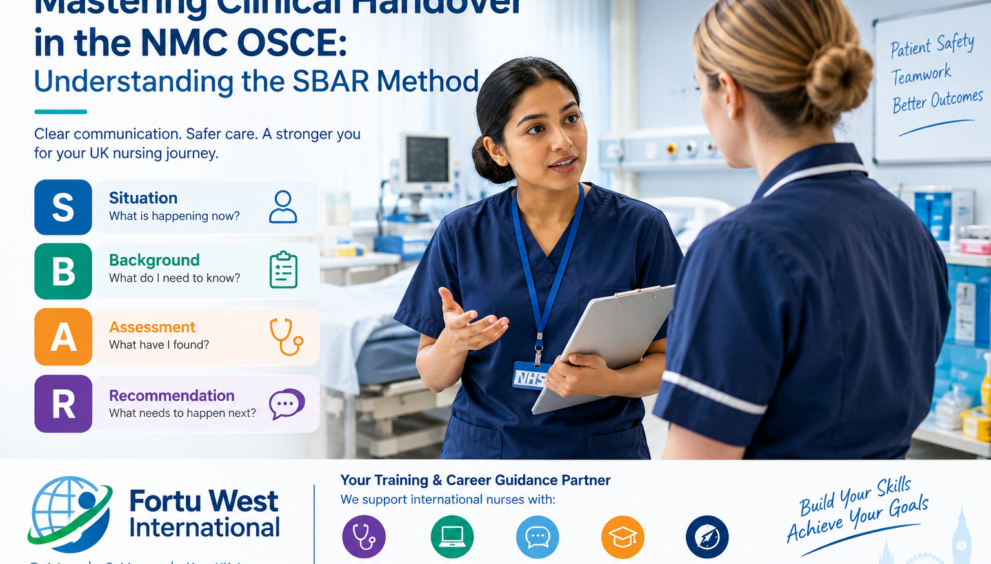
SBAR helps you organise your communication into four stages:
Situation: What is happening now?
Background: What information does the healthcare professional need to understand the situation?
Assessment: What have you observed and assessed?
Recommendation: What action or review is required?
This structure can help candidates maintain a logical flow during an OSCE handover.
Situation: Start With the Main Issue
The first part of the handover should immediately establish the context.
Depending on the scenario, introduce yourself and identify the patient before explaining the reason for the communication.
Relevant information may include:
- Patient identification
- Your role
- Current location or care setting
- Reason for admission
- Current clinical concern
- Reason for requesting a review or giving a handover
Keep this section focused. The listener should understand the main reason for the communication early in the handover.
Background: Select What Matters
The Background section provides supporting information.
You may need to communicate:
- Relevant diagnosis
- Previous medical history
- Current treatment
- Allergies
- Regular medication
- Recent procedures
- Relevant assessment history
- Factors affecting daily activities
The important point is relevance.
For example, if you are escalating a patient’s respiratory deterioration, information directly related to the patient’s respiratory history and current treatment is more useful than unrelated historical information.
Assessment: Communicate What You Found
The Assessment section demonstrates your ability to identify and communicate clinical findings.
Depending on the case, consider:
- Current observations
- Changes in observations
- Pain score
- Relevant assessment tools
- Medication administered
- Response to treatment
- Nutritional or cognitive assessment where applicable
- Other important clinical findings
When communicating observations, make sure that important changes or abnormal findings are clearly highlighted.
A strong handover does not simply provide information; it helps the receiving professional understand why the information matters.
Recommendation: Make the Next Step Clear
The final part of SBAR is the Recommendation.
After communicating the patient’s condition, explain what you require next.
This could include:
- A medical review
- Further clinical assessment
- Continued monitoring
- Review of medication
- Review of pain management
- Escalation of deterioration
- Additional investigations as directed by the appropriate professional
- Ongoing nursing care
Your recommendation should be appropriate to the situation and within your professional role.
What Should You Avoid During the Handover?
A common problem is trying to provide too much information.
Avoid:
- Unnecessary patient history
- Repetition
- Unclear statements
- Missing important clinical findings
- Reading the case notes word for word
- Ignoring changes in observations
- Giving a recommendation that does not address the concern
- Using overly casual language
Instead, concentrate on the information that helps the receiving healthcare professional understand the patient’s current needs.
A Simple Practice Technique
When practising an NMC OSCE scenario, divide your notes into four sections:
S — What is happening?
Identify the immediate concern.
B — What background is important?
Select the history, diagnosis, medication and other information that affects the situation.
A — What did I find?
Communicate your observations, assessments and response to treatment.
R — What needs to happen?
State the appropriate next step or escalation.
Practising this method with different scenarios can help you become more comfortable with clinical handover.
Communication Confidence for International Nurses
International nurses may need to adapt to UK clinical communication styles while preparing for registration. Practising professional terminology, structured handover and appropriate escalation can help candidates become more familiar with expectations in a UK healthcare environment.
The aim should not be to memorise a fixed paragraph. Instead, understand the purpose of each SBAR section and learn to adapt the structure to the patient scenario.
Fortu West International: Your Training and Career Guidance Partner
Fortu West International provides training and career guidance for international nurses and students preparing for opportunities in the UK. Our programmes include NMC OSCE training, NMC CBT training, OET preparation and IELTS preparation, supporting candidates at different stages of their UK healthcare and education journey.
Our NMC OSCE training helps candidates practise clinical stations, communication and practical skills through structured preparation. NMC CBT training focuses on preparation for the computer-based examination, while OET training helps nurses and healthcare professionals develop the English communication skills required for healthcare contexts. Alongside these programmes, Fortu West International offers career guidance to help candidates understand their training pathway and prepare for their future professional goals.
Conclusion
SBAR provides a practical structure for communicating patient information during clinical handover. By understanding Situation, Background, Assessment and Recommendation, NMC OSCE candidates can practise communicating information in a clear and organised way.
The key is to focus on the patient’s current needs, communicate relevant findings accurately and identify when appropriate escalation or review is required.
With regular practice and structured preparation through Fortu West International’s NMC OSCE, CBT and OET training, international nurses can develop the communication and professional skills needed for their UK nursing journey.