


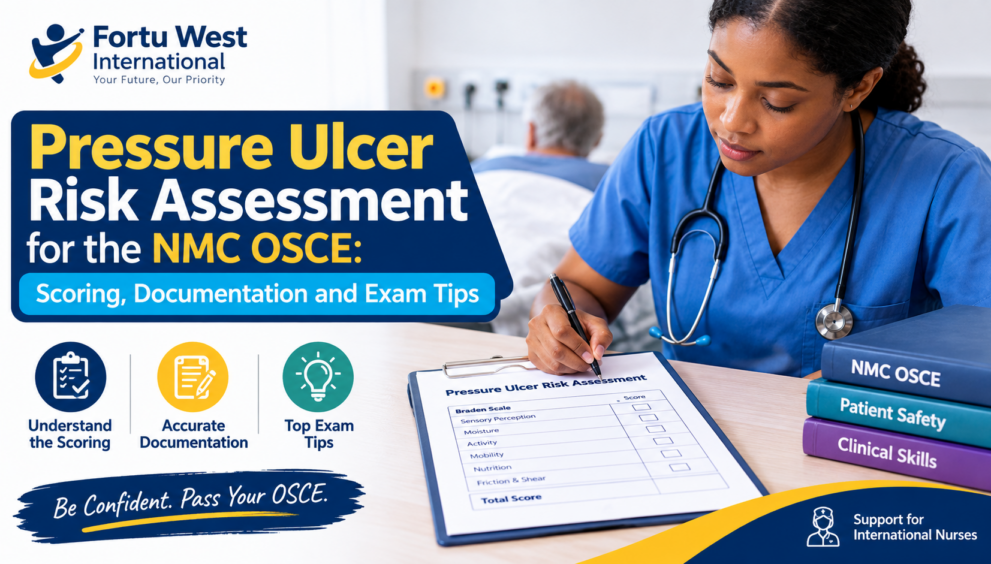
Understanding pressure-ulcer risk is an important nursing skill, especially when caring for patients with limited mobility. For international nurses preparing for the NMC OSCE, the Pressure Area Assessment station tests your ability to interpret patient information, apply a structured assessment and document your findings correctly.
The station can initially feel challenging because several pieces of information must be processed within a short period. The key is to use a consistent assessment method.
A Simple Introduction to the Pressure Area OSCE
The provided material describes the Pressure Area Assessment as a silent station. Candidates are given a patient scenario and documentation and must complete the assessment without a conventional patient interaction.
The stated time for the station is 8 minutes.
Candidates need to focus on three main areas:
Assessment → Scoring → Documentation
You need to identify the appropriate Braden score, calculate the total and complete the additional pressure-risk documentation.
The Braden Assessment: Six Areas to Remember
The six components are:
Sensory Perception
Consider how effectively the patient can respond to pressure-related discomfort.
Categories:
- Completely limited
- Very limited
- Slightly limited
- No impairment
Moisture
Consider the patient’s exposure to moisture and information such as urinary incontinence.
Categories:
- Constantly moist
- Very moist
- Occasionally moist
- Rarely moist
Activity
Consider how much physical activity the patient is able to undertake.
Categories:
- Bedfast
- Chairfast
- Walks occasionally
- Walks frequently
Mobility
Consider the patient’s ability to change and control body position.
Categories:
- Immobile
- Very limited
- Slightly limited
- No limitation
Nutrition
Consider the patient’s usual food intake and nutritional information.
Categories:
- Very poor
- Probably inadequate
- Adequate
- Excellent
Friction and Shear
Consider problems associated with moving, repositioning or requiring assistance.
Categories:
- Problem
- Potential problem
- No problem
Activity and Mobility: Do Not Mix Them Up
One of the key areas to understand is the difference between activity and mobility.
Activity considers the patient’s degree of physical activity.
Mobility considers the patient’s ability to change and control their body position.
For example, a patient may be able to sit in a chair but may require assistance to reposition themselves. Therefore, these two components need to be assessed separately.
How to Read an OSCE Scenario
Do not begin by guessing the score.
Instead, read the complete scenario and highlight or identify information connected to the six Braden components.
For example, look for information relating to:
- Movement
- Repositioning
- Moisture
- Food intake
- Sensory response
- Assistance with movement
Then compare the information with the relevant assessment categories.
Pressure-Risk Areas
The provided content lists several areas that should be revised for the OSCE:
- Heels
- Sacrum
- Buttocks
- Elbows
- Temporal region of the skull
- Shoulders
- Hips
- Back of head
- Toes
- Ears
- Spine
The station instructions described in the source require documentation of at least 8 pressure-risk areas.
Practising this list before the examination can help improve recall under time pressure.
Recognising Signs of Pressure-Ulcer Development
The source identifies several signs that candidates should know:
- Persistent erythema
- Non-blanching hyperaemia
- Blisters
- Discoloration
- Localised heat
- Localised oedema
- Localised indurations
- Purplish/bluish localised areas
- Localised coolness
At least 7 signs are specified in the station information provided.
Documentation Checklist
Before finishing the station, check whether you have included everything required.
Braden Assessment
☐ Sensory perception
☐ Moisture
☐ Activity
☐ Mobility
☐ Nutrition
☐ Friction and shear
Final Documentation
☐ Individual scores
☐ Total score
☐ At least 8 pressure-risk areas
☐ At least 7 signs of pressure-ulcer development
A checklist like this can be useful during practice sessions.
How to Improve Your Time Management
The station is stated to provide 8 minutes, so practising the complete process is important.
Try using this sequence:
First: Understand
Read the scenario and understand the patient.
Second: Identify
Find information relating to each Braden component.
Third: Score
Match the information to the appropriate category.
Fourth: Calculate
Add the scores carefully.
Fifth: Document
Complete the required documentation.
Sixth: Review
Check for missing information and calculation errors.
This approach helps prevent candidates from spending all their time on the scoring section and forgetting the documentation requirements.
Mistakes That Can Affect Your OSCE Preparation
Rushing Through the Scenario
Reading too quickly can cause important information to be missed.
Selecting Scores From Diagnosis Alone
The score should be based on the scenario information rather than assumptions.
Forgetting One of the Six Components
Always check all six Braden areas.
Confusing Activity and Mobility
Treat them as two separate assessment categories.
Leaving Documentation Until the Last Moment
Documentation is an important part of the station. Practise completing it as part of the full process.
Forgetting the Pressure-Risk and Sign Lists
Revise these separately so you can recall them efficiently.
Practice Makes the Station More Manageable
One of the most useful preparation methods is repeated scenario practice.
For every practice scenario:
- Read the patient information.
- Identify relevant details.
- Assess all six Braden components.
- Select the appropriate categories.
- Record the scores.
- Calculate the total.
- Document pressure-risk areas.
- Document signs of pressure-ulcer development.
- Review your work.
Practising the complete process rather than only memorising the scoring chart can improve familiarity with the station format.
Fortu West International NMC CBT and OSCE Training
Fortu West International offers preparation and training support for international nurses through NMC CBT and NMC OSCE training. The programmes are intended to help candidates prepare in a structured way, strengthen their understanding of nursing topics and become familiar with examination-focused approaches. CBT preparation can support knowledge-based revision, while OSCE training can help candidates practise clinical assessment, documentation and station-based skills. Fortu West International can therefore support nurses as they work through different stages of their UK nursing preparation journey.
Final Revision Points
Before your Pressure Area Assessment OSCE, make sure you are comfortable with:
The six Braden elements
Sensory perception → Moisture → Activity → Mobility → Nutrition → Friction and shear
The assessment process
Read → Identify → Score → Calculate → Document → Review
The pressure-risk areas
Know at least 8 relevant areas from the provided revision list.
The signs
Know at least 7 signs of pressure-ulcer development.
Time
Practise completing the complete assessment within the stated 8-minute station time.
Conclusion
The Pressure Area Assessment station combines knowledge, interpretation and documentation. Rather than trying to memorise isolated answers, develop a consistent method for working through every scenario.
Start with the patient information, identify the six Braden components, select the appropriate scores, calculate the total and complete all required documentation.
With regular practice and structured preparation, international nurses can become more familiar with the requirements of this NMC OSCE station and approach their preparation with greater confidence.