

Pressure-area assessment is an important part of safe nursing practice, particularly when caring for patients with reduced mobility. Nurses need to recognise pressure-related risks, assess patients systematically and document their findings accurately.
For international nurses preparing for the NMC OSCE, the Pressure Area Assessment station can seem difficult at first because it requires you to read a patient scenario, identify relevant information, apply the Braden assessment and complete documentation within a limited time.
With structured preparation and regular practice, however, the station becomes much easier to manage.
What Is the Pressure Area Assessment Station?
The Pressure Area Assessment is presented as a silent OSCE station. Instead of communicating with a patient, candidates work from the information provided in the scenario and documentation.
According to the provided material, candidates have 8 minutes to complete the assessment.
The station requires you to:
- Read the patient scenario carefully
- Identify information relevant to pressure-area risk
- Assess the six Braden elements
- Select the appropriate score for each element
- Calculate the overall score
- Document the assessment clearly
- Identify at least 8 pressure-risk areas
- Identify at least 7 signs of pressure-ulcer development
Because there is no patient interaction, careful reading and accurate documentation are especially important.
Understanding the Six Braden Assessment Elements
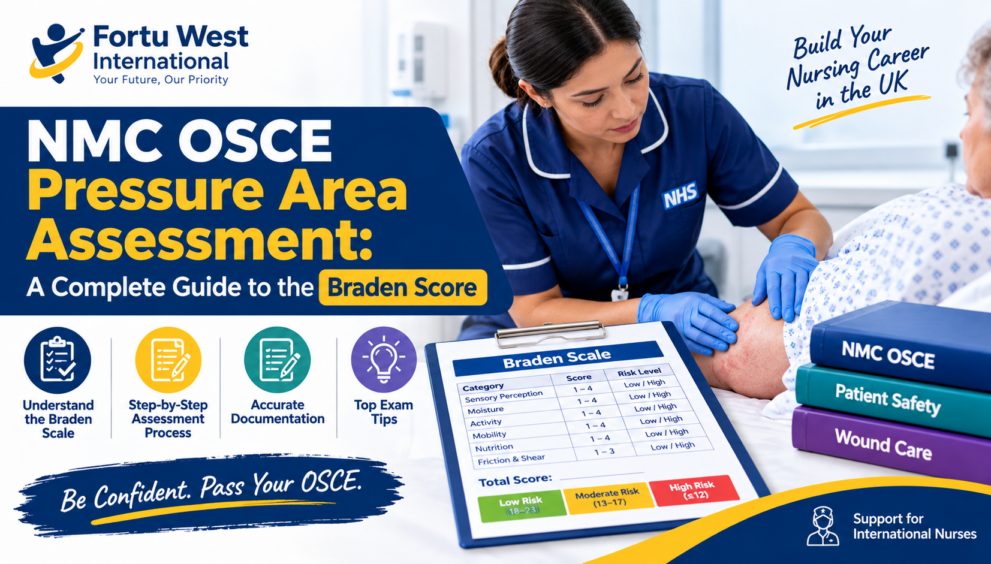
The Braden assessment in the provided material includes six key areas:
- Sensory perception
- Moisture
- Activity
- Mobility
- Nutrition
- Friction and shear
Each element has different categories and scores. The important skill is to connect the information in the scenario with the correct category rather than selecting a score based on assumptions.
1. Sensory Perception
Sensory perception refers to the patient’s ability to respond meaningfully to pressure-related discomfort.
The categories include:
- Completely limited
- Very limited
- Slightly limited
- No impairment
When reading the scenario, look for information about whether the patient can recognise and communicate discomfort and respond appropriately to sensory stimuli.
Always use the information actually given in the scenario.
2. Moisture
Moisture relates to the extent to which the patient’s skin is exposed to moisture.
The categories include:
- Constantly moist
- Very moist
- Occasionally moist
- Rarely moist
Look for information about urinary incontinence, frequency of moisture exposure and whether the patient’s skin remains moist.
The presence of incontinence alone does not automatically determine the score. Consider the frequency and extent of moisture exposure described in the scenario.
3. Activity
Activity refers to the patient’s degree of physical activity.
The categories include:
- Bedfast
- Chairfast
- Walks occasionally
- Walks frequently
Ask yourself:
How physically active is this patient?
Look for information about whether the patient remains in bed, sits in a chair, walks occasionally or walks frequently.
4. Mobility
Mobility is different from activity.
Mobility refers to the patient’s ability to change and control their body position.
The categories include:
- Immobile
- Very limited
- Slightly limited
- No limitation
A patient might be able to sit in a chair but still have difficulty changing their position independently.
Therefore, remember:
Activity = degree of physical activity
Mobility = ability to change and control body position
Keeping these two concepts separate is important during the OSCE.
5. Nutrition
Nutrition considers the patient’s usual food intake.
The categories include:
- Very poor
- Probably inadequate
- Adequate
- Excellent
Look for information relating to:
- Food intake
- Appetite
- Quantity of food consumed
- Nutritional supplements
- Usual dietary pattern
Nutrition should not be overlooked simply because the station focuses on pressure-area risk.
6. Friction and Shear
Friction and shear relate to difficulties associated with movement and assistance.
The categories include:
- Problem
- Potential problem
- No problem
Look for information about whether the patient requires assistance when moving, has difficulty repositioning or experiences problems associated with movement.
This should not be confused with mobility. Mobility focuses on changing and controlling body position, while friction and shear focus on risks associated with movement and assistance.
How to Complete the Assessment Step by Step
A systematic method can make the station easier.
Step 1: Read the complete scenario
Read the entire patient scenario before deciding on your scores.
Step 2: Find the six assessment elements
Look specifically for information relating to:
Sensory perception → Moisture → Activity → Mobility → Nutrition → Friction and shear
Step 3: Match the information
Compare the scenario with the appropriate categories on the assessment chart.
Step 4: Record individual scores
Document each component separately.
Step 5: Calculate the total
Add the individual scores carefully.
Step 6: Complete the remaining documentation
Record the total score, pressure-risk areas and signs of pressure-ulcer development required by the station.
Pressure-Risk Areas to Revise
The provided material identifies several areas that may be vulnerable to pressure:
- Heels
- Sacrum
- Buttocks
- Elbows
- Temporal region of the skull
- Shoulders
- Hips
- Back of the head
- Toes
- Ears
- Spine
The station information specifies documenting at least 8 pressure-risk areas.
Learning a larger list during revision can make recall easier during the examination.
Signs of Pressure-Ulcer Development
The provided material identifies the following signs:
- Persistent erythema
- Non-blanching hyperaemia
- Blisters
- Discoloration
- Localised heat
- Localised oedema
- Localised indurations
- Purplish or bluish localised areas
- Localised coolness
The station information specifies documenting at least 7 signs.
Why Documentation Matters
This is a silent station, so your written documentation is particularly important.
Make sure your work is:
- Clear
- Accurate
- Complete
- Legible
- Organised
Do not only write the final score. Record the individual assessment components and complete all the additional requirements.
Managing the 8-Minute Station
The provided material states that candidates have 8 minutes.
A useful sequence is:
Read → Identify → Score → Calculate → Document → Check
Avoid spending too much time on one component. After completing the assessment, leave time to review your calculations and documentation.
Common Mistakes to Avoid
Confusing Activity and Mobility
Remember that these are separate Braden elements.
Ignoring Nutrition
Nutrition is one of the six assessment components and should always be considered.
Forgetting Friction and Shear
Make sure all six elements are assessed.
Making Assumptions
Base your score on the information provided rather than assuming a particular score from a diagnosis alone.
Incomplete Documentation
Remember the individual scores, total score, pressure-risk areas and signs required by the station.
Prepare for NMC CBT and OSCE with Fortu West International
Fortu West International provides training support for international nurses preparing for the NMC CBT and NMC OSCE. The training is designed to help candidates develop examination knowledge, understand important nursing concepts and practise approaching assessment-based scenarios systematically. For OSCE candidates, structured preparation can help improve familiarity with station requirements, clinical documentation and examination techniques, while CBT preparation can support revision of professional and clinical knowledge required for the computer-based test.
Conclusion
The NMC OSCE Pressure Area Assessment requires candidates to combine careful reading, structured assessment, scoring and accurate documentation.
Focus on the six Braden elements:
Sensory perception, moisture, activity, mobility, nutrition, and friction and shear.
Also revise pressure-risk areas and signs of pressure-ulcer development, and practise completing the complete station within the stated 8-minute timeframe.
A consistent approach will help you become more familiar with the station and approach your OSCE preparation with greater confidence.